09. Chain mode: validators, custody, authentication, commitments, slashing
Draft 0.2, 2026-11-13. Normative for CHAIN mode. 01-conventions.md wins over this chapter, and
its §14 is binding. Source: DESIGN.md §7.
1. Scope and the chain on one page#
In CHAIN mode the exchange is a blockchain. The order stream, the consensus and the replay engine
are the ones that 05-engine.md and 07-replication.md specify. This chapter adds what a chain
needs on top of them: a validator set with keys and bonds, custody of user funds, authentication
that a public network can trust, slashing, state commitments, light clients and economics.
The decisions, each stated once:
- Five operators, fifteen nodes. Each operator runs one node in each home. The committee of an
epoch is the 5 nodes in that epoch's home.
N_CHAIN = 5,Q_CHAIN = 4,F = 1. - One sequencer operator per epoch. The role rotates by
e mod 5. Because 3 and 5 are coprime, every operator sequences every home once in 15 epochs (5 days). - The sequencing operator holds
K_seqand neverK_com. The other 4 operators holdK_comthrough a per-epoch committee key. A forged packet needs both keys, which needs 2 byzantine operators, and 2 >F. - The sequencing operator is never the Simplex leader. Leaders rotate over the other 4. So the leader can always compute the exclusion list, and the sequencer cannot censor the forced path.
- Everything that is not an order enters on a low-rate transaction path. The Simplex leader
includes it. It takes effect no later than a fixed boundary
FIN_GATE_BLOCKS+ 1 (9) book blocks after the last book block in the same chain block. The sequencer never runs more than 8 closed blocks ahead of finality. If finality lags more, the book halts rather than issue a fill that cannot be final within 10 ms (01 §14.9). - A packet with a bad
tag_comis busted, not erased. Matching replays as executed. The fills of the bad packet's orders are reversed at the boundary, and the session's bond pays the counterparties. The engine never rewinds. A bust is a correction of a misbehaving client, not a finality exemption: the verdict is final with the block, ≤ 10 ms after the packet was sent. - Custody is an Ethereum L1 bridge contract that checks 4-of-5 secp256k1 signatures, credits deposits only after L1 finality, and releases withdrawals after a 1 h challenge period. If the validators stop posting for 14 days, the contract opens an escape hatch against the last posted balance root.
- Commitments: a BLAKE3 log chain per chain block, a sparse Merkle tree of balances every 1 s, and a lattice hash of resting orders every 1 s over the net diff.
- Slashing is automatic for evidence that signatures prove: sequencer equivocation, double votes, fence violations, double commit votes, bridge equivocation. Absence (a withheld handoff) is proved by a quorum attestation and slashed less.
- Front-running by the sequencer cannot be prevented at 1 µs. It is capped by rotation, a bond, and published per-sequencer statistics that are computed from certified data.
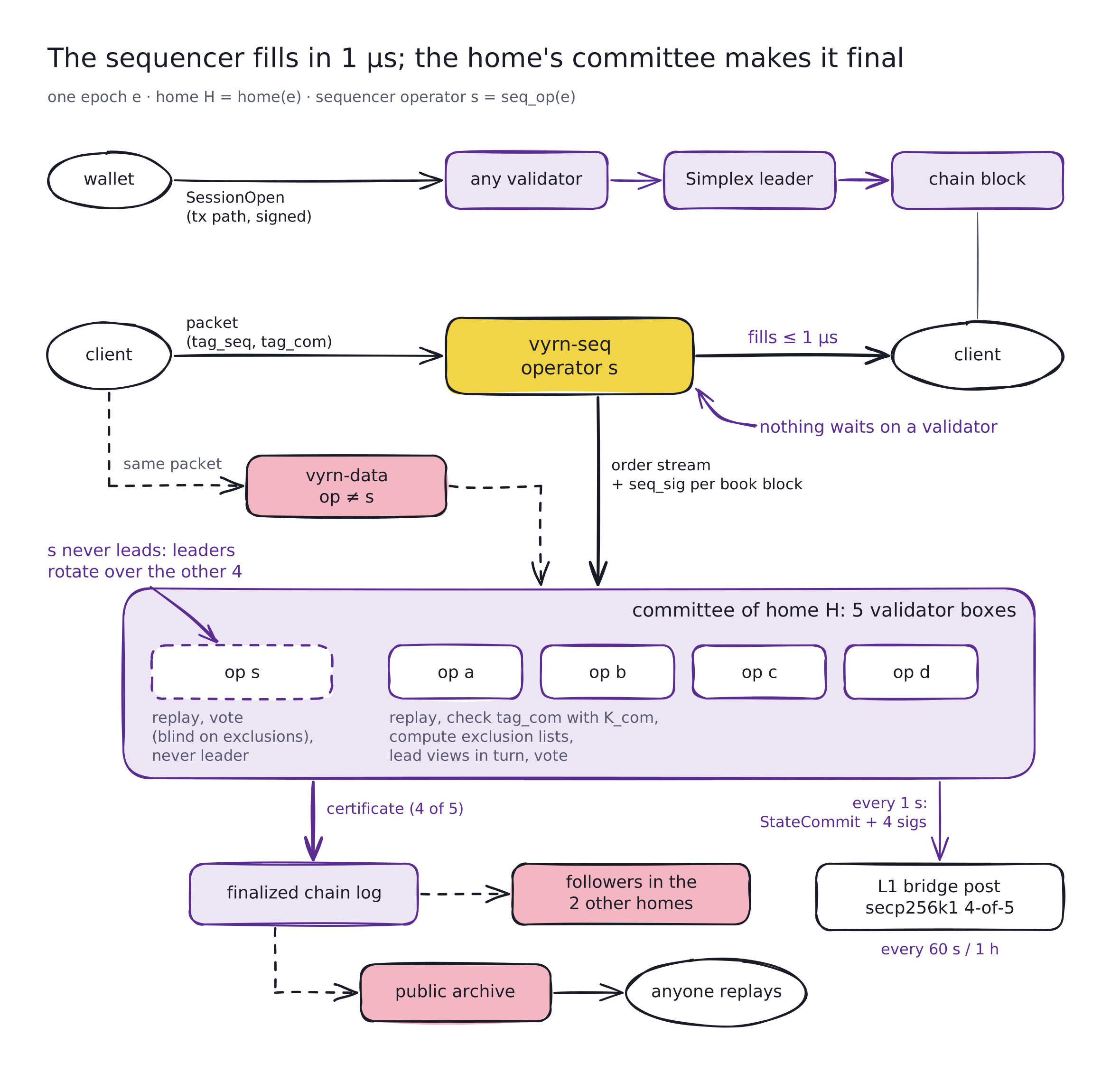
ASCII original
                         one epoch e, home H = home(e), sequencer operator s = seq_op(e)
  wallet ──SessionOpen (tx path, signed)──► any validator ──► Simplex leader ──► chain block
                                                                                    │
  client ── packet (tag_seq, tag_com) ──► vyrn-seq (operator s)  ── fills ≤ 1 µs ──► client
     │                                        │ order stream + seq_sig per book block
     └── same packet ──► vyrn-data (op ≠ s) ──► │
                                              ▼
            ┌──────────── committee of home H: 5 validator boxes ──────────────┐
            │ op s : replay, vote (blind on exclusions), never leader          │
            │ op a,b,c,d : replay, check tag_com with K_com, compute exclusion │
            │              lists, lead views in turn, vote                     │
            └──────────────┬───────────────────────────────────────────────────┘
                           │ certificate (4 of 5)          every 1 s: StateCommit + 4 sigs
                           ▼                                        │
         finalized chain log ──► followers in the 2 other homes      ▼
                           │                          L1 bridge post (secp256k1 4-of-5)
                           └──► public archive ──► anyone replays    every 60 s / 1 h
1.1 Hard constraints#
- C-UNIX: every VYRN process in this chapter is a Rust binary on Linux (
vyrn-seq,vyrn-validator,vyrn-data). The L1 client is third-party software (an Ethereum execution client and a consensus client) on Linux. Light-client code runs on any Unix. - C-NOCHIP: all cryptography runs on general-purpose CPUs: SipHash-2-4, BLAKE3 (SIMD), Ed25519, X25519, secp256k1. A COTS HSM or hardware wallet may store cold keys. It runs no VYRN logic and sits on no packet path.
- C-COTS: validator boxes are
REFboxes (01 §10). The commit box (§9.6) is any COTS server. - C-ONEBIN:
vyrn-validatoris one binary. The rolesvalandcommitare configuration.
1.2 The hard requirements in CHAIN mode (01 §14.0)#
| Requirement | How CHAIN meets it |
|---|---|
| 1 µs, as a maximum | The chain adds one SipHash (tag_seq, inside 14.2's 45 ns per packet) and a gate flag read to the lane. Item ops are capped per lane per block (§4.6). A gate halt answers every packet with Reject BOOK_HALTED within the 1 µs. Nothing waits on a validator. |
| 1B msgs/s on one book | Sized at WL-REF: 145.5M packets/s (02 §5.2). tag_com costs ~3 cores per validator box, hashing ~5 (§5.1, §9.2). |
| 10 ms finality for every accepted order | §4.8: ≤ 8.11 ms from block start with one fault, and the gate halts the book before it issues a fill that the model cannot finalize. |
| The 8 h move | The committee is the 5 nodes of the epoch's home (§2.1). Keys, schedule and committee keys are fixed 4 epochs ahead (§2.3, §2.4, §3.1). |
| 5 validators | N_CHAIN = 5, Q_CHAIN = 4, 3 Rust and 2 Vx (§2.1). The sequencer box never votes (01 §14.4). |
2. Validator set#
2.1 Operators, nodes and boxes#
| Term | Meaning |
|---|---|
| operator | One independent organization. Identified by OpIdx (u8, 0–4). It is the unit of trust, of bonds and of slashing. |
| node | The set of boxes one operator runs in one home. Identified by (OpIdx, HomeCode). 15 nodes in total. |
| validator box | The box in a node that runs vyrn-validator --role=val: replay, tag_com checks, votes. One per node. |
| commit box | The box in a node that runs vyrn-validator --role=commit: SMT, LtHash, L1 client, archive, RPC. One per node. |
| sequencer box | A box that runs vyrn-seq for one book or book group. Each operator keeps one in F1 and one in F2 of every home (03). In epoch e, the F1 box of seq_op(e) is live and the F2 box of next_seq(e, seq_op(e)) is the warm standby (§3.2). A sequencer box never votes and never holds a G private half. |
| data node | A box that runs vyrn-data. Every node runs at least two. |
| committee(e) | The 5 nodes (i, home(e)) for i = 0–4. They vote in epoch e. |
home(e) |
[TYO, LDN, NYC][e mod 3] unless a certified HomeOverride for e exists (08-epochs.md). Genesis epoch 0 is TYO. |
Each operator is assigned a client kind at genesis: operators 0, 1, 2 run the Rust validator
client, and operators 3 and 4 run the Vx client (CLIENT_SPLIT_CHAIN). A node's validator box
always runs its operator's client kind. INV-CHN-SPLIT: an operator's consensus vote and commit
vote are always cast by its validator box, never by its sequencer box. This is 01 §14.4 in CHAIN
form: the sequencing operator votes from its validator box. The reason: the sequencer box runs Rust
for every operator. If the sequencer box voted, an epoch sequenced by a Vx operator would give Rust
4 votes, and Rust alone could finalize.
2.2 Key hierarchy#
Every key has one purpose. A key never signs a message of another purpose, and every signed message starts with a domain-separation context (§17.3).
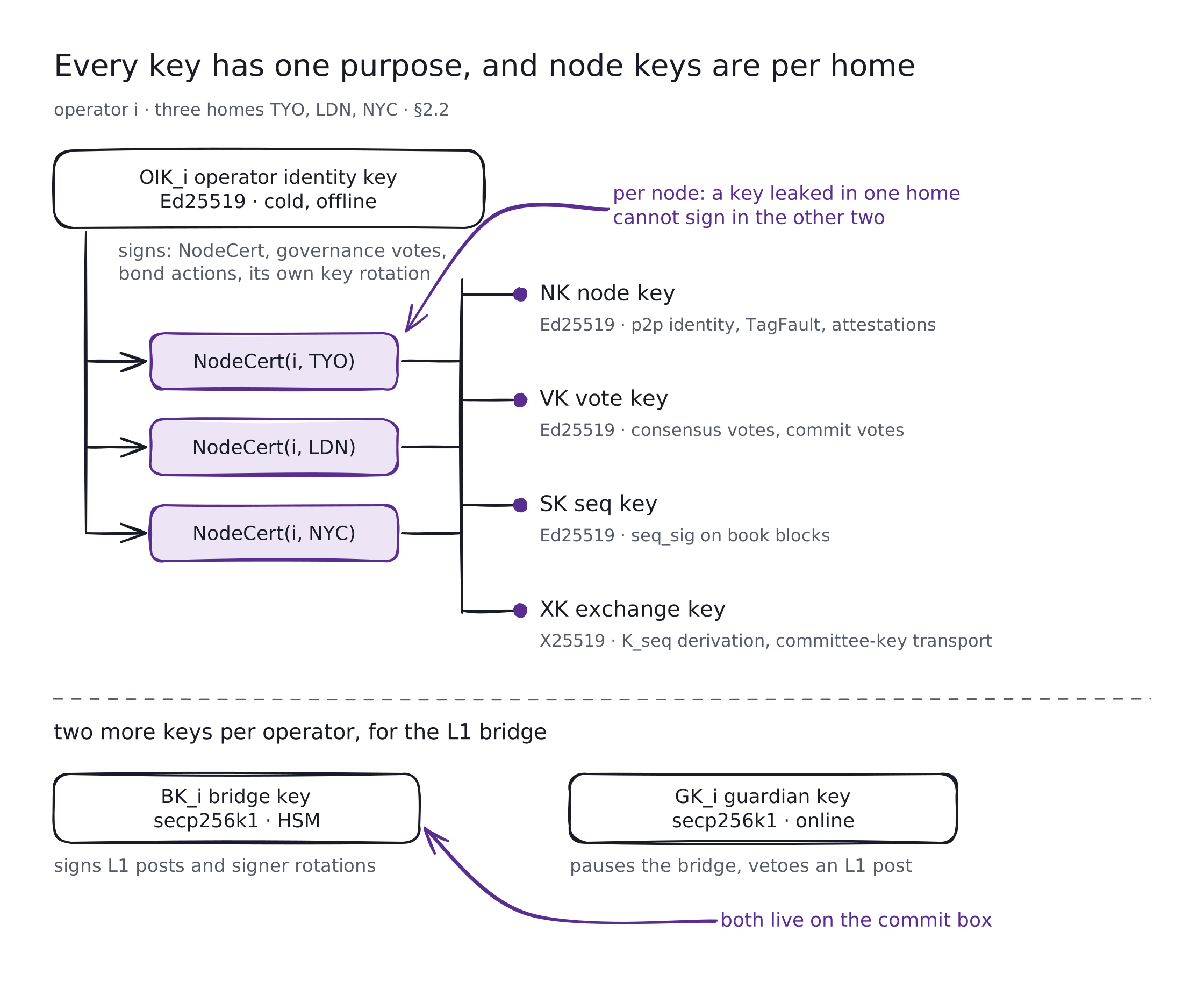
ASCII original
  operator identity key OIK_i  (Ed25519, cold, offline)
     │ signs: NodeCert, governance votes, bond actions, its own key rotation
     ├──► NodeCert(i, TYO) ─┬─ node key      NK  (Ed25519)  p2p identity, TagFault, attestations
     ├──► NodeCert(i, LDN)  ├─ vote key      VK  (Ed25519)  consensus votes, commit votes
     └──► NodeCert(i, NYC)  ├─ seq key       SK  (Ed25519)  seq_sig on book blocks
                            └─ exchange key  XK  (X25519)   K_seq derivation, committee-key transport
  bridge key BK_i   (secp256k1, HSM)    signs L1 posts and signer rotations
  guardian key GK_i (secp256k1, online) pauses the bridge, vetoes an L1 post
| Key | Scheme | Where it lives | Rotation |
|---|---|---|---|
OIK_i |
Ed25519 | Air-gapped Linux machine or COTS HSM | Governance (§2.10), timelocked |
NK, VK, SK, XK |
Ed25519 / X25519 | The node's boxes, in memory, loaded from an encrypted file at start | New NodeCert; active from the node's next active epoch |
BK_i |
secp256k1 | COTS HSM on the commit box | L1 signer rotation (§6.7) |
GK_i |
secp256k1 | Online watcher process on the commit box | L1 signer rotation |
Why per-node keys and not one key per operator: a key leaked in one home does not let the thief sign
in the other two. Why the votes still count per operator: certificates list (OpIdx, sig) (01 §4),
and the verifier picks the key VK(i, home(e)). A light client needs only the key table of each
epoch (§10).
2.3 NodeCert#
NodeCert {
    chain_id:     u32,
    op:           OpIdx,
    home:         HomeCode,
    serial:       u32,          // +1 per rotation of this node's keys
    valid_from:   Epoch,        // first epoch in which these keys may sign
    node_key:     [u8; 32],     // Ed25519
    vote_key:     [u8; 32],     // Ed25519
    seq_key:      [u8; 32],     // Ed25519
    xchg_key:     [u8; 32],     // X25519
    client_kind:  u8,           // 0 Rust, 1 Vx
    sig:          [u8; 64],     // Ed25519 by OIK_op over ctx "vyrn      v1 nodecert" ‖ fields
}
A NodeCert takes effect only when a chain block includes it, and only from valid_from, which
must be at least CHN_KEY_LEAD_EPOCHS (4) after the including block's epoch. The lead time exists
because sessions derive K_seq from xchg_key up to 3 epochs ahead (§5.3). The newest cert with
valid_from ≤ e is the one in force for epoch e.
2.4 Committee keys#
K_com must be identical for the 4 non-sequencing operators, or a client could give them different
keys and split their verdicts. Pairwise X25519 cannot give 4 parties one key. So each epoch has one
committee key per possible sequencer.
- For each epoch e and each operator s,
G(e, s)is an X25519 key pair. Its private half is held by the nodes(i, home(e))for every i ≠ s, and by no one else. - Dealer: the lowest
OpIdxincommittee(e) \ {s}. It generatesG(e, s), encrypts the private half to each other member underX25519(dealer XK, member XK)with BLAKE3derive_key("vyrn v1 gkey wrap"), and submitsCommitteeKeyto the chain. - Each member decrypts, checks that the scalar multiplied by the base point equals the published public key, and signs a confirmation. The record takes effect with 3 confirmations, so one absent member does not block it.
CommitteeKey {
    epoch: Epoch, seq_op: OpIdx, pub_key: [u8; 32],
    wrapped: [(OpIdx, [u8; 48]); 3],          // to the 3 other members
    confirms: [(OpIdx, [u8; 64]); ≥ 3],      // Ed25519 by each member's NK
}
G(e, s) for all 5 values of s is on chain at least CHN_KEY_LEAD_EPOCHS (4) before e. Five keys
are needed because a failover in epoch e moves the sequencer role to another operator (§3.2), and
that operator must not hold the K_com of its own epoch.
A byzantine dealer can leak G(e, s) to sequencer s. That is 2 byzantine operators, outside the
model. A byzantine dealer cannot give members different keys, because each member checks its key
against the one published key.
2.5 Votes#
The consensus is Simplex (07-replication.md). Every consensus message an operator signs has this
layout, signed with VK(op, home):
VoteMsg {
    ctx:     "vyrn      v1 vote",
    chain_id: u32,
    epoch:   Epoch,
    kind:    u8,       // 1 Notarize, 2 Nullify, 3 Finalize
    view:    u64,      // Simplex view within the epoch's instance, starts at 1
    height:  Height,   // chain height of the proposal; 0 for Nullify
    block:   Hash,     // BLAKE3 of the ChainHeader; zero for Nullify
}
The one-vote rule (INV-CHN-ONEVOTE): across all its nodes and keys, an operator signs for
each (epoch, view) at most one Notarize, at most one Finalize, and never both a Finalize and
a Nullify. These are the three conflicts Simplex defines, and each is slashable (§8).
Why the rule is per (epoch, view) and not per (epoch, height): in Simplex an honest node can
finalize-vote block B at height h in view v while the other 4 nullify view v. View v+1 then proposes
a different block B′ at the same height h, and the same honest node votes for it. A rule keyed by
height would slash that honest node. Each view is one proposal slot, so "one vote per slot" is the
correct form of "one vote per height".
Each validator box persists a high-water mark (epoch, view, kind, block) to NVMe and fsyncs it
before it sends a vote. After a restart it never signs below the mark.
2.6 The double-sign rule across homes#
An operator has 3 vote keys. Only one of its nodes is eligible in an epoch:
eligible(op, node_home, e) = (node_home == home(e))
home(e) comes from certified chain state (the schedule and any HomeOverride), never from a
clock. Rules:
- A vote is valid only if it verifies under
VK(op, home(e))from theNodeCertin force for e. - A vote signed by a node key of a home that is not eligible for e is invalid. If anyone submits
it, it is
CrossHomeVoteevidence (§8), slashed lightly. It shows that an operator runs a node that signs outside its epoch, which is the precondition for a real double vote after aHomeOverride. - Conflicting votes from two keys of one operator count as a double vote by that operator. Attribution is to the operator, not to the key.
- At a handoff, epoch e and epoch e+1 have different homes, different keys and separate Simplex
instances (the instance namespace includes the epoch). The old committee signs only the
HandoffRecordof e, and the new committee signs only views of e+1. They cannot conflict.
2.7 Genesis#
GenesisRecord {
    chain_id:      u32,
    genesis_time:  Nanos,            // TAI; start of epoch 0 (a TYO epoch boundary, 00:00 TYO)
    operators:     [OperatorEntry; 5],  // OIK, BK, GK, client_kind, name hash
    node_certs:    [NodeCert; 15],
    committee_keys:[CommitteeKey; 5 × CHN_KEY_LEAD_EPOCHS],   // epochs 0–3
    params:        ParamSet,         // every governance parameter, §2.10 and §17
    assets:        [AssetEntry],     // asset id, L1 token address, decimals
    books:         [BookEntry],      // book id, base, quote, tick size, lot size, book group
    bridge:        { l1_chain_id: u64, contract: [u8; 20], deploy_block: u64 },
    sigs:          [(OpIdx, [u8; 64]); 5],   // all 5 OIKs: genesis is 5-of-5
}
genesis_hash = BLAKE3(derive_key("vyrn      v1 genesis", canonical_encoding(GenesisRecord)))
Genesis is 5-of-5 because no earlier set exists to certify it. Every client is configured with
genesis_hash. The bridge contract is deployed first with the 5 bridge keys and chain_id, and
the genesis record names its address. Chain height 0 is the genesis. Epoch 0 opens with an opening
auction like every other epoch.
2.8 Bonds#
| Bond | Amount (budget, governance parameter) | Posted by | Locked |
|---|---|---|---|
| Operator bond | CHN_OPERATOR_BOND = 20,000,000 USDC |
each operator | from joining until CHN_UNBOND_EPOCHS (63 epochs, 21 days) after leaving |
| Sequencer bond | CHN_SEQ_BOND = 10,000,000 USDC |
the sequencing operator of e | from e − 4 until e + CHN_EVIDENCE_EPOCHS (42 epochs, 14 days) |
| Session bond | ≥ CHN_SESSION_BOND_MIN = 1,000 USDC, and ≥ the session's rate-based minimum (§5.9) |
the account opening the session | from open until the close is final plus FIN_GATE_BLOCKS |
Bonds are chain state, held in the chain's USDC balances of a reserved bond account per operator. They come from deposits through the bridge like any balance. Slashing moves bond balance by state transition. No L1 action is needed to slash, because the funds already sit behind the bridge.
An operator that cannot post its sequencer bond by e − 4 is skipped in the schedule for e (§3.1).
Why the unbonding period is 21 days: it must exceed the evidence window (14 days) so that every slashable fault can be proved while the bond is still locked. It also exceeds the light-client weak-subjectivity period (§10.4).
2.9 Membership changes#
- The set always has exactly 5 operators in v1. A change replaces one operator with another.
- A change is a governance action (§2.10) with an activation epoch
e_act. It takes effect only at the start ofe_act, which is an epoch boundary. - The incoming operator must, before
e_act − CHN_KEY_LEAD_EPOCHS: post the operator bond, have its 3NodeCerts included, take part in theCommitteeKeyrecords for epochs ≥e_act, and have its validator boxes in every home following the log. - The outgoing operator stops voting at
e_act. Its bonds unbond afterCHN_UNBOND_EPOCHS. - Because
home(e)rotates, the incoming operator's first active epoch ise_actinhome(e_act). It needs its node there to be synced at that moment, not earlier.
Jailing. An operator that is slashed for equivocation or a double vote is jailed at the
boundary where the slash applies. A jailed operator's votes do not count, it is skipped as
sequencer and as leader, and it does not receive committee keys for later epochs. The set then has
4 counting operators and still needs Q_CHAIN = 4 signatures. So until governance replaces the
jailed operator, the chain tolerates 0 further faults for liveness. Safety is unchanged: 4 honest
signatures out of 4 are still required. This is a residual risk (§15). Governance must start a
replacement within CHN_JAIL_REPLACE_EPOCHS (9).
2.10 Governance#
Governance is a set of actions signed by 4 of the 5 operator identity keys.
GovAction {
    ctx: "vyrn      v1 gov", chain_id: u32, gov_nonce: u64,
    action: GovKind, activation: Epoch,
    sigs: [(OpIdx, [u8; 64]); ≥ 4],      // Ed25519 by OIK
}
GovKind = SetParam { id: u16, value: u128 } | ReplaceOperator { out: OpIdx, entry: OperatorEntry }
        | Upgrade { proto: ProtoVer, release_hash: Hash } | AddBook { .. } | AddAsset { .. }
        | Jail { op: OpIdx } | Unjail { op: OpIdx } | HaltBook { book: BookId } | ResumeBook { .. }
        | HomeOverride { epoch: Epoch, home: HomeCode } | RotateOperatorKey { op, new_oik }
Two classes:
| Class | Actions | Delay |
|---|---|---|
| Tightening (reduces power or risk) | Jail, HaltBook, lower any cap, raise any bond, HomeOverride for an epoch that has not started |
effective at the next boundary (§4.6), no timelock |
| Loosening (everything else) | parameters that raise caps or lower bonds, ReplaceOperator, Upgrade, AddBook, AddAsset, Unjail, ResumeBook, RotateOperatorKey |
activation ≥ current epoch + CHN_GOV_TIMELOCK_EPOCHS (9 epochs, 72 h) |
Why 72 h: the worst-case exit is a withdrawal request, a 60 s batch, an L1 post, a 1 h challenge period and an L1 claim, about 1.5 h in total (§6.5). A user who disagrees with an approved action can leave well before it takes effect.
Governance cannot move a user balance, mint an asset, or change a past block. No GovKind does
those things, and an Upgrade that adds one is visible in the 72 h before it activates.
A stolen OIK_i is handled by the other four: they Jail operator i (tightening, immediate) and
then rotate its key or replace it (loosening, timelocked). A RotateOperatorKey signed by the old
key alone is not valid. It needs 4 of 5 like any other action.
3. The sequencer role#
3.1 Schedule#
seq_op(e) = first i in [e mod 5, e+1 mod 5, …, e+4 mod 5] such that
            i is not jailed, i is bonded, and i posted CHN_SEQ_BOND for e by e − 4
The schedule is a pure function of chain state at e − 4. Clients and validators compute it four epochs ahead. Since gcd(3, 5) = 1, the pair (home(e), seq_op(e)) cycles through all 15 combinations every 15 epochs. No operator always sequences the same session of the day, so no operator always faces the same flow.
One sequencer operator serves every book of the home in its epoch. Why not a different operator per book: the Simplex leader set excludes the sequencing operator (§4.3). With several sequencing operators the leader set would shrink below what liveness needs.
3.2 Failover order#
08-epochs.md and 07-replication.md own the failover protocol (FAILOVER_SILENCE_MS = 2,
FAILOVER_TARGET_MS = 20). This chapter fixes only who takes over and which keys apply:
next_seq(e, s) = first i in [s+1, s+2, s+3, s+4] mod 5 that is eligible for e and has not
                 already been sequencer in e
| After a failover from s to s′ | Value |
|---|---|
| Book blocks are signed by | SK(s′, home(e)) |
| Packets are checked on the fast path with | K_seq(e, s′) (§5.3) |
tag_com is checked with |
K_com(e, s′, i), held by committee(e) minus s′. That set includes s. |
| Simplex leaders | committee(e) minus s′ |
| s may sequence again in e | no |
Operator s holds K_com(e, s′, ·) but not K_seq(e, s′), so the key split still holds.
Clients precompute K_seq(e, i) for all 5 values of i, so a failover needs no client transaction.
The standby (01 §14.4). Failover promotes the warm standby: the F2 sequencer box of
s′ = next_seq(e, s), which replays the order stream and has derived K_seq(e, s′) for every
session from XK(s′, home(e)). It never promotes a validator box, so the client split and the 5
voters survive. No sequencer box, live or standby, of any operator ever holds a G private
half. G private halves are loaded only on validator boxes and commit boxes. So s′ never holds
K_com(e, s′, ·), although its validator box holds G(e, s). A same-operator standby (an F2 box of
s itself) would keep K_seq(e, s) and SK(s, home(e)) and would still receive no G key, because
K_com(e, s, ·) stays with the four other members. v1 does not use it: a byzantine s controls both
of its boxes, so promoting its own standby would not remove the fault.
The client learns the new sequencer from the failover notice (04-protocol.md) and switches the
key it uses for tag_seq and the chain it uses for tag_com.
3.3 Duties#
The sequencing operator must:
- Run
vyrn-seqfor every book of the home for the whole epoch (05-engine.md). - Check
tag_seqwithK_seq(e, s)on every packet, and close the session on the first failure from the bound address (01 §4, §12.5). - Tag every response with
K_out(e, s)(§5.3). - Emit one book block per book per
BLOCK_NS, withseq_sig(§3.4). - Apply every item at the first boundary after its chain block is notarized or final, never after
its deadline, and obey
INV-CHN-TXGATE(§4.6). - Suspend a session when
CHN_TAGFAULT_QUORUM(2) distinct committee members report atag_comfailure on it (§5.8), and log the suspension. - Stop at the end of the epoch, emit the
HandoffRecordand hand off (08-epochs.md). - Keep its validator box voting. The validator box is a separate box (
INV-CHN-SPLIT).
The sequencing operator must not lead a Simplex view, hold any G(e, s) private key, or run the
data node that a client's data copy goes to (§13.3).
3.4 seq_sig#
seq_sig = Ed25519_sign(SK(s, home(e)),
                       derive_key("vyrn      v1 seqsig", encode(BlockHeader without seq_sig)))
One signature per book per millisecond costs about 1,000 signatures per second per book. It runs on
order-stream core A (core 4, 07 §6.2) in slices, off the 1 µs path. Before it signs height h,
vyrn-seq's control thread (core 51, 01 §10) persists
(book, h, header hash) as its high-water mark and never signs a different header at or below it.
That mark makes equivocation impossible for an honest sequencer, even across a crash: an honest
sequencer that crashes is failed over and does not sign again in the epoch.
3.5 What the sequencer cannot do#
| Attempt | Why it fails |
|---|---|
| Forge a client packet | It lacks K_com. The committee excludes the packet and its fills are busted (§5.9). |
| Sign two histories for one height | Two valid seq_sigs for one (book, height) are evidence; the bonds are slashed (§8). |
| Keep trading after the handoff | A header of epoch e above the certified last_height is FenceViolation evidence. |
| Censor a client | The client uses the forced path; the leaders are other operators (§7). |
| Delay a transaction's effect | The boundary is fixed by finalized chain blocks, not by the sequencer (§4.6). A halt that continues after the gate's condition holds counts as silence and starts a failover (§4.6). |
| Reorder a client's packets against others | It can. That is front-running, capped in §13. |
4. State model#
4.1 Two levels of state#
State has two levels. The chain level is ordered by chain blocks and changes at low rate. The book level is ordered by the order stream, lives in lanes while the book is live, and changes at up to 1B messages per second.
| Level | Object | Key | Fields | Writer while live |
|---|---|---|---|---|
| chain | Account | AccountId |
owner: OwnerKey, nonce: u64, exit_address: [u8; 20], created: Height |
chain state machine |
| chain | Free balance | (AccountId, AssetId) |
free: u128, pending_withdraw: u128 |
chain state machine |
| chain | Session | SessionId |
account, book group, x25519_pub, sign_pub, bound address, bond, epochs, anchors, status |
chain state machine (open, close, suspend results come from lanes) |
| chain | Validator set | OpIdx |
OperatorEntry, NodeCerts, bonds, jail flag |
chain state machine |
| chain | Committee keys | (Epoch, OpIdx) |
CommitteeKey |
chain state machine |
| chain | Bridge | — | deposit nonce credited, pending L1Attests, withdrawal queue, L1 posts and their status |
chain state machine |
| chain | Governance | — | ParamSet, pending GovActions, gov_nonce, protocol version table |
chain state machine |
| chain | Funds | — | insurance fund, fee pool per epoch, bust escrow | chain state machine |
| book | Allocation | (AccountId, BookId, AssetId) |
available: u128, reserved: u128 |
the account's lane (01 §12.2) |
| book | Resting order | (LaneId, Handle) |
account, side, tick, open qty, rx_ts | the account's lane; filled qty by the BBO core |
| book | Lane session state | SessionId |
K_seq, K_out, bound address, pkt_seq window, suspended flag |
the session's lane |
OwnerKey = Ed25519([u8; 32]) | Secp256k1([u8; 20]) (an EVM address). An account is created by its
first credited deposit, which names the owner (§6.3). AccountIds are assigned in credit order,
starting at 1. The lane of an account in a book group is assigned by 10-accounts-risk-md.md.
Allocations are escrow (01 §12.4). Allocate moves an amount from the free balance into a
book's allocation. From then on the lane owns that amount. The chain level does not hold a live
copy. It holds the allocation as of the last finalized book block, which every validator computes by
replay. A light client sees it every second in the SMT (§9.3).
4.2 How book-level state is committed#
Book-level state is never written by a transaction. It is a pure function of the finalized order
stream and the items applied at boundaries (INV-DET). So:
- per book block: the order stream of the block is final when the chain block that includes it is final. From that moment every byte of book state at the end of that block is determined.
- per second: validators publish the SMT root of all allocations and the lattice hash of all resting orders (§9).
No validator signs book state block by block, because computing it is the replay itself and runs behind the live book. Signing the order is enough, and the per-second commitment lets anyone check that the validators computed the same state.
4.3 The chain block#
The Simplex payload in chain mode is a ChainBlock. One view proposes one chain block. A chain
block wraps the book blocks that the leader holds and that follow the last included ones.
ChainHeader {
    chain_id:    u32,
    epoch:       Epoch,
    height:      Height,     // chain height: parent.height + 1. Never resets.
    view:        u64,
    parent:      Hash,       // BLAKE3 of the parent ChainHeader
    leader:      OpIdx,
    books_root:  Hash,       // Merkle root over BookEntry, sorted by book
    items_root:  Hash,       // Merkle root over the item list, in order
    excl_root:   Hash,       // Merkle root over the ExclusionLists, sorted by (book, book height)
    log_hash:    Hash,       // §9.2
}
BookEntry { book: BookId, first: Height, last: Height, last_header: Hash }   // book heights
ChainBlock { header: ChainHeader, books: [(BookEntry, [BlockHeader])], items: [Item],
             excl: [ExclusionList] }
BlockHeader.height (01 §6.6) is the book height: one per book per millisecond. ChainHeader.height
is the chain height. With one hot book, a chain block usually carries exactly one book block, and
the two heights advance together. A chain block that carries no book block is valid; it can still
carry items.
Leader schedule. leaders(e) = committee(e) minus the current sequencing operator, minus jailed
operators, in OpIdx order. leader(e, v) = leaders(e)[v mod len]. A leader is always a K_com
holder, so it can always compute the exclusion lists of the book blocks it proposes.
What a voter checks before it notarizes (in this order; 07-replication.md gives the generic
checks):
parent,viewandleaderfollow Simplex and the leader schedule.- For each book: the headers continue the last included header of that book with no gap, each has
a valid
seq_sigunderSKof the current sequencer, and the voter holds every order-stream record and every payload they reference (07-replication.md). - Each exclusion list equals the one the voter computes (§5.7). The sequencing operator's
validator box skips this check, because it has no
K_com. - Each item that a book block h applies comes from an ancestor C of this chain block (or is a
signed forced hint), with
lastb(C) < h, in item order, at a boundary or at the gate-open point; and every lane item whose deadlineact(C, b)(after carries) is ≤ h has been applied (§4.6). - Each item is valid against the state after the parent: signature, nonce, fee, size and rate limits, and not already included.
- At most
CHN_MAX_ITEMS(500) items andCHN_MAX_ITEM_BYTES(256 KiB) of items. log_hashand the three roots are recomputed and equal.
4.4 The transaction path#
Non-order actions use their own path, which never touches the 1 µs path.
- Transport: QUIC (RFC 9000) to
CHN_TX_PORTon any node of any home. A node outside the active home forwards to the active committee. The NIC flow filter of a sequencer box never sees this port. - Mempool: a validator box that accepts an item gossips it to the next 3 leaders in the schedule. A leader includes items in arrival order, up to the caps.
- Envelope:
TxEnvelope {
    version: u8 (= 1), kind: u8, body_len: u16,
    signer:  SignerRef,       // Account(AccountId) | Session(SessionId) | Node(OpIdx, HomeCode)
                              //   | Operator(OpIdx) | Anyone
    nonce:   u64,             // per signer; must be last + 1
    max_fee: u64,             // in USDC micro-units; the fee charged is ≤ this
    body:    [u8; body_len],
    scheme:  u8,              // 0 Ed25519, 1 secp256k1 (EIP-712)
    sig:     [u8; 64 or 65],
}
- Signatures: Ed25519 signs
derive_key("vyrn v1 tx", encode(envelope without sig)). secp256k1 signs the EIP-712 digest of the same fields, with the domain{name: "VYRN", version: "1", chainId: l1_chain_id, verifyingContract: bridge}, so that EVM wallets can show what they sign. - Rate:
CHN_TX_RATE(10 per second) per signer, enforced at inclusion. The whole path is sized for 500 items per chain block, 500k per second (budget). Real load is orders of magnitude lower.
4.5 Item kinds#
| Code | Item | Signer | Applies in | Effect |
|---|---|---|---|---|
| 0x01 | SessionOpen |
wallet | chain, then lane | Registers a session (§5.2). Locks the bond. Installs keys in the lane at the boundary. |
| 0x02 | SessionClose |
wallet or session key | lane, then chain | Cancels the session's resting orders, closes it, releases the bond after the close is final. |
| 0x03 | SessionRebind |
session key | lane | Changes the bound source address. |
| 0x04 | Allocate |
wallet or session key | chain, then lane | free → allocation of one book. |
| 0x05 | Deallocate |
wallet or session key | lane, then chain | allocation → free, if available covers it; else rejected in the lane. |
| 0x06 | Move |
wallet or session key | lane, chain, lane | Deallocate on one book, then Allocate on another (§4.7). |
| 0x07 | Withdraw |
wallet | chain | free → pending_withdraw, queued for the next L1 post (§6.5). |
| 0x08 | CancelWithdraw |
wallet | chain | Undoes a Withdraw that is not yet in an L1 post. |
| 0x09 | SetExitAddress |
wallet | chain | Sets the L1 address used by the escape hatch (§6.8). |
| 0x10 | ForcedPacket |
session key | lane | A request packet on the forced path (§7). |
| 0x20 | L1Attest |
node key | chain | Deposits and contract events seen on L1 (§6.3). |
| 0x21 | CommitteeKey |
node keys | chain | §2.4. |
| 0x22 | NodeCert |
operator key | chain | §2.3. |
| 0x23 | AnchorFault |
node key | chain | A session's anchor does not match (§5.4). |
| 0x24 | CommitCert |
4 vote keys | chain | Puts a state commitment on chain (§9.5). |
| 0x25 | HandoffTimeout |
vote keys | chain | Quorum attestation of a missing handoff (§8.4). |
| 0x26 | ReadySignal |
node key | chain | Upgrade readiness (§14.2). |
| 0x30 | Evidence |
anyone | chain | A slashing proof (§8). |
| 0x31 | GovAction |
4 operator keys | chain | §2.10. |
Items in one chain block are applied in list order. A leader orders them by arrival, so a leader can reorder items within one block. Items do not trade, so the value of reordering them is small, and §13 covers the orders that do trade.
4.6 Positioning: the boundary rule#
An item that touches a book must take effect at a point that is deterministic and that replay can check. The sequencer chooses the point and logs it. Consensus fixes the latest allowed point:
lastb(C, b)  = the highest book-b height included in chain block C or in any ancestor of C
act(C, b)    = lastb(C, b) + FIN_GATE_BLOCKS + 1        // D + 1 = 9: the deadline, not the delay
- Chain-only effects of the items in chain block C apply at the end of C, in item order.
- Lane effects on book b apply at a block boundary: as the first ops of the lane in a book
block, before any packet the lane processes in it. Several items for one lane apply in item order.
The sequencer logs each applied item as an
ItemRecordin the order stream (§17.2), so replay applies it at the same op. An honest sequencer uses the first boundary after it holds:- the notarization of C, for a self-authenticating lane item:
ForcedPacket,SessionRebind,SessionClose,Deallocateand the first half ofMove. Each carries the signature of its session or wallet and a nonce, so it is valid in any position, and a copy that C's branch later loses is a no-op when it is included again (nonce orpkt_seqdedupe). - the finalization of C, for an item whose lane effect needs a chain effect first (
SessionOpen,Allocate, the second half ofMove) and for busts and suspensions (§5.8, §5.9), whose chain block is the one that includes the exclusion list.
- the notarization of C, for a self-authenticating lane item:
- The deadline. Every lane effect of C is applied at or before the first boundary of book block
act(C, b). A voter that finds one missing there fails check 4 (§4.3), treats the sequencer as silent (07 failover) and submitsCensorshipevidence (§8.2). The new sequencer applies the missing items first (01 §14.0 fact 3). - Lane results flow back. A lane result that changes chain state (a
Deallocatethat succeeded, a session that closed) applies at the end of the first chain block that includes the book block in which the lane produced it. - Item work per lane is capped. Item ops run on the lane core, ahead of the block's packets. A
lane applies at most
CHN_ITEM_OPS_PER_BLOCK(16) item ops at one boundary, ≤ ~0.64 µs (budget); the rest carry, in order, to the next boundary, and the deadline moves with them. Deadline admission (01 §14.1) sheds any packet they would make late, and B3 counts it against theBUSYbudget. So no item, however large, breaks the 1 µs.
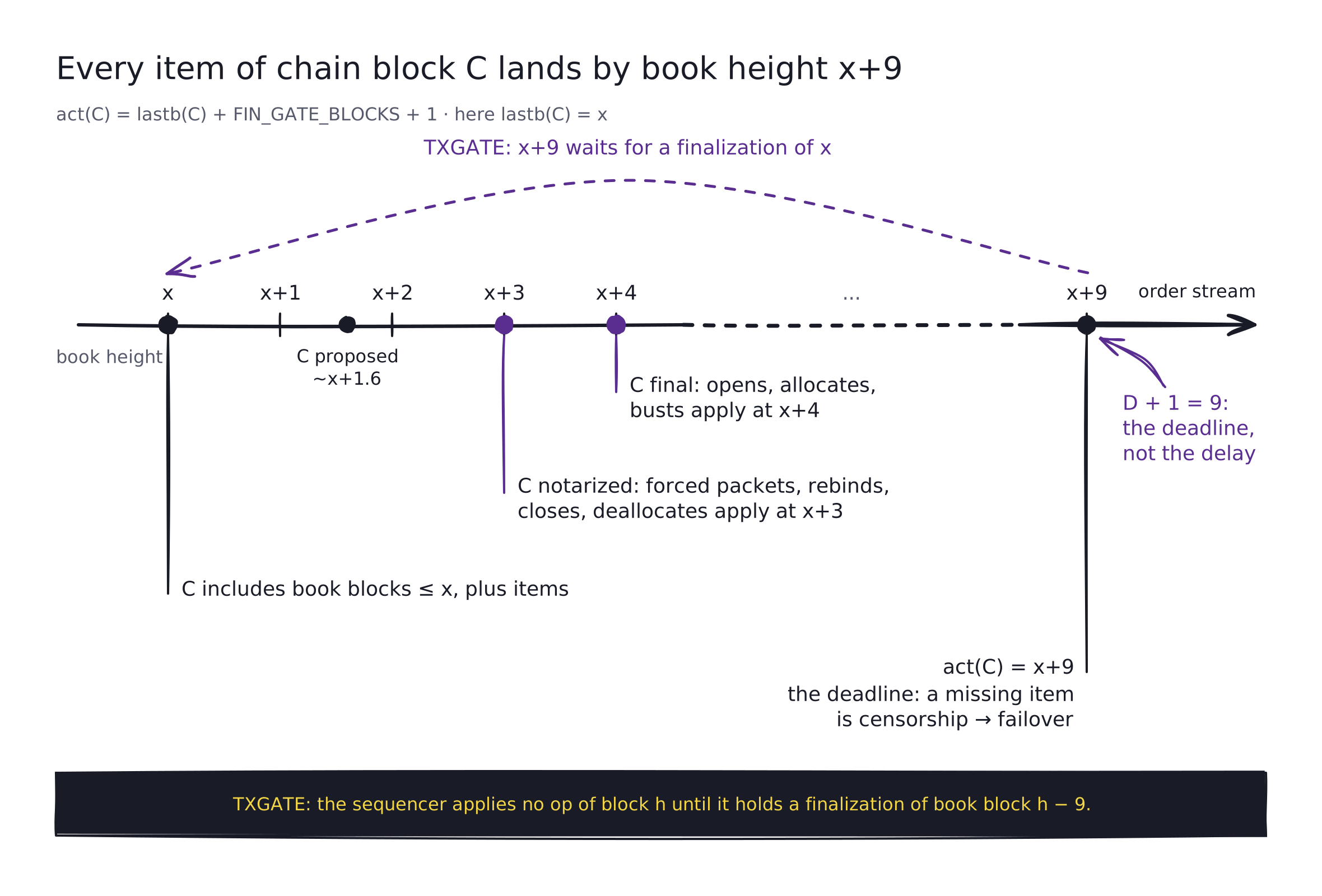
ASCII original
book height  ...  x     x+1     x+2     x+3     x+4    ...    x+9
order stream ────┼──────┼───────┼───────┼───────┼─── ... ─────┼────►
                 │ C includes book blocks ≤ x, plus items (proposed at ~x+1.6)
                 │        │ C notarized: forced packets, rebinds, closes, deallocates apply at x+3
                 │                │ C final: opens, allocates, busts apply at x+4
                 │                                            │ act(C) = x+9: the deadline; a missing
                 │                                            │ item is censorship → failover
TXGATE: the sequencer applies no op of block h until it holds a finalization of book block h − 9.
INV-CHN-TXGATE (01 §14.9): the sequencer never runs more than D = FIN_GATE_BLOCKS = 8
closed blocks ahead of finality, the count 07 §6.8 uses. It applies no op of book block h (no
item, no packet, no step) until it holds a finalization certificate for a chain block that
includes book block h − D − 1. Finalize votes go to the
live and the standby sequencer boxes as well as to the voters, so the sequencer holds the
certificate at hop 4 (§4.8). The gate also makes every deadline reachable: an item with deadline h
comes from a chain block C with lastb(C) = h − D − 1, and C is final once h − D − 1 is.
The halt. If the certificate for h − 9 is missing at h's boundary, the book halts instead of issuing fills that cannot be final within 10 ms:
- Order-stream core A (core 4) asks for a
Controlstep (01 §14.10) with sub-code 1, halt, and the BBO core logs it. Every lane answers every packet withReject BOOK_HALTED(detail 1 = gate) within the 1 µs and logs it as aPacketRecordwithflags.SHED, as deadline admission does. A shed record applies nothing and does not advance the session'spkt_seq, so it needs no item, and the client resends after the halt. - Blocks keep their 1 ms length while halted. When the certificate arrives, core 4 asks for a
Controlstep with sub-code 2, gate open. Items due in the halted blocks apply at that point, in order; then trading resumes in the same block. Replay reads both steps from the log (INV-DET). - A validator that holds the finalization of h − 9 and still sees shed records of block h or later
CHN_HALT_GRACE_MS(1 ms) afterward treats the sequencer as silent. So a byzantine sequencer cannot use a halt to delay items or forced packets.
Consequences:
- At most D = 8 closed blocks plus the open one, ≤ 9 ms of order stream, are ever unfinalized.
That bounds every fill that a failover could revert (
07-replication.md). - With at most
Ffaults and the metro within its delay bound, the gate never binds: the worst case is 8.11 ms from block start to the certificate (§4.8), against 9.00. A halt therefore means that the network has left its bound or that more thanFoperators failed (01 §14.0 fact 3). The fills already issued (≤ 8 blocks) are on a quorum before any response (INV-FRAME-FIRST) and finalize when the network recovers. B-CHN-3 checks that the gate never binds with ≤ 1 injected fault (§19). - Why D = 8 and not smaller: the worst in-model finality from block start (8.11 ms) must fit before block h + 9 opens, or the gate would halt on every slow view. Why not larger: D bounds how far the book runs beyond finality, and 9 ms from block start, plus the client hop (0.05) and the finality notice (0.05), is 9.1 ms: still inside 10 ms of the send, with no room for a tenth block.
4.7 Moving an allocation between books#
Move { account, from: BookId, to: BookId, asset, amount } runs in three steps:
- Chain block C includes it. At the first boundary after C is notarized (deadline
act(C, from)), the lane offromdebitsavailable. Ifavailableis short, the move fails there and nothing else happens. - Chain block C′ includes that book block. At the end of C′ the chain credits the amount to a per-move transit balance and schedules the second half.
- At the first boundary after C′ is final (deadline
act(C′, to)), the lane oftocreditsavailable.
The amount is usable in to ~9 ms after submission and ≤ 15.7 ms (bound, §4.8). This meets
01 §12.4 ("milliseconds", never on the 1 µs path). The amount is in the transit balance between
steps 2 and 3, and the SMT shows it there.
4.8 Finality of every order, and item latency#
Normal-path orders. 07 §6.6 gives the stages. CHAIN adds the tag_com check before the vote
and keeps the data copy out of the sequencer's facility (01 §14.16). Every row is the bound of 07 §6.6, used as the
delay bound of the model (01 §14.0 fact 3):
| Stage, from the start of the order's book block | Bound (ms, budget) | CHAIN change |
|---|---|---|
| Order → block close (an order in the block's first µs) | 1.00 | |
Seal: roots, seq_sig, header out |
0.10 | |
| Hop 1: header → leader and voters | 0.80 | |
| Data lag beyond the order path | 0.71 | each session's data home is the primary data box of an operator ≠ s in its F2–F5 facility (below): two metro hops (0.80 + 0.005 batch + 0.80) against the header's seal and one hop (0.90) |
| One frame repair | 0.00 | 0.20, in parallel with the data lag: verify waits for the later of the two |
verify completion |
0.10 | |
tag_com of the last payload, exclusion list |
0.05 | 20 ns per packet, incremental; keys precomputed (§5.4) |
Hops 2–4: proposal, notarize, finalize → Q_CHAIN at every voter and at the sequencer |
2.45 | |
| Vote signature checks | 0.10 | |
| No fault | 5.31 | was 4.85 with F1 data homes |
One nullified view (a byzantine or dead leader, t_l 2 ms + 1 hop) |
+2.80 → 8.11 | the sequencer never leads, so a leader fault is a member fault |
| or a data box redirect (07 §5.7, 3 ms in place of 0.71) | 7.60 | |
| or the sequencer is the fault | 07 failover; its seal must be final ≤ 9 ms after the last frame |
The gate counts closed blocks (§4.6): block h must be final before block h + 9 opens, 9.00 ms
after h starts, so the margin is 0.89 ms in the worst one-fault case. With the old count (h final
before h + 8 opens, 8.00 ms) the data home outside F1 would leave −0.11 ms and halt the book at
every leader fault, which is why the count changed. The order is sent ≤ 0.05 ms before its
rx_ts (the client is in F1), and the finality notice reaches it ≤ 0.05 ms after the
certificate, so every accepted order is final ≤ 8.21 ms after it is sent, within
FINALITY_MAX_MS = 10. The order's tag_com verdict, and so whether its fills stand or are
busted, is part of the same final block. The TESLA schedule adds nothing to this path: members
derive every K_com before its interval (§5.4), and disclosure (§5.10) comes seconds after
finality.
Data placement (01 §14.16). A data home is never in the sequencer's facility, F1 (07 §5.1):
if F1 held both, one facility loss would lose both copies of the packets in flight and revert
their fills. So in CHAIN each operator runs its primary data box in the operator's F2–F5 facility
and its backup in another of F2–F5. No data box in F1 is ever a primary home. Session σ's data home
is the primary data box of data_op(e, σ), the first operator in [σ mod 5, …] that is not s. Its
timestamps stay independent of s (§13.3). The cost is the 0.71 ms data lag in the table above,
which the closed-block gate absorbs. 03 and 07 own the boxes.
Items. The bounds below place one fault where it costs most: a skipped or nullified view. Hop δ = 0.8 ms, a view ≤ 2δ = 1.6 ms, and an item reaches the leaders ≤ 2δ after submission (a forced packet ≤ δ, because the client sends it to all 4 members).
| Item | Takes effect | Typical (ms from submission) | Bound (ms, budget) |
|---|---|---|---|
Withdraw, CancelWithdraw, SetExitAddress, governance, evidence, attestations |
end of C, final with C | ~4 | 8.6 |
SessionOpen (SessionId in the receipt) |
end of C | ~4 | 8.6 |
SessionOpen keys, Allocate |
lane, first boundary after C is final | ~5.5 usable, ~9 final | 9.6 usable, 14.9 final |
SessionRebind, SessionClose, Deallocate debit |
lane, first boundary after C is notarized | ~4.5 usable, ~8 final | 8.7 usable, 14.0 final |
Deallocate credit to free, close's bond release |
end of C′, which includes that book block | ~9 | 15.2 |
Move |
lane of to |
~9 usable, ~13 final | 15.7 usable, 21.1 final |
ForcedPacket, honest sequencer |
the hint (§7.1), or the boundary after C is notarized | ~4 executed, ~7.5 final | final ≤ 10 (§7.4) |
ForcedPacket, censoring sequencer |
the new sequencer's first block | — | final ≤ deadline + FAILOVER_TARGET_MS + FINALITY_MAX_MS ≈ 41 |
Every item has the same hard deadline, act(C, b), ≤ 8 ms after C's proposal. A sequencer that
misses it is replaced.
5. Authentication at 1B messages per second#
5.1 Why not a signature per packet#
Every packet must be attributable to a client, by a check that 4 validators can repeat. A signature per packet is the obvious answer, and it does not fit.
| Option | Verify cost per packet | Cores per validator at 145.5M packets/s (WL-REF, 02 §5.2) |
Bytes per packet |
|---|---|---|---|
| Ed25519 per packet | ~20 µs (budget planning figure: "tens of µs"); batch verification ~2× better | ~2,900 (~1,450 batched) | +64 |
| secp256k1 per packet | slower than Ed25519 | > 2,900 | +65 |
| Two SipHash-2-4 tags (this design) | 20 ns per tag (budget) | 2.9 for tag_com (budget 4 with margin) |
+16 |
The sequencer has 1 µs for the whole packet, and one Ed25519 verify alone is about 20 times that budget. A validator would need well over a thousand cores just to verify. The two-tag scheme costs ~3 cores and keeps the property that matters: no single byzantine operator can forge a packet.
5.2 Session open#
SessionOpen {                               // TxEnvelope kind 0x01, signed by the wallet
    account:        AccountId,
    book_group:     u16,
    x25519_pub:     [u8; 32],              // fresh per session; never reused
    sign_pub:       [u8; 32],              // Ed25519 session signing key (forced path, small txs)
    bound_addr:     { family: u8, ip: [u8; 16], port: u16 },
    bond:           u64,                    // USDC micro-units
    max_msgs_per_s: u32,                    // the session's rate limit (04-protocol.md)
    first_epoch:    Epoch,
    n_epochs:       u8,                     // 1 ..= CHN_SESSION_MAX_EPOCHS (3)
    anchors:        [[Hash; 5]; n_epochs],  // A(e, s) for each epoch and each possible sequencer
}
Validity, checked against the state after the parent chain block:
- The wallet signature verifies against the account's
owner. first_epoch ≥ current epochandfirst_epoch + n_epochs − 1 ≤ current epoch + 3. EveryG(e, s)and everyNodeCertthat the session needs are already on chain (CHN_KEY_LEAD_EPOCHS= 4).x25519_pubis not a low-order point and is not used by any other session, open or closed.bond ≥ max(CHN_SESSION_BOND_MIN, CHN_BOND_PER_MSGRATE × max_msgs_per_s)and the free balance covers the bond plus the fee.
The session gets the next SessionId at the end of the chain block C that includes it. Its keys
reach the lane of each book b of the group at the first boundary after C is final: ~5.5 ms after
submission, ≤ 9.6 ms (bound, §4.8), and never later than act(C, b).
The client learns its SessionId from the transaction receipt (§10.3). A session expires at the end
of first_epoch + n_epochs − 1. A client that trades continuously opens its next session an epoch
before the current one expires.
Why 3 epochs at most: a session derives keys from NodeCerts and committee keys that must already
exist. With a 4-epoch key lead, 3 epochs is the longest lifetime that never needs a key from the
future. One day is also a natural rotation period for trading keys.
5.3 Key derivation#
All derivations use BLAKE3 derive_key(context, material) (01 §4). le(e) is the epoch as 4
little-endian bytes. x is the session's X25519 private key.
P_seq(e, s)    = X25519(x, XK(s, home(e)))                       // client ↔ sequencer node of s
K_seq(e, s)    = derive_key("vyrn      v1 session", P_seq ‖ x25519_pub ‖ le(e) ‖ [s] ‖ "seq")[0..16]
K_out(e, s)    = derive_key("vyrn      v1 session", P_seq ‖ x25519_pub ‖ le(e) ‖ [s] ‖ "out")[0..16]

P_com(e, s)    = X25519(x, G(e, s).pub)                          // client ↔ committee(e) minus s
head(e, s)     = derive_key("vyrn      v1 kcom head", P_com ‖ x25519_pub ‖ le(e) ‖ [s])   // 32 B
c(e, s, N)     = head(e, s)
c(e, s, k − 1) = BLAKE3(c(e, s, k))          for k = N, N−1, …, 1
A(e, s)        = c(e, s, 0)                                       // the anchor, on chain
K_com(e, s, i) = derive_key("vyrn      v1 kcom", c(e, s, i))[0..16]    for i = 1 ..= N
N = CHN_TESLA_N = 28,800, the number of 1 s intervals in an 8 h epoch.
| Party | Can compute | Because it holds |
|---|---|---|
| Client | everything | x |
| Sequencer node of s in home(e) | K_seq(e, s), K_out(e, s) |
XK(s, home(e)) private |
Node (i, home(e)), i ≠ s |
head(e, s), every c(e, s, ·), every K_com(e, s, ·) |
G(e, s) private |
| Anyone | A(e, s); c(e, s, j) for j ≤ i after c(e, s, i) is disclosed |
chain state, disclosures |
K_seq and K_com use the 128-bit SipHash key size of 01 §4. K_out tags responses (01 §6.3).
INV-CHN-KEYSPLIT: for every (session, e, s), no operator other than s can compute K_seq(e, s),
and operator s cannot compute any K_com(e, s, ·) before its disclosure.
5.4 TESLA intervals and anchors#
Interval index of a book block, with h0(e, b) the first book height of book b in epoch e:
interval(e, b, h) = min(N, 1 + (h − h0(e, b)) / CHN_TESLA_BLOCKS) // CHN_TESLA_BLOCKS = 1000
The interval is counted in book blocks, not in clock time, so it is deterministic and the sequencer cannot move it. A book block is 1 ms, so one interval is about 1 s. A failover leaves a gap of about 20 ms, so the interval drifts behind wall time by about 20 ms per failover.
Acceptance window. A packet in book block h passes tag_com if the tag verifies under
K_com(e, s, j) for some j in {i, i − 1, i + 1} ∩ [1, N], where i = interval(e, b, h). The
validator tries i first, then i − 1, then i + 1, so only failing packets cost more than one SipHash.
Key schedule on the validator box. K_com(e, s, i) sits N − i hashes below the chain head,
so computing it on demand costs up to 28,800 BLAKE3 calls (~1.5 ms) per session. That must never
happen on the voting path. Each member keeps, per (session, e, s) for the 4 values of s it holds,
a fractal hash-chain traversal state (Jakobsson; ⌈log2 N⌉ = 15 pebbles, ≤ 15 BLAKE3 calls per
interval step), seeded by the anchor-check walk below. During interval i it derives
K_com(e, s, i + 2), so the keys for i − 1, i and i + 1 are always in a 3-entry ring when a packet
arrives. Cost (budget): 100k sessions × 4 × ~0.8 µs ≈ 0.3 core per second and ~190 MB. A
failover to s′ needs no recomputation, because the ring for s′ is already warm.
The client picks i from the latest book height it has seen (every market-data packet carries it,
10-accounts-risk-md.md) plus the milliseconds elapsed since. The ±1 window tolerates ±1 s of
error, which covers clock error, network delay and failover drift.
Anchor check. When a chain block includes a SessionOpen, each node (i, home(e)) with i ≠ s
computes head(e, s), hashes it N times and compares the result with A(e, s). That is 28,800
BLAKE3 calls on 32 bytes, about 1.5 ms per (session, e, s) (budget), and it runs on the commit box
long before epoch e starts. On a mismatch the node submits AnchorFault { session, e, s, node sig }.
When CHN_ANCHORFAULT_QUORUM (2) distinct operators have submitted one, the session is marked
NoKey(e, s). In any block of epoch e signed by sequencer s, the lane rejects its packets with
SESSION_CLOSED, and the exclusion list marks any that slip through with reason NO_KEY. One
byzantine operator cannot mark an honest session, because the quorum is 2 and honest verdicts agree.
5.5 Which check runs where#
| Where | Check | Key | Cost (budget) | On failure |
|---|---|---|---|---|
| Sequencer lane, on the 1 µs path | tag_seq |
K_seq(e, s) |
20 ns per packet | From the bound address: close the session (BAD_MAC). From another address: drop and count (01 §12.5). |
| Validator box of each committee member except s | tag_com |
K_com(e, s, i ± 1) |
20 ns per packet; 2.9 cores at 145.5M/s, budget 4 | Exclusion list entry, TagFault to the sequencer (§5.8). |
| Validator box of operator s | none | — | — | Votes on the leader's exclusion list without checking it (§5.6). |
| Any third party, after disclosure | tag_com |
disclosed K_com |
20 ns per packet | WrongExclusion evidence (§8.2). |
No validator checks tag_seq, because no validator holds K_seq. The order stream contains only
packets that passed it, and an honest sequencer guarantees that. A byzantine sequencer can insert
packets that fail it; they still need a valid tag_com, which is the point of the scheme.
5.6 Security argument#
Claim 1 (no single-operator forgery). A packet of session σ that is not excluded in a finalized book block was produced by σ's client, or by a coalition of the sequencing operator s and at least one other operator.
- A packet enters the order stream only through s. An honest s accepts only valid
tag_seq, and only the client and s can computeK_seq(e, s). - A packet is not excluded only if it has a valid
tag_com(Claim 3). Only the client and the 4 committee members other than s can computeK_com(e, s, j). A key is disclosed only after every block that could accept it is final (§5.10). - So a forgery needs s (to put it in the stream) and a member (to tag it): 2 byzantine operators,
and 2 >
F= 1. The forced path does not weaken this, because forced packets carry an Ed25519 signature by the session key instead of tags (§7.2).
Claim 2 (honest members agree). The verdict on a packet is a pure function of the packet bytes,
the session's x25519_pub (chain state), G(e, s) (one key that every member checked against one
public key, §2.4) and the book height. So every honest member reaches the same verdict on every
packet. A client cannot split them, because it chooses none of these inputs per member.
Claim 3 (certified exclusion lists are correct). A finalized chain block carries 4 signatures. Only one signer, s, is not a committee member, so at least 3 signers are members. At most 1 is byzantine, so at least 2 honest members recomputed the list and found it equal to theirs. By Claim 2 the list is the honest verdict.
Claim 4 (liveness with one fault). If s is faulty, failover replaces it (§3.2). If one member is faulty, the 3 honest members plus the blind vote of s make 4.
Blind votes are safe. An honest s may sign a chain block whose list a byzantine leader got wrong. By Claim 3 that block cannot gather 4 signatures, so the blind vote never finalizes a wrong list. A blind vote is never slashable.
5.7 The exclusion list#
ExclusionList { book: BookId, height: Height, entries: [ExclEntry] }   // one per included book block
ExclEntry     { rec: u32,          // index of the PacketRecord in the book block, in record order
                session: SessionId, pkt_seq: u32,
                reason: u8 }       // 1 BAD_COM, 2 SESSION_DEAD, 3 NO_KEY
Every included book block has a list, empty when nothing is excluded. Entries are sorted by rec.
excl_root in the ChainHeader is the Merkle root over the encoded lists, so a vote on the header
covers every list in the block.
fn exclusion_list(st: &ChainState, blk: &BookBlock, pay: &Payloads) -> ExclusionList {
    let b = blk.header.book;
    let (e, s) = (blk.header.epoch, st.signer_of(blk));        // s from the seq_sig key
    let i = interval(e, b, blk.header.height);
    let mut entries = Vec::new();
    for (rec, r) in blk.packet_records().enumerate() {
        let sess = st.session(r.session);
        let reason = if sess.dead_before(b, blk.header.height, rec) {
            Some(SESSION_DEAD)                                  // after its first exclusion
        } else if sess.no_key(e, s) {
            Some(NO_KEY)
        } else {
            let p = pay.get(r.pkt_hash);                        // held before voting (07)
            let body = p.body_without_tags();
            let ok = [i, i - 1, i + 1].into_iter().filter(|j| (1..=N).contains(j))
                .any(|j| siphash24(st.k_com(sess, e, s, j), body) == p.tag_com());
            if ok { None } else { Some(BAD_COM) }
        };
        if let Some(reason) = reason {
            entries.push(ExclEntry { rec: rec as u32, session: r.session, pkt_seq: r.pkt_seq, reason });
        }
    }
    ExclusionList { book: b, height: blk.header.height, entries }
}
- Who computes it: the validator box of every committee member other than s, incrementally as payloads arrive. The leader, always a member (§4.3), puts its result in the chain block.
- How votes cover it:
excl_rootis in theChainHeader, and every vote signs the header hash. Members recompute and notarize only on equality (§4.3 check 3). - Determinism (
INV-CHN-EXCL): the function reads only chain state, the book block and the payloads. It reads no clock, no local configuration and no arrival order. - A missing payload is never an exclusion. Whether a node holds a payload is not a
deterministic verdict. A voter that lacks a payload does not vote.
07-replication.mdspecifies how it gets the bytes (from the data tier, or from the sequencer, which received them). SESSION_DEAD: once a packet of a session is excluded, every later packet of that session in the book group's order stream is excluded too. This makes the bust (§5.9) cover everything the session did after its first bad packet, without trusting the sequencer to stop in time.
5.8 TagFault and suspension#
A member that finds a BAD_COM packet does not wait for the chain block. Its validator box sends
TagFault { epoch, book, height, rec, session, pkt_seq, sig by NK } to the sequencer's control
port. When the sequencer holds TagFaults for one session from CHN_TAGFAULT_QUORUM (2) distinct
operators, it suspends the session: a control op in the session's lane, logged in the order stream,
after which the lane rejects the session's packets with SESSION_CLOSED.
- Latency (budget): the check runs within ~50 µs of the payload's arrival, and one metro hop is ≤ 0.5 ms, so a bad session is suspended ≤ 1 ms after its first bad packet.
- One byzantine member cannot suspend an honest session, because the quorum is 2.
- A byzantine sequencer can ignore
TagFaults. That changes nothing in the final state:SESSION_DEADexcludes every later packet, and the bust covers them. It only lets more fills go out that are busted later. §13 publishes the time from the secondTagFaultto the suspension per sequencer.
5.9 The bust, and who pays#
When chain block C includes an exclusion list with entries for session σ, the following runs as
lane ops at the first boundary after C is final (deadline act(C, b), §4.6), in this order:
- Cancel. Every resting order of σ is canceled, whether its packet was excluded or not. σ is closed.
- Reverse. Every fill in which one side is an order from an excluded packet of σ is reversed. Each party's allocation changes by the negative of that fill's settlement in base and quote, and both fees are refunded. This covers every fill of such an order from its entry to its cancel in step 1, including fills in book blocks after the excluded one.
- Pay. σ's bond is seized. Each counterparty of a reversed fill f receives
min(CHN_BUST_COMP_BPS × notional(f), its pro-rata share of the bond). The rest goes to the insurance fund. - Notify. Every party of a reversed fill receives a
Bustresponse record (0x87, 01 §14.10; layout in §17.2) on its sessions and a drop-copy record with the execution ID.
Each lane applies the reversals as one net op per (account, book), so a bust costs a lane one op per affected account, not one per fill, and the item cap (§4.6) holds.
A bust is not a finality exemption. A fill is final when its block is final, ≤ 10 ms after the
order was sent (§4.8). Its fate is fixed at that moment: the exclusion list of the block that holds
the order's packet is final with it, and that block is the fill's own block or an earlier one. No
later event can bust a final fill whose packets passed tag_com. A bust only executes a verdict that
is already final, and only for fills against a packet that failed tag_com: a misbehaving client,
or the indistinguishable case below. Timing (bound): the bad packet's block h is final ≤ 8.11 ms after it
starts, so the bust ops apply and the Bust records leave ≤ 9.11 ms after h starts, ≤ 9.16 ms after
the bad packet was sent, and within the 10 ms. A bust that affects more than
CHN_ITEM_OPS_PER_BLOCK accounts on one lane finishes one block later per 16 accounts.
Second-order effects stand. A fill between two other parties that would have gone differently
without the excluded orders is not changed. This is the rule for a trade bust at a conventional
venue, and it is what keeps the engine from rewinding: matching replays exactly as it ran, so the
live book never diverges from the replay (INV-DET).
Bust debt. A reversal can make a counterparty's available negative, when the counterparty
already spent the proceeds. The lane keeps the negative value as a debt. While any balance of an
account in a book is negative, its lane accepts from it only cancels and orders that reduce the debt
(RISK_CREDIT otherwise). After CHN_DEBT_GRACE_S (3,600 s), the chain settles what is left: it
debits the account's other balances at the busted fill's price, and the insurance fund covers any
shortfall. Every reversal is a transfer between two allocations, so no asset is created or destroyed
(INV-CHN-NOMINT).
Bond size. CHN_BOND_PER_MSGRATE (0.01 USDC per message per second of rate limit) ties the
bond to how much a session can do before its suspension. A session allowed 10M messages per second
posts at least 100,000 USDC.
The case nobody can tell apart. A packet with a valid tag_seq and a bad tag_com comes from
the client or from the sequencer, and no proof says which. The client's bond pays in both cases.
A byzantine sequencer can therefore cost an honest client one bond per session, and it gains nothing
unless it also trades against the forged order. That is bounded by one bond per victim session, it
shows up in the per-sequencer exclusion rate (§13.4), and it is listed in §15.
5.10 TESLA disclosure and public verification#
KeyDisclosure { session: SessionId, epoch: Epoch, seq_op: OpIdx, index: u32, value: [u8; 32] }
A disclosure is self-certifying: hashing value index times must give the on-chain anchor
A(epoch, seq_op). It needs no signature and no consensus.
- When:
c(e, s, i)may be disclosed once every book block of interval i + 1 or earlier is final, because blocks of interval i + 1 still acceptK_com(e, s, i). In practice that is when a block of interval i + 2 is final, about 2 s after interval i ends (budget). - Who: the client SDK discloses the newest allowed index every
CHN_DISCLOSE_PERIOD_S(10 s). Every committee member discloses, for every session that has not disclosed for 60 s, the newest allowed index, and at the end of the epochc(e, s, N)for every session. One honest member is enough. Disclosures go to the disclosure stream of the public log (§11.4), not into chain blocks. - Cost: about 100k sessions × 45 bytes per 60 s ≈ 75 KB/s (budget).
- Disclosing is safe.
c(e, s, i)reveals keys for intervals ≤ i of one (e, s) chain, and every block that accepts those keys is already final. It reveals nothing about later intervals, other epochs or other sequencers.
Verification by a third party:
fn audit_block(chain: &ChainState, blk: &BookBlock, pay: &Payloads,
               disc: &Disclosures, cert_list: &ExclusionList) -> Result<(), WrongExclusion> {
    let (e, s) = (blk.header.epoch, chain.signer_of(blk));
    let i = interval(e, blk.header.book, blk.header.height);
    for (rec, r) in blk.packet_records().enumerate() {
        let sess = chain.session(r.session);
        let d = disc.newest(r.session, e, s).filter(|d| d.index >= (i + 1).min(N));
        let Some(d) = d else { continue };                       // not yet disclosed: skip
        assert!(hash_n(d.value, d.index) == sess.anchor(e, s));  // self-certifying
        let keys: Vec<_> = [i - 1, i, i + 1].into_iter().filter(|j| (1..=N).contains(j))
            .map(|j| kcom_from(hash_n(d.value, d.index - j))).collect();   // c(j) = H^(index−j)
        let mine = verdict(pay.get(r.pkt_hash), &keys, sess, blk, rec);
        if mine != cert_list.reason_of(rec) { return Err(WrongExclusion { .. }); }
    }
    Ok(())
}
A mismatch proves that at least 2 committee members signed a chain block with a wrong excl_root.
That is outside the fault model, so it should never happen. If it does, the mismatch is
WrongExclusion evidence (§8.2): the state machine re-runs the same check on the submitted packet,
key and anchor, and slashes every member that signed Finalize for that chain block.
If the client never discloses, nothing about validity changes. The committee already decided
every verdict when it voted, and the certificate is final. The members' disclosure duty makes the
keys public anyway. If every member also withholds, which takes all 4 members and so at least 3
honest operators breaking protocol, third parties cannot re-check tag_com for that session. They
can still replay everything else: order, matching, balances. The anchor stays on chain forever, so a
late disclosure is still verifiable.
6. Custody and the bridge#
6.1 Choice: an Ethereum L1 contract#
User funds sit in one contract on Ethereum mainnet. The contract releases funds only against 4-of-5 secp256k1 signatures from the operators' bridge keys.
- Why L1 and not an L2: an L2 adds its own sequencer, upgrade keys and proof system to the trust base, and an optimistic L2 adds 7 days to every exit to L1. Native USDC and the deepest liquidity are on L1.
- Why secp256k1:
ecrecoveris an EVM precompile at 3,000 gas per signature (vendor), so 4 signatures cost about 12k gas. Ed25519 has no precompile on L1. - Why not a light client of VYRN on L1: verifying VYRN's Ed25519 certificates in Solidity costs about 1M gas or more per signature (budget estimate). The validators are the same 5 operators either way, so a multisig of their bridge keys has the same trust assumption at a small fraction of the cost.
- Immutable contract. It has no proxy and no admin upgrade. A new contract is a new bridge that governance adds and users opt into. The contract is EVM-generic, so governance can add a second instance on an L2 later.
6.2 Contract interface#
function deposit(address token, uint256 amount, uint8 ownerKind, bytes32 owner) external;
    // emits Deposited(uint64 nonce, address token, uint256 amount, uint8 ownerKind,
    //                 bytes32 owner, address sender)
function proposePost(Post calldata p, bytes[] calldata bridgeSigs) external;   // ≥ 4 distinct BK
function veto(uint64 postNo) external;                                         // any one GK
function claim(uint64 postNo, Withdrawal calldata w, bytes32[] calldata proof) external;
function pause() external;                                                     // any one GK
function unpause(bytes[] calldata bridgeSigs) external;                        // 4 BK, then 24 h
function rotateSigners(SignerSet calldata s, bytes[] calldata bridgeSigs) external; // queued 72 h
function enterEscape() external;          // only if no post accepted for CHN_ESCAPE_S
function escapeClaim(BalanceLeaf calldata l, bytes calldata smtProof) external;
function refundDeposit(uint64 nonce) external;                                 // escape mode only

struct Post {
    uint64  postNo;  uint32 chainId;  bytes32 prevPost;
    bytes32 commit;               // hash of the StateCommit this post checkpoints (§9.5)
    bytes32 smtRoot;              // from that StateCommit
    uint64  depositNonce;         // highest deposit nonce credited in that state
    bytes32 wdRoot;               // keccak256 Merkle root over Withdrawal leaves
    uint32  wdCount;
    uint256[] wdTotals;           // per token, in asset order
}
struct Withdrawal { uint64 wdId; address token; uint256 amount; address recipient; }
The withdrawal tree in a post uses keccak256, because the contract must verify it cheaply. Every
other structure uses BLAKE3 (Request to 01, §18). Bridge signatures are EIP-712 signatures over
Post, with the same domain as transactions (§4.4).
6.3 Deposits and the confirmation policy#
- A user calls
deposit. The contract assigns the next nonce and emitsDeposited. The owner is an EVM address or an Ed25519 key. The account'sexit_addressdefaults tosender. - Each operator runs its own L1 nodes (an execution client and a consensus client) on its commit boxes. Operators use different client implementations from each other.
- Only finalized L1 blocks count. A validator reports an L1 event only once the block that contains it is at or below the L1 finalized checkpoint. That takes about 12.8 minutes (two L1 epochs, vendor). Undoing a finalized checkpoint requires at least one third of L1 stake to be slashed. "Head" and "safe" blocks never count, and no count of confirmations replaces finality.
- Each operator submits
L1Attest { l1_block: u64, l1_block_hash: [u8; 32], events: [L1Event] }with the events of finalized L1 blocks in log order. - The state machine credits deposit nonce n once
CHN_ATTEST_QUORUM(3) distinct operators have attested an identicalDepositedevent for n. It credits in nonce order only. The first deposit for an unknown owner creates the account.
Why 3 attestations and not 2: 2 already include one honest operator, which is enough for safety. The third tolerates one honest operator whose L1 node has a bug. Liveness of deposits then needs 3 of 5 working L1 nodes. If L1 finality stalls, deposits wait. There is no fallback to unfinalized blocks.
6.4 Withdrawals#
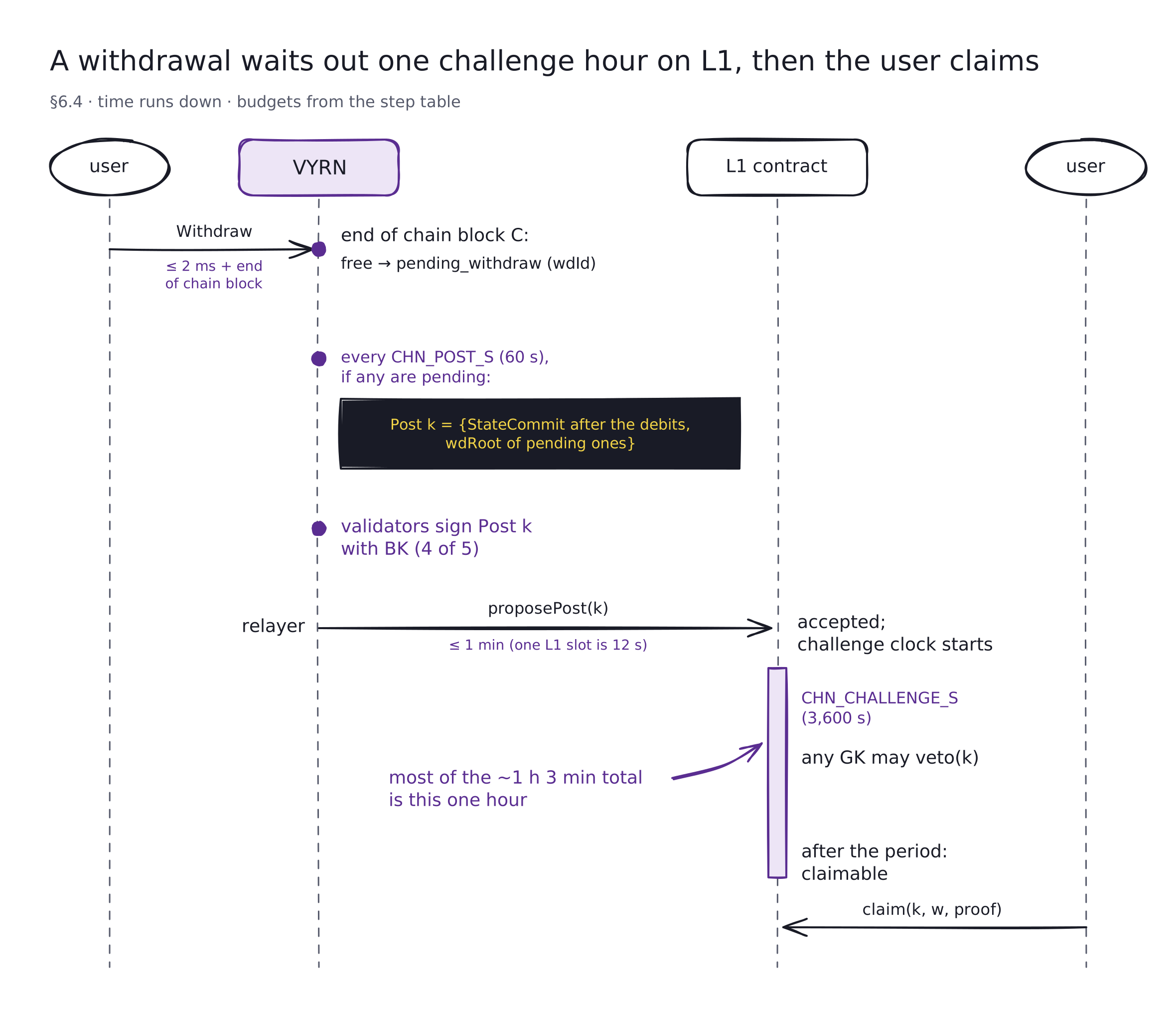
ASCII original
 user          VYRN                               L1 contract                      user
  │ Withdraw ──► end of chain block C:
  │               free → pending_withdraw (wdId)
  │             every CHN_POST_S (60 s), if any are pending:
  │               Post k = {StateCommit after the debits, wdRoot of pending ones}
  │               validators sign Post k with BK (4 of 5)
  │             relayer ─────────── proposePost(k) ──► accepted; challenge clock starts
  │                                                    CHN_CHALLENGE_S (3,600 s)
  │                                                    any GK may veto(k)
  │                                                    after the period: claimable
  │                                                    claim(k, w, proof) ◄─────────── │
| Step | Time (budget) |
|---|---|
Withdraw included and applied |
≤ 2 ms + end of chain block |
| Included in the next post | ≤ 60 s |
| Post signed by 4 bridge keys and proposed on L1 | ≤ 1 min (one L1 slot is 12 s, vendor) |
| Challenge period | 1 h |
| Claim | one L1 transaction, paid by the user or a relayer |
| Total | about 1 h 3 min |
- A post always checkpoints the full state: its
commitnames aStateCommitwhose SMT already reflects the debits of its withdrawals. That ordering is what makes the escape hatch (§6.6) double-spend free. - If no withdrawal is pending, a post is still made every
CHN_CHECKPOINT_S(3,600 s), so that the L1 contract always holds a balance root less than an hour old. CancelWithdrawworks until the withdrawal is in a post that the validators signed.- The contract limits the outflow per token to
CHN_BRIDGE_DAILY_CAP_BPS(1,000 bps, 10%) of its balance per rolling 24 h. Claims above the cap wait. This bounds the loss if 4 bridge keys are stolen and every guardian fails to react. - An L1 post costs about 150k gas (budget estimate). At one post per minute that is about 216M gas
per day, a few ETH at typical gas prices.
CHN_POST_Sis a governance parameter.
6.5 Challenge and veto#
Any one guardian key can veto a post during its challenge period. A veto delays a post and never destroys it:
- The vetoed post's withdrawals stay pending in state.
- The same post can be proposed again with 5-of-5 bridge signatures at once, or with 4-of-5 after
CHN_VETO_OVERRIDE_S(72 h). A post accepted by override cannot be vetoed again. - Later posts are not blocked by a vetoed one. Each post's claims are independent.
Who vetoes: each operator's guardian process recomputes every proposed post from its own validator's
state. It vetoes when the post differs from its own computation. A post that 4 bridge keys signed but
that differs from the chain's post with the same number is BadPost evidence (§8.2).
6.6 Pause and escape#
| Event | L1 contract | VYRN |
|---|---|---|
pause() by any one guardian |
Rejects deposits, proposals and claims | Trading continues. Withdraw is accepted and stays pending. Deposits finalized before the pause are still credited. Validators stop signing posts. |
unpause by 4 bridge keys |
Effective 24 h after the call | Posts resume; pending withdrawals go into the next post |
No post accepted for CHN_ESCAPE_S (14 days) |
Anyone may call enterEscape(); escape is permanent |
The bridge is dead. Governance must deploy a new one. |
Escape mode. The contract takes the last accepted post's smtRoot as final. A user calls
escapeClaim with its BalanceLeaf (§9.3) and an SMT proof. The contract pays
free + alloc_sum + transit + pending_unposted of that leaf to the leaf's exit_address.
Withdrawals in accepted posts stay claimable as usual, and the post's state already excludes them,
so nothing is paid twice. Deposits with a nonce above the post's depositNonce are refunded to
their sender with refundDeposit. Escape proofs use BLAKE3 in Solidity, about 1M gas per claim
(budget estimate, §19). Escape is a last resort, and its cost is acceptable for that.
Why one guardian can pause: a pause stops theft at the cost of liveness, and liveness has a 14-day backstop. A byzantine guardian that pauses repeatedly is removed by signer rotation.
6.7 Bridge key rotation#
- Governance approves the new signer set (
SetParamon the signer table, loosening, 72 h). - At activation, 4 of the 5 current bridge keys sign
rotateSigners(new set, rotation_no). - The contract queues the rotation for
CHN_BRIDGE_ROTATE_S(72 h). Any guardian can veto it in that time, and a veto can be overridden with 5-of-5. - After activation, posts need signatures from the new set. Posts accepted earlier stay claimable.
The L1 delay exists on its own because the contract cannot see VYRN's governance. If 4 bridge keys are stolen, the thief can try to rotate to its own keys, and the 72 h window lets guardians veto and pause. Guardian keys rotate by the same flow.
7. Forced inclusion#
7.1 Path#
A client that the sequencer ignores sends its packet as a ForcedPacket item on the transaction
path (§4.4) to the validator boxes of all 4 committee members other than s. Each relays it to the
live sequencer as a hint. The next leader includes the item in its chain block. An honest
sequencer applies the forced packet at the earlier of two points:
- the hint: the control core verifies the session's Ed25519 signature (~40 µs, off the 1 µs
path) and injects the packet into its lane as a packet, logged as an
ItemRecord; - the boundary: the first block boundary after the chain block that includes it is notarized (01 §14.9, §4.6).
Its deadline is act(C, b). A sequencer that misses it is censoring: voters fail check 4, treat
it as silent, and submit Censorship evidence (§8.2).
7.2 Format#
ForcedPacket {                         // TxEnvelope kind 0x10, signer = Session(σ)
    packet: [u8; ≤ MAX_REQ_PAYLOAD],   // the request packet of 01 §6.1; tags may be zero
}
// envelope.nonce = packet.pkt_seq; envelope.sig = Ed25519 by σ.sign_pub over
//   derive_key("vyrn      v1 tx", envelope without sig)
A forced packet is authenticated by the session's Ed25519 signature, not by its tags. Why: with
tags alone, one byzantine committee member (which knows K_com) could forge a forced packet, and
only the sequencer could check tag_seq, so a byzantine sequencer could reject an honest forced
packet by claiming a bad tag_seq. A signature is checkable by everyone and settles both cases.
The forced path is low-rate, so the signature cost is small: 50k forced packets per second cost
about 1 core per validator (budget).
7.3 Positioning and deduplication#
- The packet applies at the hint or at the first boundary after C is notarized, and never after
act(C, b)(§4.6, §7.1). Its position is logged, so replay applies it at the same op. The signature makes it valid in any position, and the members hold its bytes from the client, so it needs neither a final schedule nor the data tier. - If the lane has already applied
(σ, pkt_seq)on the fast path, the forced copy is a no-op and the lane records it as a duplicate. - If
pkt_seqis beyond a gap, the lane applies it and marks the gap entry as filled. The fast path rules for gaps are in04-protocol.md, which must accept a forced packet out of order (§16). - Responses go to the session as normal response packets, with
echo_pkt = pkt_seq. - A sequencer that has not applied a forced packet by
act(C, b)produces a book block that fails voter check 4 (§4.3). It gets no votes, the voters treat it as silent, and failover replaces it. The new sequencer applies the packet in its first block.
7.4 The censorship bound#
With f = 1 the fault is either the sequencer or someone else, never both (bounds are budgets, hop δ = 0.8 ms, a view ≤ 1.6 ms):
| Case | Path | Bound |
|---|---|---|
| Honest sequencer, one other fault | client → members δ, hint → sequencer δ, verify 0.04; then the block's finality ≤ 8.11 (§4.8) | final ≤ 9.75 ms after send |
| Honest sequencer, every hint lost (outside the model: 4 members relay it) | to leaders δ, proposal ≤ 1.6, notarized +1.65, boundary ≤ 1, finality 5.31 | final ≤ 10.4 ms |
| Censoring sequencer (the fault) | included ≤ 2.4 ms (every leader is honest); deadline act(C, b) ≤ 10.4 ms; then failover and finality |
final ≤ ~10.4 + FAILOVER_TARGET_MS + FINALITY_MAX_MS ≈ 41 ms |
So under an honest sequencer a forced packet is final ≤ 10 ms after it is sent, like any order
(01 §14.9): the hint path is 9.75 ms, and only a loss of every hint, which is outside the model,
leaves the slower boundary path. A censoring sequencer can keep a packet out of the log for ≤ 2.4 ms, which is the bound
in DESIGN.md §7. It can delay execution only by getting itself replaced, and the packet is final
within FAILOVER_TARGET_MS + FINALITY_MAX_MS of the deadline (01 §14.0 fact 3).
7.5 Limits#
CHN_FORCED_RATE (100 packets per second per session) and CHN_FEE_FORCED (0.01 USDC per packet)
make the forced path useless for normal trading and cheap as an escape. A validator checks the
session, the rate and the fee before it verifies the signature, so junk costs it only those cheap
checks.
8. Slashing and evidence#
8.1 Processing#
Anyone submits an Evidence item. Its handling is automatic:
- The state machine verifies the evidence against chain state: Ed25519 verification for votes and
seq_sigs,ecrecoverfor bridge signatures, recomputation forWrongExclusionandBadPost. Each check is deterministic. - Evidence older than
CHN_EVIDENCE_EPOCHS(42 epochs, 14 days) is rejected. Duplicate evidence (the same fault by the same operator) is a no-op. - The slash applies at the end of the including chain block: bond balance moves to the insurance
fund, and
CHN_REPORTER_SHARE(5%) goes to the submitting account. A jail takes effect at the next boundary (§4.6), and the operator leaves the leader schedule and the sequencer schedule.
8.2 Evidence formats#
Evidence =
  | SeqEquivocation { a: BlockHeader, b: BlockHeader }
        // same book and height, different hashes, both seq_sig valid under one SK
  | DoubleVote { a: VoteMsg + sig, b: VoteMsg + sig }
        // same operator and (epoch, view); Notarize/Notarize or Finalize/Finalize with
        // different blocks, or Finalize/Nullify. Keys may be any two of the operator's VKs.
  | FenceViolation { handoff: HandoffRecord + cert, h: BlockHeader }
        // h.epoch = handoff.epoch and h.height > handoff.last_height, seq_sig valid
  | HandoffWithheld { epoch: Epoch, attests: [HandoffTimeout + sig; 4] }          // §8.3
  | CrossHomeVote { v: VoteMsg + sig, cert: NodeCert }
        // valid under a VK of a home that is not eligible for v.epoch
  | DoubleCommit { a: CommitVote, b: CommitVote }
        // same operator, same chain_id and second, different StateCommit hashes
  | BadPost { p: Post, sig: [u8; 65] }
        // valid BK signature on a Post whose content differs from the chain's post p.postNo
  | Censorship { block: ChainHeader + finalization cert, item: u16 + proof,
                 h: BlockHeader, lane_records: [ItemRecord] + proof }
        // a lane item of a final chain block C is absent from the book blocks (lastb(C), h],
        // h = act(C, b) after carries, all signed by one SK; proofs cover each block's
        // item section of that lane. Censoring is not a crash, so it jails.
  | WrongExclusion { block: ChainHeader + finalization cert, list: ExclusionList + proof,
                     rec: u32, packet: [u8; ≤ 192], disclosure: KeyDisclosure }
        // the disclosed key gives a verdict that differs from the certified list
8.3 The withheld handoff#
At the epoch's end time T, the sequencer must stop and emit its HandoffRecord (08-epochs.md).
If no HandoffRecord has reached a committee member by T + CHN_HANDOFF_DEADLINE_MS (10 ms), the
member signs HandoffTimeout { epoch, last_final_height }. Four such signatures are a quorum fact
that the handoff was withheld. The committee then builds and certifies the HandoffRecord from the
last finalized book block itself, so the next home starts without the sequencer. Absence cannot be
proved by one signature, so this is the one fault proved by quorum attestation. It is slashed
lightly, because an honest crash at T produces the same attestations.
8.4 Amounts#
| Fault | Slash (budget, governance parameter) | Jail |
|---|---|---|
SeqEquivocation |
100% of the sequencer bond + 50% of the operator bond | yes |
FenceViolation |
100% of the sequencer bond | yes |
DoubleVote |
50% of the operator bond | yes |
WrongExclusion |
50% of the operator bond of each operator whose Finalize is in the certificate, except the sequencing operator |
yes |
BadPost |
100% of the operator bond | yes |
DoubleCommit |
25% of the operator bond | yes |
Censorship |
10% of the sequencer bond | yes |
HandoffWithheld |
2% of the sequencer bond | no |
CrossHomeVote |
1% of the operator bond | no |
Faults that can fork the chain or steal funds take most of a bond and jail the operator. Faults that
an honest crash can cause take a small amount and do not jail. SeqEquivocation takes both bonds
because one equivocation can make different clients see different fills.
9. State commitments#
9.1 Summary#
| Commitment | Cadence | Structure | Lets you | Cost (budget) |
|---|---|---|---|---|
| Log hash chain | every chain block | BLAKE3 chain over headers and roots | check that two copies of the log are identical | ~5 cores per validator box, mostly per-packet hashes |
| Balance SMT | every 1 s | sparse Merkle tree, BLAKE3, depth 256 | prove one balance to a light client | ~2 cores on the commit box |
| Order LtHash | every 1 s | lattice hash of the resting-order set | check a snapshot of the book; detect divergence | ~6 cores on the commit box |
StateCommit + CommitCert |
every 1 s | one record, 4 Ed25519 signatures | anchor all three for light clients and L1 | 1 signature per second per operator |
9.2 The log hash chain#
log_hash(H) = BLAKE3(derive_key("vyrn      v1 log",
                log_hash(H − 1) ‖ books_root(H) ‖ items_root(H) ‖ excl_root(H)))
log_hash(0) = genesis_hash
books_root covers every BlockHeader, and each header covers its order_root and data_root
(01 §6.6). So log_hash(H) commits to every order-stream record, every payload, every item and every
exclusion up to chain height H. The HandoffRecord.log_hash is the log_hash of the last chain
block of the epoch.
| Work per validator box at peak | Volume (budget) | Cores (budget) |
|---|---|---|
pkt_hash of every payload, 16-way SIMD BLAKE3 |
145.5M packets/s (WL-REF), ≤ 176 B each |
~3 |
data_root Merkle over packet hashes |
~145k leaves per book block | ~1 |
order_root over the encoded order stream |
≤ 25 Gbps ≈ 3.1 GB/s | ~1 |
| Total | ~5 (DESIGN.md §7 has ~4 at 100M packets/s) |
9.3 The balance SMT#
A binary sparse Merkle tree of depth 256. A key is a BLAKE3 hash, so leaves spread evenly.
| Leaf | Key | Value |
|---|---|---|
AccountLeaf |
BLAKE3(0x01 ‖ le(account)) |
owner kind and bytes, nonce, exit_address |
BalanceLeaf |
BLAKE3(0x02 ‖ le(account) ‖ le(asset)) |
free, alloc_sum, transit, pending_unposted, pending_posted (u128 each) |
AllocLeaf |
BLAKE3(0x03 ‖ le(account) ‖ le(book) ‖ le(asset)) |
available (i128, negative for bust debt), reserved (u128) |
SessionLeaf |
BLAKE3(0x04 ‖ le(session)) |
account, status, bond, epochs, BLAKE3(anchors) |
OperatorLeaf |
BLAKE3(0x05 ‖ [op]) |
bonds, jail flag, NodeCert hashes |
leaf_hash = BLAKE3(derive_key("vyrn      v1 smt leaf", key ‖ encode(value)))
node_hash = BLAKE3(derive_key("vyrn      v1 smt node", left ‖ right))
E[0] = [0; 32];  E[d + 1] = node_hash(E[d], E[d])        // the empty subtree of height d
proof = { bitmap: [u8; 32], siblings: [Hash] }           // bit d set ⇔ sibling at depth d not empty
With 100M leaves a proof has about 27 non-empty siblings, about 900 bytes (budget).
Which state a commit covers. Commit k covers the state at the end of chain block H = k ×
CHN_COMMIT_BLOCKS (1,000). Book-level values are those after the last book block included at or
before H, with every item applied by then. That is a pure function of the finalized chain prefix.
Net diff. The replay engine on the validator box marks every allocation it changes as dirty. At commit k it sends the dirty leaves to the commit box and clears the marks. So the work per second is the number of distinct changed leaves, not the number of fills. An account that trades a million times in a second costs 2 leaf updates. Budget: 1M distinct changed leaves per second, about 20M node hashes, about 2 cores.
9.4 The order LtHash#
elem(o)  = encode { book: u16, lane: u8, handle: u32, account: u32, side: u8,
                    tick: u32, open_qty: u32, rx_ts: u64 }                       // 28 bytes
v(o)     = BLAKE3_XOF(derive_key("vyrn      v1 lthash", elem(o)))[0..2048] as [u16; 1024] (LE)
L(S)     = Σ_{o ∈ S} v(o)   componentwise mod 2^16                               // S = resting set
L_k      = L_{k−1} + Σ_{o ∈ S_k \ S_{k−1}} v(o) − Σ_{o ∈ S_{k−1} \ S_k} v(o)
digest_k = BLAKE3(derive_key("vyrn      v1 lthash digest", L_k as bytes))
- An order whose
open_qtychanges is a different element: the commit removes the old element and adds the new one. - Orders that live and die within one second never touch
L. Each resting order carries acommittedflag and its committed quantity. At commit k the lane walks only the orders it touched since commit k − 1: new and still resting → add; committed and now gone → remove; committed and changed → remove old, add new; new and already gone → nothing. - Addition commutes, so each lane's diff is summed separately and the commit box adds the 50 lane sums. The work parallelizes across any number of cores.
- Cost (budget): one
v(o)is a 2 KB XOF output, about 0.4 µs; the add is about 30 ns. Assume a net diff of 10M elements per second at peak, about 1% of joins surviving a second boundary, counted twice for add and remove. That is about 4 core-seconds per second, so the budget is 6 cores. Benchmark B-CHN-2 measures the real net-diff rate and the per-element cost. - Security: 1024 × u16 is the parameter set that Solana adopted for its accounts lattice hash. Its collision resistance rests on the hardness of a lattice problem (SIS). We take that as a literature claim, not as our result.
- Limits: an LtHash proves no single order. It proves that a whole snapshot of the book is the one the validators hold, and it detects any divergence between validators within one second. To check one order, replay the public log.
- The full 2 KB vector
L_kis published in the commitment stream (§11.4), so a node that syncs can continue the sum without rebuilding it.
9.5 StateCommit and its signatures#
StateCommit {
    ctx: "vyrn      v1 commit", chain_id: u32, epoch: Epoch,
    height: Height,              // chain height H = second × CHN_COMMIT_BLOCKS
    second: u64,
    log_hash: Hash, smt_root: Hash, orders_lthash: Hash, orders_count: u64,
    books: [(BookId, Height)],   // the last book height of each book covered
    params_hash: Hash,           // hash of the ParamSet in force
    keys_hash: Hash,             // hash of EpochKeys(epoch), §10.2
    prev: Hash,                  // hash of StateCommit for second − 1
}
CommitVote { commit: Hash, op: OpIdx, sig: Ed25519 by VK(op, home(epoch))
             over derive_key("vyrn      v1 commit", encode(StateCommit)) }
CommitCert { commit: StateCommit, sigs: [(OpIdx, [u8; 64]); ≥ 4] }
- Every operator's commit box computes the
StateCommitfrom its own validator box's replay. The validator box signs it with the vote key, soINV-CHN-SPLITholds: the Vx operators' commits come from the Vx replay. - Commit votes are gossiped to the committee. The next leader that holds 4 matching votes includes
the
CommitCertas an item (0x24). Budget: theCommitCertis on chain withinCHN_COMMIT_LAG_MS(500 ms) after H. - Commits are decoupled from blocks. No vote on a chain block waits for a commit, so a slow commit box never stalls consensus or trading.
- Two commit votes by one operator for one second with different hashes are
DoubleCommit(§8). - If the commit votes for a second do not reach 4 matching values within 10 s, at least one
validator computes different state: a determinism bug. Every operator's node raises its highest
alert, and
11-build.mdreplays the second invyrn-simagainst the Vx oracle. The chain keeps finalizing order, because order and state are separate.
9.6 The commit box#
| Work | Cores (budget) |
|---|---|
| SMT updates | 2 |
| LtHash | 6 |
| L1 execution client and consensus client | 8, plus 4 TB NVMe (vendor guidance for L1 clients) |
| Archive writer, snapshots | 4 |
| Public RPC and light-client proofs | 4 |
| Total | ~24, so any 32-core COTS server |
10. Light clients#
10.1 What a light client trusts#
A light client trusts genesis_hash and, after a long absence, one recent checkpoint (§10.5). It
trusts no RPC server. Every RPC answer comes with a proof.
10.2 The validator-set history#
EpochKeys(e) = { epoch: e, home: home(e), vote_keys: [[u8; 32]; 5],   // VK(i, home(e))
                 seq_keys: [[u8; 32]; 5],                              // SK(i, home(e))
                 jailed: u8 bitmap, seq_op: OpIdx }
keys_hash(e) = BLAKE3(derive_key("vyrn      v1 epochkeys", encode(EpochKeys(e))))
The HandoffRecord of epoch e carries next_keys = keys_hash(e + 1) (Request to 01, §18), and the
committee of e certifies it. So the handoff certificates form a chain from genesis:
fn follow_keys(genesis: &GenesisRecord, rpc: &impl Rpc, target: Epoch) -> EpochKeys {
    let mut keys = genesis.epoch_keys(0);
    for e in 0..target {
        let (rec, cert) = rpc.handoff(e);                 // HandoffRecord(e) + 4 signatures
        assert!(rec.epoch == e && cert.verify(&keys.vote_keys, Q_CHAIN));
        let next = rpc.epoch_keys(e + 1);
        assert!(keys_hash(&next) == rec.next_keys);
        keys = next;
    }
    keys
}
That is 3 handoffs per day, about 1,100 per year, each 4 Ed25519 verifications: well under a second
of CPU for a year of history (budget). A failover inside an epoch changes the sequencer, not the
vote keys, and EpochKeys lists the seq keys of all 5 operators, so failovers need no extra record.
10.3 Verifying a block or a transaction#
- A chain block: the
ChainHeaderand its finalization certificate: 4Finalizevotes for(epoch, view, block)underEpochKeys(epoch).vote_keys. - A transaction receipt:
Receipt { item_hash, height, index, result: u16, proof }, whereproofis the Merkle path from the item toitems_root. The result code says what the item did at the end of its chain block; a lane result comes in a second receipt for the book block in which it applied.
10.4 Verifying a balance#
fn verify_balance(keys: &EpochKeys, cc: &CommitCert, leaf: &BalanceLeaf, p: &SmtProof) -> bool {
    cc.commit.epoch == keys.epoch
        && cc.commit.keys_hash == keys_hash(keys)
        && cc.verify(&keys.vote_keys, Q_CHAIN)                       // 4 distinct operators
        && smt_verify(cc.commit.smt_root, leaf.key(), leaf.encode(), p)
}
The balance is at most 1 s plus CHN_COMMIT_LAG_MS old. A light client that needs the balance at
an exact block replays the public log from the nearest commit.
10.5 Weak subjectivity#
Once an operator's bond has unbonded, its old keys cost it nothing, and a set of old keys could sign
a fake history (a long-range attack). So a light client that has been offline for more than
CHN_WS_EPOCHS (42 epochs, 14 days, shorter than the 21-day unbonding) must re-anchor from a recent
checkpoint before it trusts a new history. The natural checkpoint is the L1 contract: its latest
accepted post names a StateCommit hash, and reading it needs only an L1 light client.
11. Data availability and sync#
11.1 What every validator stores#
| Data | Rate at peak (budget) | Average at 10% load |
|---|---|---|
| Payloads (data) | ~30 GB/s (242 Gbps, 02 §5.2) | ~3.0 GB/s |
| Order stream | ~3.1 GB/s | ~0.31 GB/s |
| Chain blocks, certificates, items, exclusion lists | < 10 MB/s | < 1 MB/s |
| Commitment stream, disclosures | < 1 MB/s | < 1 MB/s |
| Total | ~33 GB/s | ~3.3 GB/s ≈ 285 TB/day |
A validator box votes only when it holds every payload a block references (07-replication.md). So
when a block is final, at least 4 operators held all of its data, and at least 3 of them are honest.
11.2 Retention#
- Every node keeps at least 24 h of the full log hot on NVMe.
- Every operator keeps
CHN_HOT_DAYS(7 days) hot in at least 2 of its 3 homes. At the average load that is about 2.0 PB per copy, about 65 drives of 30.72 TB (budget). Two homes per operator survive the loss of one home. - Follower nodes receive the finalized log over the WAN (
08-epochs.md), so all 15 nodes have it.
11.3 Archive#
After 7 days the log moves to archive storage: HDD object storage in colo, or an archive storage
class in a cloud. Payloads are compressed with zstd; benchmark B-CHN-6 measures the ratio. Each
archived segment is named by its chain-height range, and its content is covered by log_hash, so
any copy can be checked against the chain. At least 2 operators, chosen by governance, each keep a
full archive for CHN_ARCHIVE_YEARS (7).
11.4 The public log#
Anyone can replay the chain. The operators publish these streams:
| Stream | Content |
|---|---|
blocks |
chain blocks with headers, finalization certificates, items, exclusion lists |
order |
the order stream of every book block |
data |
every payload |
commits |
every StateCommit, CommitCert and full L_k vector |
disclosures |
every KeyDisclosure |
snapshots |
every snapshot (§11.5) |
They are served from each operator's archive with requester-pays transfer, and as a live finalized
feed about 1 s behind the head from the commit boxes. vyrn-validator --role=replay starts from any
snapshot and reproduces every state byte, every fill and every StateCommit.
11.5 Sync#
- Snapshots: every
CHN_SNAPSHOT_S(3,600 s) at a commit point, and at every epoch boundary. A snapshot is the canonical serialization of chain state and of every book's engine state (lanes, orders, allocations, BBO). Budget: ≤ 40 GB, about 4 s at 100 Gbps. - Checking a snapshot: the node recomputes the SMT root and the LtHash from the snapshot and
compares them with the
CommitCertof that second. A snapshot from any source is then as good as one from the node's own operator. - Catching up: the node replays the finalized log from the snapshot height. Replay must run at
least
CHN_REPLAY_SPEEDUP(2×) the peak live rate (budget), so a 1 h snapshot gap closes within 1 h even at sustained peak. At the average load it closes in minutes. - Recovering after a crash: a node whose gap is inside its local hot log replays from its own write-ahead state. Otherwise it takes a snapshot.
- Where from: first its own operator's nodes in the other homes, then any operator's archive.
- A new validator for a home syncs in the home where it will be active, then follows the live log. It must be in sync before its operator's first active epoch there (§2.9).
12. Economics#
12.1 Fees per message class#
The scarce resource is the BBO core: CROSS_CAP is 10M crosses per second, and every improve or
depletion takes BBO_IMPROVE_NS of it. Joins and cancels cost only lane time, which scales with the
number of lanes. So fees follow the BBO core, not the message count (DESIGN.md §3).
| Class | Resource it uses | Default fee (budget, governance parameter) |
|---|---|---|
| Cross (taker fill) | BBO core, BBO_CROSS_NS |
CHN_FEE_TAKER_BPS = 2.0 bps of notional |
| Maker fill | none beyond the cross | CHN_FEE_MAKER_BPS = 0 |
| Improve | BBO core, BBO_IMPROVE_NS |
CHN_FEE_IMPROVE = 10 µUSDC per message |
| Join | lane, LANE_NS_PER_MSG |
CHN_FEE_MSG = 0.1 µUSDC per message |
| Cancel, Reduce, CancelAll | lane | CHN_FEE_MSG per message |
| Replace | lane, plus the BBO core if it improves or crosses | by the class of the new order |
| Heartbeat, ResendReq | lane | 0 within the session rate |
| Message in a busted packet | — | refunded (§5.9) |
| Transaction item | validators | CHN_FEE_TX = 0.01 USDC |
| Forced packet | validators | CHN_FEE_FORCED = 0.01 USDC |
| Session open | validators, lane slot | CHN_FEE_SESSION = 1 USDC, plus the bond |
- The lane classifies every order against its snapshot (01 §1), and replay reproduces that classification, so the fee class of every message is deterministic.
- Fees are charged in the book's quote asset, from the account's allocation in that book. Fill fees
are part of the reserve that an order takes when it enters (01 §12.1). Message fees accrue per
account in the lane and are debited at each commit point. An account that cannot pay its accrued
fees gets
RISK_CREDITon new messages until it allocates more.
12.2 Distribution#
All fees of epoch e go to that epoch's fee pool. At the end of e + 1 (after every block of e is final and the evidence for e has had one epoch to arrive), the pool is split:
| Share | Recipient |
|---|---|
CHN_FEE_INS_SHARE = 10%, until the fund reaches CHN_INS_TARGET |
insurance fund |
CHN_FEE_SEQ_SHARE = 25% |
the sequencing operator(s) of e, pro rata to the book blocks each signed |
| the rest | the 5 operators, pro rata to the chain blocks of e whose finalization certificate contains their signature |
A sequencer that is slashed in e or e + 1 forfeits its share to the insurance fund. Operators earn nothing for epochs in which they only follow. Their follower nodes are a cost of being allowed to sequence and vote in the other homes.
12.3 Costs#
| Item, per node | Colo (reference) | AWS |
|---|---|---|
| Inbound log into the validator box, 33 GB/s peak | flat: metro waves and cross-connects, priced per port per month | cross-AZ transfer at $0.02/GB for both sides together (vendor): about $57k per day at sustained peak, about $5.7k per day at 10% average |
| Log to the 2 follower homes over the WAN | leased waves, flat | inter-region transfer per GB (vendor price needed, §19) |
| Hot storage, 2.0 PB per copy | ~65 NVMe drives (budget) | instance storage or EBS at per-GB-month prices (vendor) |
| Validator box | REF box (01 §10) |
the AWS target (01 §10), one NUMA node |
| Commit box | 32-core COTS server | a 32-vCPU instance |
The traffic cost decides the deployment. At sustained peak, AWS transfer alone is about $21M per validator per year. In colo the same traffic costs a fixed monthly port fee. So the reference chain deployment is colo, and AWS is supported for followers, development and small books (C-ONEBIN).
13. Front-running by the sequencer#
13.1 It cannot be prevented at 1 µs#
The sequencer sees every packet in plaintext before it orders it. Preventing it from acting on that needs either threshold decryption (at least one metro round trip of 0.5–1 ms plus tens of µs of CPU) or commit-reveal (two round trips). Both cost 100 to 1,000 times the 1 µs budget. Detecting it order by order is impossible too: the cut has 100 ns granularity (01 §14.3) and NIC timestamps have jitter, so a single reordering of a few hundred ns looks like normal operation.
What a byzantine sequencer can do: put its own order ahead of a client order it has seen, delay a
client packet by microseconds, and write rx_ts values of its choosing. What it cannot do: change a
client order, forge one, censor beyond §7, or move a boundary.
13.2 Mitigations#
- Rotation. An operator sequences 1 epoch in 5, and every (home, operator) pair once in 5 days (§3.1). A front-running operator gets at most 20% of the flow.
- Bond.
CHN_SEQ_BONDis slashed for every provable fault (§8). Statistical evidence is not proof, so for front-running the bond is what governance can take after a jail and a replacement. - Independent timestamps. A client sends its data copy to a data node of an operator other than the sequencer. Those data nodes timestamp packets with their own PTP-synced NICs. The sequencer cannot change those timestamps.
- Published statistics with fixed definitions (§13.3), so every client can compare sequencers.
13.3 Fill-quality statistics#
Sampling. Each data node of an operator j ≠ s records DataStamp { pkt_hash, data_rx_ts } for a
sample of packets:
K_sample(e, s) = derive_key("vyrn      v1 sample key", G(e, s).private ‖ le(e) ‖ [s])
sampled(p)     = BLAKE3(derive_key("vyrn      v1 sample", K_sample(e, s)) ‖ pkt_hash)[0]
                 < 256 / CHN_FR_SAMPLE                                     // 1 in 64
Only committee members know K_sample during the epoch, so the sequencer cannot treat sampled
packets differently. Members disclose K_sample(e, s) at the end of the epoch, so anyone can check
the sample.
Metrics, per (epoch, home, sequencer), computed by each committee member over its own stamps:
| ID | Metric | Definition |
|---|---|---|
| FQ-1 | Delay skew | δ(p) = seq_rx_ts(p) − data_rx_ts(p) − median δ of p's session in the epoch. SKEW = p99(δ over cross packets) − p99(δ over join packets). An honest sequencer cannot delay by class before it parses, so its SKEW is about 0. Flag above CHN_FR_SKEW_NS (500 ns). |
| FQ-2 | Fast-taker markout | For sessions with ≥ CHN_FR_FAST_FILLS (1,000) taker fills in the epoch: notional-weighted mean of side × (mid at the first step with rx_ts ≥ fill rx_ts + 1 ms − fill price), in ticks. Report the z-score against the trailing 15 epochs of the same home. Flag at z < −3. |
| FQ-3 | Inversion rate | Pairs of crosses from different accounts on the same side, both sampled, both reaching the same best level, where the later-executed one has a data_rx_ts at least CHN_FR_INV_NS (1 µs) earlier. Per million crosses. Flag above 3× the trailing median. |
| FQ-4 | Bust rate | Excluded packets per billion packets, and the time from the second TagFault to the suspension (§5.8). |
Each member publishes SeqStats { epoch, home, seq_op, reporter: OpIdx, fq1..fq4, n_samples }
signed with its node key in the public log, and an item with its hash on chain. FQ-2 and FQ-4
use only certified log data, so every reporter must publish the same values. FQ-1 and FQ-3 use the
reporter's own stamps, so values differ between reporters within sampling error.
Consequence. There is no automatic slash. If at least 2 reporters flag FQ-1 or FQ-3 for one
operator in 3 of the last 5 epochs it sequenced, the other operators are expected to Jail it
(tightening, immediate) and to start its replacement. The rule is published so that clients can
check it was followed.
14. Upgrades#
14.1 Versions#
ProtoVer { major: u16, minor: u16 }. The chain keeps a version table: the state-transition version
in force for each epoch. A version changes only at an epoch boundary, by an Upgrade action, with
the 72 h timelock. release_hash is the BLAKE3 hash of a release manifest that lists the build hashes
of the Rust validator, the Vx validator and vyrn-seq.
14.2 Coordinated activation for both clients#
- Governance approves
Upgrade { proto, release_hash }with anactivationepoch. - Each operator installs the release on every node, and each validator box submits
ReadySignal { proto, client_kind, build_hash }signed by its node key. - At
activation − 1, the state machine checks readiness: at leastQ_CHAIN(4) operators have signaled for their node inhome(activation). If yes, the version table entry is fixed. If no, the activation moves 3 epochs later (the same home, one day on). After 3 moves it is cancelled.
Because Rust validators are 3 operators and the quorum is 4, an upgrade cannot activate unless at
least one Vx operator is ready. So a release that only one client implements cannot take effect,
the same property that CLIENT_SPLIT_CHAIN gives finality.
14.3 The version handshake#
Every p2p connection starts with:
Hello { chain_id: u32, genesis_hash: Hash, op: OpIdx, home: HomeCode, client_kind: u8,
        build_hash: Hash, proto_min: ProtoVer, proto_max: ProtoVer, epoch: Epoch,
        version_table_hash: Hash, sig: Ed25519 by NK }
A node refuses the connection if chain_id or genesis_hash differ, if no version in
[proto_min, proto_max] matches the version in force for the current epoch, or if
version_table_hash differs. The last check catches two nodes that disagree about governance before
they disagree about a block. Client protocol versions on the order path belong to 04-protocol.md.
14.4 History stays replayable#
Every released binary keeps the state-transition code of every earlier version and selects it by
the version table. Replaying epoch e uses version_table[e], so INV-DET holds across upgrades.
14.5 Emergencies#
A fix that does not change the state transition (p2p, DoS, performance) is node-local and needs no
governance. A fix that changes it is an Upgrade with the full timelock. If a bug threatens funds,
the operators use HaltBook or pause() at once (tightening), then ship the fix under the timelock.
No path changes the rules without 72 h of notice.
15. Threat model#
| Attacker | Capability | Defense | Residual risk |
|---|---|---|---|
| Byzantine sequencer | signs two histories | high-water mark; SeqEquivocation slash |
clients that saw the losing history get busted fills until failover |
| Byzantine sequencer | forges a client packet | needs K_com (§5.6) |
none within f = 1 |
| Byzantine sequencer | sends bad-tag_com packets of a client |
busted; the client's bond pays | one bond per victim session; visible in FQ-4 |
| Byzantine sequencer | front-runs | rotation, bond, FQ-1–FQ-3 | up to 20% of flow, until governance acts |
| Byzantine sequencer | censors a client | forced path (§7), deadline, Censorship slash, failover |
≤ 2.4 ms out of the log; final ≤ ~40 ms (FAILOVER_TARGET_MS + FINALITY_MAX_MS after the deadline) |
| Byzantine sequencer | halts without cause | CHN_HALT_GRACE_MS, then silence and failover (§4.6) |
≤ 1 ms of BOOK_HALTED plus the failover |
| Byzantine sequencer | keeps trading after T | fence, FenceViolation, HandoffWithheld |
the next home starts ~10 ms later |
| Byzantine sequencer | ignores TagFaults |
SESSION_DEAD busts everything after |
more busted fills, visible in FQ-4 |
| Byzantine member | wrong exclusion list as leader | members recompute (§5.6) | one nullified view (≤ 2.8 ms), inside the 8 ms gate (§4.8) |
| Byzantine member | double vote | DoubleVote slash, jail |
none for safety |
| Byzantine member | leaks G(e, s) |
needs the sequencer too | none within f = 1 |
| Byzantine member | false TagFault / AnchorFault |
quorum of 2 | none |
| Byzantine member | censors items as leader | next leader includes them | ≤ 1 view |
| Two colluding operators (seq + member) | forge packets | outside the model | trades the honest operators cannot detect live; WrongExclusion after disclosure only if they also sign a wrong list |
| Client | bad tag_com |
exclusion, bust, bond | counterparties keep second-order effects |
| Client | two versions of one packet | pkt_hash mismatch kills the session (07-replication.md) |
none |
| Client | floods the forced path | rate, fee, cheap checks first | none |
| Client | spends proceeds of a busted fill | bust debt, insurance fund | insurance fund loss |
| L1 reorg | undoes a deposit | finalized checkpoints only | requires 1/3 of L1 stake slashed |
| Thief of 4 bridge keys | signs a false post | guardian veto, 1 h challenge, 10% daily cap | up to 10% of TVL per day if every guardian fails |
| Thief of one operator key | governance actions | 4-of-5; the others Jail |
none |
| Lying RPC server | false balance or history | proofs (§10) | none |
| Long-range attacker | fake history from old keys | weak subjectivity, L1 checkpoint | clients that skip re-anchoring |
| Data withholding | blocks replay | votes require all payloads | liveness only |
| Validators stop entirely | funds stuck | escape hatch after 14 days | 14 days of illiquidity |
| Compiler or client bug | wrong state | 3 Rust + 2 Vx; CommitCert divergence alarm |
a halt instead of a fork |
| Jailed operator not replaced | — | — | f = 0 for liveness until replacement |
| Network beyond its delay bound, or > F faults | finality stalls | the gate halts the book after 8 unfinal closed blocks (§4.6) | ≤ 9 ms of issued fills final late, none lost (01 §14.0 fact 3) |
16. Interfaces to other chapters#
| Chapter | This chapter consumes | This chapter provides |
|---|---|---|
| 02 | REQ-CHN-*, REQ-SEC-* |
the mechanisms and numbers those requirements cite; REQ-CHN-12 must read "the gate never binds with ≤ F faults" (B-CHN-3), and 02's CHAIN unfinalized-depth bound must cite D = 8, not 16 |
| 03 | the box roles and core maps | the commit box (§9.6); core budgets for tag_com (4) and hashing (5) on the validator box; each operator's primary data box in its F2–F5 facility and backup in another of F2–F5, never a primary in F1 (§4.8, 01 §14.16); one standby per epoch, the F2 box of next_seq (§3.2) |
| 04 | session protocol, failover notice, gap rules | chain-mode session open (§5.2), key derivation (§5.3), the interval choice (§5.4); 04 must accept a forced packet out of order (§7.3) |
| 05 | lanes, the cut, INV-DET, the fill ring, deadline admission |
ItemRecord, the boundary rule and CHN_ITEM_OPS_PER_BLOCK (§4.6); the gate halt and its Control steps (§4.6); bust ops as net ops (§5.9); dirty marks and LtHash diffs (§9.3, §9.4); session suspension op (§5.8); forced packets injected from the control core (§7.1) |
| 06 | Linux, NIC backends, PTP | none beyond C-UNIX and C-NOCHIP compliance (§1.1) |
| 07 | Simplex, payload availability, the order stream, failover | the ChainBlock and voter checks (§4.3), the custom leader schedule (§4.3), INV-CHN-TXGATE and the halt (§4.6), exclusion lists (§5.7), the log hash (§9.2); 07 sends finalize votes to the live and standby sequencer boxes and counts the gate in closed blocks (07 §6.8); it must home sessions on F2–F5 data boxes (§4.8, 07 §5.1), treat a missed item deadline or an unjustified halt as silence, and finalize the failover seal ≤ 9 ms after the last frame |
| 08 | handoff, HomeOverride, failover detection |
next_keys in HandoffRecord (§10.2), HandoffTimeout (§8.3), sequencer schedule (§3.1) |
| 10 | accounts, lanes per account, risk, fees, market data | allocations, bust debt, fee classes (§12.1), book height in market data (§5.4) |
| 11 | benchmarks, vyrn-sim, the Vx oracle |
B-CHN-1 to B-CHN-6 (§19), the divergence drill (§9.5) |
17. Local definitions#
17.1 Constants#
All values are budgets and governance parameters unless marked otherwise.
| Name | Value | Meaning |
|---|---|---|
FIN_GATE_BLOCKS (D) |
8 (01 §14.9, fixed) | Gate depth in closed blocks; the item deadline is D + 1 blocks after lastb(C) (§4.6) |
CHN_HALT_GRACE_MS |
1 | A halt that outlasts the gate's condition by this much is silence (§4.6) |
CHN_ITEM_OPS_PER_BLOCK |
16 | Item ops per lane per boundary; the rest carry (§4.6) |
CHN_TESLA_PEBBLES |
15 | Traversal state per (session, e, s) on a member (§5.4) |
CHN_KEY_LEAD_EPOCHS |
4 | Lead time of NodeCerts, committee keys and the sequencer schedule |
CHN_SESSION_MAX_EPOCHS |
3 | Longest session lifetime |
CHN_TESLA_BLOCKS |
1,000 | Book blocks per TESLA interval (~1 s) |
CHN_TESLA_N |
28,800 | Intervals per epoch; hash-chain length |
CHN_GOV_TIMELOCK_EPOCHS |
9 | 72 h timelock for loosening actions |
CHN_UNBOND_EPOCHS |
63 | 21 days |
CHN_EVIDENCE_EPOCHS |
42 | 14 days |
CHN_WS_EPOCHS |
42 | Light-client weak-subjectivity period |
CHN_JAIL_REPLACE_EPOCHS |
9 | Time by which a jailed operator's replacement must start |
CHN_OPERATOR_BOND |
20,000,000 USDC | Per operator |
CHN_SEQ_BOND |
10,000,000 USDC | Per sequenced epoch |
CHN_SESSION_BOND_MIN |
1,000 USDC | Floor of the session bond |
CHN_BOND_PER_MSGRATE |
0.01 USDC | Session bond per message per second of rate limit |
CHN_TAGFAULT_QUORUM |
2 | Distinct operators to suspend a session |
CHN_ANCHORFAULT_QUORUM |
2 | Distinct operators to mark NoKey |
CHN_ATTEST_QUORUM |
3 | Distinct operators to credit an L1 event |
CHN_MAX_ITEMS |
500 | Items per chain block |
CHN_MAX_ITEM_BYTES |
262,144 | Item bytes per chain block |
CHN_TX_RATE |
10 | Items per second per signer |
CHN_TX_PORT |
configuration (default 9443) | QUIC port of the transaction path |
CHN_BUST_COMP_BPS |
10 | Bond payout per busted counterparty fill |
CHN_DEBT_GRACE_S |
3,600 | Time to repay a bust debt |
CHN_DISCLOSE_PERIOD_S |
10 | Client disclosure period |
CHN_COMMIT_BLOCKS |
1,000 | Chain blocks per StateCommit |
CHN_COMMIT_LAG_MS |
500 | CommitCert on chain after its second |
CHN_POST_S |
60 | L1 post period when withdrawals are pending |
CHN_CHECKPOINT_S |
3,600 | L1 post period otherwise |
CHN_CHALLENGE_S |
3,600 | Challenge period of a post |
CHN_VETO_OVERRIDE_S |
259,200 | 72 h before a 4-of-5 override of a veto |
CHN_BRIDGE_ROTATE_S |
259,200 | L1 delay of a signer rotation |
CHN_BRIDGE_DAILY_CAP_BPS |
1,000 | Outflow cap per token per 24 h |
CHN_ESCAPE_S |
1,209,600 | 14 days without an accepted post |
CHN_FORCED_RATE |
100 | Forced packets per second per session |
CHN_HANDOFF_DEADLINE_MS |
10 | After T, before HandoffTimeout |
CHN_REPORTER_SHARE |
500 bps | Share of a slash paid to the reporter |
CHN_HOT_DAYS |
7 | Hot log retention per operator |
CHN_ARCHIVE_YEARS |
7 | Archive retention |
CHN_SNAPSHOT_S |
3,600 | Snapshot period |
CHN_REPLAY_SPEEDUP |
2 | Replay rate / peak live rate |
CHN_LTHASH_DIM |
1,024 × u16 | LtHash vector |
CHN_FEE_TAKER_BPS, CHN_FEE_MAKER_BPS |
2.0, 0 | Fill fees |
CHN_FEE_IMPROVE, CHN_FEE_MSG |
10 µUSDC, 0.1 µUSDC | Message fees |
CHN_FEE_TX, CHN_FEE_FORCED, CHN_FEE_SESSION |
0.01, 0.01, 1 USDC | Item fees |
CHN_FEE_INS_SHARE, CHN_FEE_SEQ_SHARE |
10%, 25% | Fee split |
CHN_INS_TARGET |
50,000,000 USDC | Insurance fund target |
CHN_FR_SAMPLE |
64 | 1 in 64 packets stamped by data nodes |
CHN_FR_SKEW_NS, CHN_FR_INV_NS |
500, 1,000 | FQ-1 and FQ-3 thresholds |
CHN_FR_FAST_FILLS |
1,000 | FQ-2 session threshold |
17.2 Types and records#
OpIdx (u8), OwnerKey, OperatorEntry, NodeCert (§2.3), CommitteeKey (§2.4), VoteMsg
(§2.5), GenesisRecord (§2.7), GovAction, GovKind (§2.10), ChainHeader, BookEntry,
ChainBlock (§4.3), TxEnvelope, SignerRef (§4.4), SessionOpen (§5.2), ExclusionList,
ExclEntry (§5.7), TagFault (§5.8), AnchorFault (§5.4), KeyDisclosure (§5.10),
ForcedPacket (§7.2), L1Attest, L1Event (§6.3), Post, Withdrawal (§6.2), Evidence
(§8.2), HandoffTimeout (§8.3), StateCommit, CommitVote, CommitCert (§9.5), the SMT leaves
(§9.3), EpochKeys (§10.2), Receipt (§10.3), DataStamp, SeqStats (§13.3), ProtoVer,
ReadySignal, Hello (§14).
One new order-stream record, logged by the lane at the op where it applies something that did not arrive as a packet:
ItemRecord { lane: LaneId, kind: u8,          // 1 item, 2 bust op, 3 suspension, 4 forced hint
             chain_height: Height,            // the chain block that scheduled it; 0 for a hint
             index: u16,                      // item index, or exclusion entry index
             lane_seq: LaneSeq, result: u16 } // 0 applied; otherwise a reject reason (01 §6.5, §14.10)
The gate uses StepKind::Control (01 §14.10) with sub-code 1 halt and 2 gate open (§4.6).
The Bust record (0x87, 01 §14.10) has the Fill layout: type, index = 0xFF, liq, handle, tick, qty, where qty is the reversed quantity of the original fill.
17.3 Derivation and signing contexts#
| Context | Used for |
|---|---|
"vyrn v1 session" |
K_seq, K_out (01 §4) |
"vyrn v1 kcom head", "vyrn v1 kcom" |
TESLA chain head; K_com per interval |
"vyrn v1 gkey wrap" |
Transport of committee private keys |
"vyrn v1 sample key", "vyrn v1 sample" |
K_sample; the FQ sample predicate |
"vyrn v1 vote", "vyrn v1 commit", "vyrn v1 seqsig" |
Consensus votes, commit votes, seq_sig |
"vyrn v1 nodecert", "vyrn v1 gov", "vyrn v1 tx" |
Certificates, governance, items |
"vyrn v1 genesis", "vyrn v1 log", "vyrn v1 epochkeys" |
Genesis hash, log hash, key-table hash |
"vyrn v1 smt leaf", "vyrn v1 smt node" |
SMT hashing |
"vyrn v1 lthash", "vyrn v1 lthash digest" |
LtHash element and digest |
17.4 Invariants#
| Name | Statement |
|---|---|
INV-CHN-SPLIT |
An operator's consensus and commit votes are cast by its validator box, which runs its client kind, never by its sequencer box. No sequencer box, live or standby, holds a G private half (01 §14.4). |
INV-CHN-ONEVOTE |
Per (epoch, view), an operator signs at most one Notarize, at most one Finalize, and never a Finalize and a Nullify. |
INV-CHN-KEYSPLIT |
No operator other than s can compute K_seq(e, s); s cannot compute K_com(e, s, ·) before its disclosure. |
INV-CHN-TXGATE |
The sequencer never runs more than D = 8 closed blocks ahead of finality: it applies no op of book block h until it holds a finalization that covers book block h − D − 1, and halts until then (01 §14.9, 07 §6.8). |
INV-CHN-EXCL |
An exclusion list is a pure function of chain state, the book block and its payloads. |
INV-CHN-NOMINT |
Per asset, total state balances equal credited deposits minus withdrawals in posts. Only a credited deposit creates an asset in state. |
18. Requests to 01#
- §4,
K_com: derive it via X25519 with the per-epoch committee keyG(e, s)(§2.4), not with each validator's static key, so that all 4 holders get one key. Add the contexts of §17.3. - Resolved by 01 §14.11: keccak256 and secp256k1 EIP-712 only for the parts that face L1.
- §4, session open: the session also registers an Ed25519 session signing key (
sign_pub), used by forced packets and small transactions (§5.2, §7.2). - §6.6,
HandoffRecord: addnext_keys: Hash=keys_hash(e + 1)(§10.2). - §6.6: state that
BlockHeader.heightis a per-book height; addChainHeader(§4.3) andItemRecord(§17.2) to the order-stream records. - Resolved by 01 §14.10:
0x87 Bust. Remaining: copy its layout (§17.2) into §6.4. CHN_TX_DELAY_BLOCKSresolved by 01 §14.9 asFIN_GATE_BLOCKS= 8. Remaining: promoteCHN_TESLA_BLOCKS, which 04 and 07 depend on.- §3: add the type
OpIdx(u8). INV-CHN-KEYSPLITresolved by §14.11;INV-CHN-SPLITandINV-CHN-TXGATEin substance by §14.4 and §14.9. Remaining: list both by name in §7, with theG-key rule ofINV-CHN-SPLIT.- §1: add the terms operator, node (one operator's boxes in one home), committee, chain block, book height, chain height and bust.
- §14.9: its last bullet still says
FINALITY_P99_MS; it should sayFINALITY_MAX_MS, the name §5 now uses. - §6.5: fix the
detailofBOOK_HALTED: 1 = chain gate (§4.6), 2 =HaltBook. Fix theControlsub-codes 1 halt and 2 gate open with §14.10'sStepKind::Control. - §14.9: state that
FIN_GATE_BLOCKScounts closed blocks (block h + 9 opens only when h is final) and that an item's deadline islastb(C) + FIN_GATE_BLOCKS + 1. With §14.16's data home outside F1, the one-fault worst case is 8.11 ms from block start (§4.8), past the 8.00 ms that the open-block count allows; 07 §6.8 already needs the closed count for BASE. - Resolved by 01 §14.16: the data home. 09 places each operator's primary data box in its F2–F5 facility (§4.8).
19. Open questions#
| # | Question | Owner | Settled by |
|---|---|---|---|
| 1 | Does one REF box hold replay plus tag_com (4 cores) plus hashing (5 cores) plus the TESLA traversal (§5.4)? Is 20 µs the right Ed25519 planning figure on REF? |
03 | B-CHN-1: validator box at WL-REF (145.5M packets/s) with tags and hashes on |
| 2 | The real net-diff rate of resting orders per second, and the LtHash cost per element with AVX-512 | 09, 11 | B-CHN-2: LtHash workers on a recorded quote-driven flow |
| 3 | D = 8 is fixed (01 §14.9). Does the one-fault worst case stay ≤ 9 ms from block start in the real metro, with data homes in F2–F5? The budget is 8.11 ms, margin 0.89 ms (§4.8). | 07, 03 | B-CHN-3: 24 h in a 5-facility metro at WL-REF, with an injected leader fault and a data box failure; the gate never binds |
| 4 | Can Commonware Simplex take a custom leader function (committee minus the sequencing operator) and one instance per epoch? | 07 | A vyrn-sim test with the leader function and a failover |
| 5 | Gas of BLAKE3 SMT proofs in Solidity for escapeClaim |
09 | B-CHN-4: Foundry gas report of escapeClaim with a 27-sibling proof |
| 6 | Frequency of bust debt, and whether CHN_INS_TARGET covers the worst day |
10 | vyrn-sim with adversarial clients sending bad tag_com into fast counterparties |
| 7 | Inter-region transfer price for follower homes (AWS) and transoceanic wave prices (colo) | 08 | Vendor quotes recorded in 08 |
| 8 | zstd ratio of payloads in the archive | 11 | B-CHN-6: compress one recorded hour |
| 9 | False-positive rate of FQ-1–FQ-3 with an honest sequencer, and detection power against a simulated front-runner | 11 | B-CHN-5: vyrn-sim with an injected 300 ns front-running strategy |
| 10 | The SMT and LtHash code on the commit box is Rust for every operator. Is that a common-mode risk that needs a Vx implementation? | 11 | Review after B-CHN-2; diff test of both if built |
| 11 | How many BUSY sheds do item ops at block boundaries cause, and is CHN_ITEM_OPS_PER_BLOCK = 16 right? |
05 | B3 with a bust over 10k accounts and 500 items per chain block |