04. Client protocol: sessions, packets, messages, responses, reliability, rate limits
Draft 0.2, 2026-11-13. Normative. The byte layouts are in 01-conventions.md §6 and this chapter
does not change them. This chapter gives their semantics, the state machines on both sides, the
order of checks, and the test vectors. Local names use the prefix PROTO_. 01 §14 is binding
here: where this chapter and 01 §14 differ, 01 §14 wins.
The latency contract, from the client's side (01 §14.0, REQ-LAT-1). Every accepted packet of
1 to 10 messages gets the first record of every message, at every index 0–9 and of every type,
within LAT_MAX_NS = 1 µs from its first bit in. This is a maximum, not a percentile, and it has
no rate, size or position condition. A packet that the exchange cannot serve in time gets
Reject BUSY within the same 1 µs (§3.5). A packet that is the session's next valid packet has no
third outcome. The only window without a 1 µs answer is the handoff window of 01 §14.0 item 2
(H6). On AWS the 1 µs is measured inside the instance (01 §14.0 item 1).
0. Scope and constraints#
This chapter covers the order-entry path between a client and the home that runs the book:
- request packets from a client to the sequencer and to the data tier;
- response packets from the sequencer (and from the recovery service) to the client;
- the session life cycle, the keys, the admin channel that opens a BASE-mode session;
- reliability across loss, failover and epoch handoff;
- rate limits and the message fee classes.
It does not cover market data or drop copy (10-accounts-risk-md.md), the order stream between
the sequencer and the replicas (07-replication.md), or the on-chain session transaction
(09-chain.md).
How the protocol meets the hard constraints:
| Constraint | How |
|---|---|
| C-UNIX | The client needs only a Unix UDP socket. The exchange side runs on ef_vi, DPDK or kernel UDP (06-platform.md). The admin channel is TLS 1.3 over TCP on any Unix. |
| C-NOCHIP | Every check in §3 runs on a lane core. SipHash-2-4 is plain 64-bit integer code. Edge filtering (§3.4) uses the fixed-function ACLs and policers of a merchant switch. Nothing is programmed into a switch or NIC. |
| C-COTS | IPv4 and UDP, 1500-byte MTU, no jumbo frames, no NIC feature beyond flow steering on the UDP destination port and RX hardware timestamps. |
| C-ONEBIN | The protocol is the same on REF, CONSUMER, AWS and DEV. Only the endpoint list in the key bundle (§4.4) differs. |
1. Decisions at a glance#
| # | Decision | Reason (section) |
|---|---|---|
| P1 | UDP over IPv4, one 16-byte header, up to 10 fixed 16-byte messages, two tags. | Datagram boundaries carry the MAC and the message count. The protocol needs its own resend for failover anyway, so TCP's reliability buys nothing (§2.1). |
| P2 | UDP destination port = PROTO_LANE_PORT_BASE + LaneId. |
The NIC steers by port, so a packet lands on its lane with no software hop (§2.2). |
| P3 | Every packet is sent twice with identical logical content: to the sequencer and to one data node. | The sequencer sends only the order. Replicas get payloads from the data tier (§2.4). |
| P4 | The cheapest checks run first. No SipHash runs for an unbound source address. | A spoofed flood costs ≤ 5 ns per packet (budget) (§3). |
| P5 | pkt_seq is gapless and the sequencer accepts only expected. A gap is answered with BAD_SEQ and the client goes back to expected (go-back-N). |
No reorder buffer in the lane. Acceptance is a pure function of logged packets (§5.1). |
| P6 | resp_seq has exactly one allocator per session: the session's lane. The TX cores (A, B, C on CCD 0, 01 §14.17.3) send taker records under a resp_seq the lane reserved, and maker fills from a 16-number maker range the lane reserves ahead (01 §14.14). resp_seq = 0 marks an out-of-stream response. |
One writer per field (INV-WRITER); taker and maker fills both leave within 1 µs from CCD 0 (§7.1). |
| P7 | Every accepted packet gets at least one in-stream record with echo_pkt = pkt_seq. |
The client always learns that a packet was accepted (rule R-ANSWER, §7.2). |
| P8 | Each lane keeps a RESP_HOT_RING_BYTES = 4 GiB byte ring of its sessions' responses (~8 s). The recovery service on one replica per home keeps RESP_RETAIN_PKTS per session. RESEND_GONE only when both dropped it. |
65,536 packets for every session do not fit in a lane's memory (§5.4, 01 §14.6). |
| P11 | Deadline admission: a packet that cannot be answered in time gets Reject BUSY within 1 µs and is not applied. |
The 1 µs is a maximum (§3.5, 01 §14.1). |
| P13 | Two lane classes (01 §14.15). A client on a dedicated lane paces its packets (LANE_PACE, §3.6) and then never waits in the lane stage; a pooled client shares 7 cores. The SDK puts a packet's cancels first. |
Each class gets a stated BUSY bound (§3.6, 01 §14.17.2); cancels get the most slack (01 §14.17.1). |
| P12 | Execution, durability, finality and settlement are separate attestations, each with its own signal. | A 1 µs Fill is not a final fill (§7.5, 01 §14.13). |
| P9 | Replace uses total-quantity semantics. A same-tick reduction keeps the handle and the priority. | A replace never over-fills, and the lane decides the priority question from its own data (§6.5). |
| P10 | Rate limits are GCRA buckets on rx_ts. They are part of the deterministic state. |
Replicas reproduce every RATE_LIMIT reject bit for bit (§9). |
2. Transport#
2.1 Why UDP, and not TCP or kernel-bypass TCP#
UDP is the transport. The reasons, strongest first:
- The protocol needs application-level sequencing anyway. A TCP connection ends at one box.
When the sequencer fails over (≤
FAILOVER_TARGET_MS) or the book moves home everyEPOCH_HOURS, the client must resend its unacknowledged packets to a different box and the new box must deduplicate them. That needspkt_seq,resp_seqand resend rules at the application layer (§5). With those in place, TCP's own retransmission is a second, redundant reliability layer. - Head-of-line blocking. TCP delivers bytes in order. One lost segment stalls every later
message until a retransmission arrives. The Linux minimum RTO is 200 ms by default (vendor:
kernel default) and ≥ 1 ms when tuned. A stall of that size breaks
LAT_MAX_NSfor every message behind the loss. With UDP, the lane rejects the packets behind a gap in tens of nanoseconds and the client resends after one round trip (§5.1). - Lane cost. TCP needs per-connection send and receive state, ACK generation, window
updates and timers. For
MAX_SESSIONS_PER_LANEsessions this is extra state and extra packets (ACKs) on a core that has a budget ofLANE_PASS1_NS+LANE_APPLY_NSper message. UDP needs one compare onpkt_seq. - Message boundaries. The MAC covers exactly one packet, and
countfixes the length. On a byte stream, the lane would need a framing layer before it could check either. - Kernel-bypass TCP does not remove 2–4. Stacks such as Onload or TCPDirect remove the syscall cost. They keep the stream semantics, the head-of-line blocking and the per-connection state, and they run their timers outside the order stream.
IPv4, not IPv6: the IPv4 header is 20 bytes shorter. At 100M packets/s that is 16 Gbps per direction (computed). Every COTS NIC filter and the AWS ENA path support IPv4. IPv6 is a v2 item (§12).
The admin channel (§4.3) is TLS 1.3 over TCP. It is never on the 1 µs path, so the cost of TCP does not matter there.
2.2 Endpoints and ports#
| Endpoint | Address | UDP port | Who listens |
|---|---|---|---|
Order entry, lane l |
the box's order address for that lane, from the key bundle | PROTO_LANE_PORT_BASE + l |
lane l of the box that is the sequencer now |
| Data copy | one data node from the key bundle | PROTO_DATA_PORT |
vyrn-data |
| Recovery | the recovery address of a box, from the key bundle | PROTO_RECOVERY_PORT |
the recovery service on a vyrn-replica (§5.4) |
| Inclusion (CHAIN only) | each validator's inclusion address | PROTO_INCLUSION_PORT |
vyrn-validator (09-chain.md) |
| Admin (BASE only) | vyrn-admin |
TCP 443 | vyrn-admin |
Rules:
- The client sends a session's packets only to its lane's port. The lane is fixed for the life of
the session and is encoded in the
SessionId(§4.1). - The NIC steers each packet by (destination address, destination port) to the lane's RX queue.
On REF,
06-platform.mdassigns lanes to NIC ports, and the key bundle carries the resulting address for each lane. - On AWS, ENA steers by RSS only. A packet can land on the wrong lane, which forwards it to the owning lane over an SPSC ring (+100 ns, budget, from DESIGN §4). The client does nothing different.
- Responses always go to the session's bound address (§4.2), never to the source address of the packet that caused them. So a replayed or spoofed packet cannot redirect any response.
- Responses come from the order address of the box that sends them. After a failover the source changes. The client accepts responses from any box listed in its key bundle and selects the tag key by the source box (§4.4).
2.3 Sizes and MTU#
| Item | Bytes | Derivation |
|---|---|---|
| Smallest request (1 message) | 48 | 16 + 16 + 2 × 8 |
| Largest request (10 messages) | 192 = MAX_REQ_PAYLOAD |
16 + 160 + 16 |
| Smallest response (1 record) | 40 | 16 + 16 + 8 |
| Largest response (16 records) | 280 = PROTO_RESP_MAX_BYTES |
16 + 256 + 8 |
| Largest request frame on the wire | 238 + 20 | 192 + UDP 8 + IPv4 20 + Ethernet 14 + FCS 4, plus preamble and IFG |
| Largest response frame on the wire | 326 + 20 | 280 + 46 |
Decisions:
- The standard 1500-byte MTU is enough. No jumbo frames are needed, so every COTS NIC and every cloud network carries the protocol unchanged.
- No fragmentation. Clients set DF. The lane drops IPv4 fragments and packets with IPv4
options, and counts them (
PROTO_CNT_MALFORMED). - The UDP checksum is optional for the client (IPv4 allows 0). The MAC covers integrity. The NIC verifies a nonzero checksum in hardware and drops a packet that fails.
- Wire load (computed): 100M full requests/s is 100M × 258 B × 8 = 206 Gbps, which loads 4 × 100GbE to 52%. This matches DESIGN §4.
2.4 The dual send#
Every request packet goes to two places:
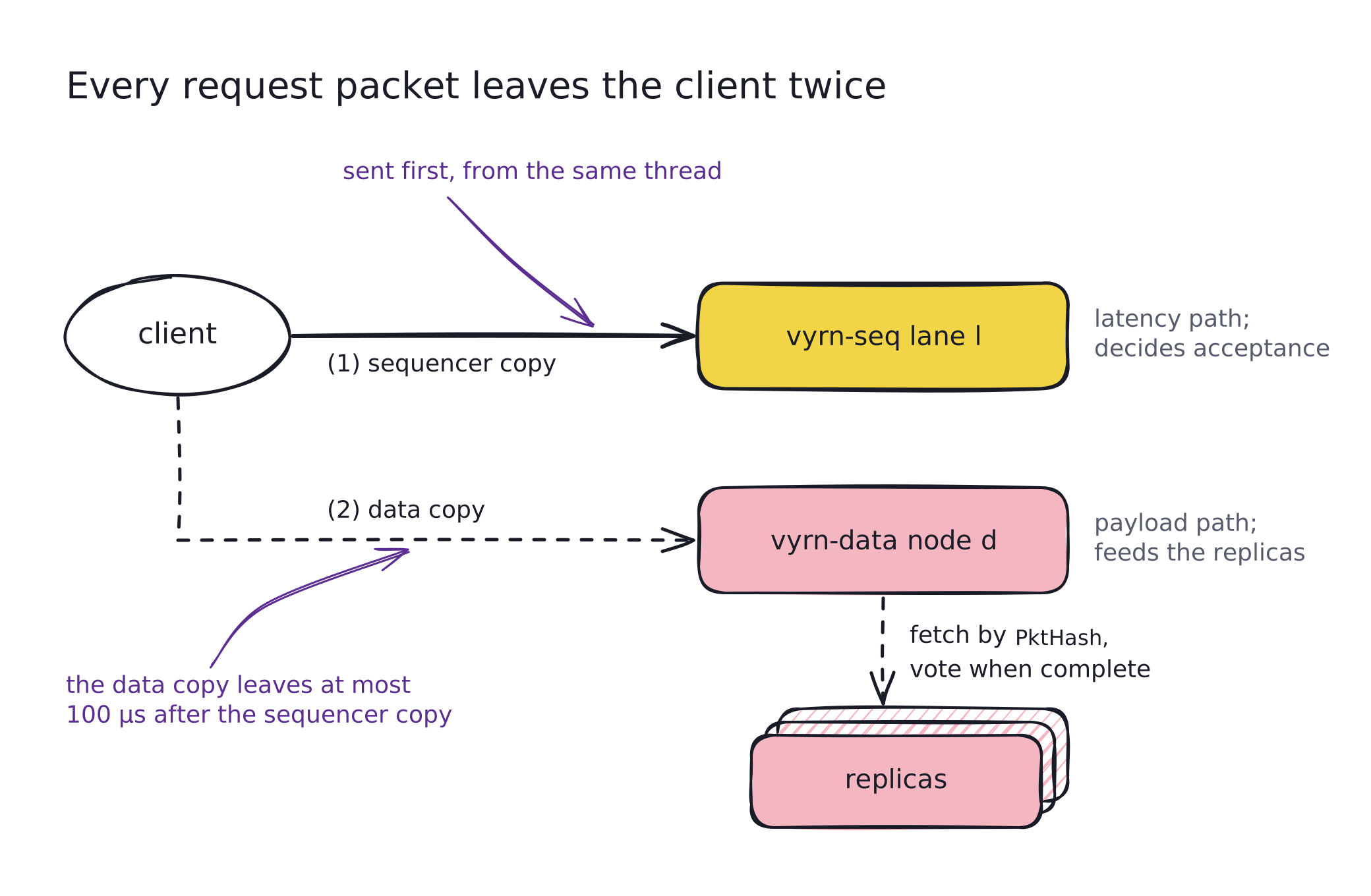
ASCII original
 client ──(1) sequencer copy ──► vyrn-seq lane l      (latency path; decides acceptance)
   │
   └────(2) data copy ─────────► vyrn-data node d     (payload path; feeds the replicas)
                                     │
                                     └──► replicas fetch by PktHash, vote when complete
Client obligations:
| ID | Obligation |
|---|---|
| D1 | Send the sequencer copy first and the data copy immediately after, from the same thread. The data copy leaves at most PROTO_DATA_LAG_MAX_US after the sequencer copy (budget). |
| D2 | Send both copies of every transmission, including resends (flags bit0 = 1) and resends to a new sequencer. A resend has a different PktHash, because flags is hashed, and the replicas need the exact copy that the sequencer accepted. |
| D3 | Keep the logical content of a pkt_seq fixed forever. The logical content is (session, pkt_seq, count, book, the message bytes). Only flags bit0, epoch16 and the tags may differ between transmissions of one pkt_seq. |
| D4 | Pick the data node from the key bundle's data list (§4.4): the first entry that the latest DataTierStatus does not mark down. The first entry is the session's data home, which is never in the sequencer's facility (01 §14.16, 07); the list is ordered per session by rendezvous hash among the other facilities, so sessions spread evenly over the data nodes. |
| D5 | Switch data nodes only when a DataTierStatus says so (admin channel in BASE, chain state in CHAIN). Data nodes never answer clients, so the client cannot detect a dead data node itself. |
| D6 | A client may send the data copy to two data nodes. The data tier deduplicates by PktHash. This costs bandwidth and buys nothing unless a data node is failing. |
Why D3. A packet that the sequencer never answered may still have been accepted, and its data
copy exists either way. If the client could reuse the pkt_seq for other content, the log would
hold two packets under one name. So the client never does that. To change its mind, it sends a
new packet that cancels or replaces.
When the copies differ. 07-replication.md detects it by PktHash: the replicas look up the
payload named by the PacketRecord, and a missing or different payload starts its check. The
outcomes, as the client sees them:
| Case | Outcome |
|---|---|
| The two copies differ only in fields D3 allows to differ | Normal. The data tier holds both. Replicas use the one the PacketRecord names. |
| The data copy is missing or arrives after the block closes | The replicas repair the payload from the sequencer (07-replication.md). The packet stands. vyrn-data counts a late copy against the session (PROTO_CNT_DATA_LATE). 10-accounts-risk-md.md sets the penalty for a persistent offender. |
A copy fails its tag check (tag_seq in BASE, tag_com in CHAIN) |
That copy is ignored and counted. A copy without a valid tag is not evidence against the client, so a spoofer cannot frame a session. |
| Two copies with valid tags have different logical content | Equivocation. The exchange closes the session (SESSION_CLOSED, detail PROTO_D_EQUIVOCATION), through an admin control record in the order stream. In CHAIN mode the session bond pays the counterparties (09-chain.md). |
Note for 07: two transmissions of one pkt_seq have different PktHash values when only
flags bit0 or epoch16 differ. Equivocation is therefore a difference in logical content
(D3), not a difference in PktHash. See Requests to 01.
3. The validation pipeline in the lane#
3.1 Order of checks#
The lane runs these checks in this order on every received packet. The cheapest check runs
first, and no check that can close a session runs before the checks that prove the packet is
for this session, from its bound address, and in its epoch. All costs are budgets on REF
at 5 GHz. Benchmark B2 (11-build.md) measures them. V0–V8 are the packet part of pass 1
(01 §14.2): together they fit the 45 ns per packet of LANE_PASS1_NS. Test D (§3.5) is
computed at dequeue; a shed is taken right after V5.
| Step | Check | Cost | On failure | Response | Counter |
|---|---|---|---|---|---|
| V0 | NIC: destination port, IPv4 without options or fragments, UDP checksum if nonzero | 0 (NIC) | NIC drops | none | NIC stats |
| V1 | UDP payload length = 32 + 16 × count, and 1 ≤ count ≤ MAX_MSGS_PER_PKT |
1 ns | drop | none | PROTO_CNT_MALFORMED |
| V2 | Session lookup: lane bits of session = this lane; slot generation = session generation; slot not FREE |
2 ns | other lane: §3.2 slow path. Unknown: drop | none, or out-of-stream WRONG_LANE |
PROTO_CNT_UNKNOWN_SESSION |
| V3 | Source (IPv4 address, UDP port) = the session's bound address (01 §12.5) | 1 ns | drop | none | PROTO_CNT_UNBOUND_SRC |
| V4 | epoch16 = low 16 bits of the box's current epoch |
1 ns | drop | out-of-stream EPOCH_MISMATCH, detail = current epoch |
PROTO_CNT_EPOCH |
| V5 | expected − PROTO_SEQ_BACK ≤ pkt_seq ≤ expected + PROTO_SEQ_AHEAD |
1 ns | drop | none | PROTO_CNT_SEQ_WINDOW |
| V6 | tag_seq = SipHash-2-4(K_seq(e, this box), bytes 0 .. 16+16n). Reached only with a bound source (V3) and a matching epoch16 (V4) |
10 ns (n = 1) to 40 ns (n = 10), inside the 45 ns | close the session (cause BAD_MAC, 01 §14.8) |
in-stream Reject BAD_MAC, index 0xFF, final record |
PROTO_CNT_BAD_MAC |
| V7 | Session state is CLOSED |
1 ns | drop | out-of-stream SESSION_CLOSED, detail = close cause |
PROTO_CNT_CLOSED |
| V8 | pkt_seq vs expected: equal → accept; less → duplicate (§5.2); greater → gap (§5.1) |
1 ns | duplicate or gap handling | resend, or out-of-stream BAD_SEQ |
PROTO_CNT_DUP, PROTO_CNT_GAP |
| — | Accept. Write the PacketRecord (07-replication.md). expected += 1. |
3 ns | — | — | — |
| V9 | Header semantics: request flags bits 1–7 = 0, reserved = 0; book is one of the session's books |
1 ns | every message is rejected | in-stream Reject BAD_TYPE (PROTO_D_BAD_HDR), or Reject BAD_BOOK (23), per message |
PROTO_CNT_BAD_HDR |
| V10 | Packet buckets of the session and the account (§9) | 2 ns | every message is rejected | in-stream Reject RATE_LIMIT per message |
PROTO_CNT_RATE |
| V11 | Per message, in index order (§3.3): pass 1, then pass 2 | LANE_PASS1_NS 5 + LANE_APPLY_NS 9 each |
that message is rejected | in-stream records | per reason |
Why this order:
- V3 before V6. A packet from an unbound address never costs a SipHash. That is the DoS defence (§3.4). It also gives 01 §12.5 its meaning: a bad MAC from an unbound address is dropped and counted at V3, and the session stays open. A bad MAC at V6 can only come from the bound address with the receiver's own epoch, so it closes the session (01 §14.8).
- V4 before V6. The tag key depends on the epoch. An honest client that is a few
milliseconds late at a boundary sends a packet tagged with last epoch's key. If V6 ran first,
that packet would fail the MAC and close an honest session. With V4 first, the client gets
EPOCH_MISMATCHand switches keys. Sessions survive the boundary (01 §14.8), so this matters for every session at every handoff. - V5 before V6. A far-out
pkt_seqcannot come from an honest client. Dropping it costs one compare and closes nothing. - V6 before every response that is not
EPOCH_MISMATCH. The lane never answers an unauthenticated packet, except at V4 (where it cannot authenticate) and then only under the holdoff of §3.2. - Acceptance before V9–V11. Once a packet passes V6 and V8, it is authenticated and it is
the next packet. The lane accepts it and records it even if its contents are wrong. If the lane
dropped it, the client would have to resend a different packet under the same
pkt_seq, which D3 forbids. Every rejection after acceptance is an in-stream record.
Speculative work. The lane may parse and classify the messages while SipHash runs. It changes no state and forwards nothing to the BBO core until V6 passes. This hides most of the MAC time on the cross path.
Two passes (01 §14.2). Pass 1 runs M1–M8 on every message in index order and pushes each
improve, cross, IOC, FOK and post-only-would-cross to the BBO ring as soon as it is
classified, with its in-packet dependency list and pre-assigned handles. Pass 2 applies the joins
and cancels in index order. A cross at index i waits only for the pass-1 work of messages
0 … i−1 (5 ns each), not for their apply. Worst case, index 9 of a full packet (budget, REF):
cross fill 880 ns, join or cancel ack 965 ns (955 typical), against the 980 ns shed threshold
(DEADLINE_GUARD_NS = 20, 01 §14.17.1). A pooled packet adds 20 ns for the account token. Index 0
is ~90 ns faster, and an ack's slack grows by ~9 ns per earlier index, so the SDK puts a
packet's cancels first (index 0 has ~100 ns of slack). Message order is the client's choice, so
this changes no semantics. Every index meets LAT_MAX_NS.
Two passes do not change outcomes. The records of every message are exactly those that applying the messages one at a time, in index order, would produce: the same fills, prices, quantities, STP outcomes, rejects and handles. The dependency list makes the BBO core treat each earlier op of the packet as resting at its own priority. A client can rely on the outcome of index order. It cannot rely on the arrival order of records across the B-packet and the L-packet (R-ACROSS, §7.2); inside one response packet, records are in index order (R-INDEX).
fn on_rx(&mut self, p: &RxPkt) {
    let late = self.must_shed(p);                                           // D, §3.5, at dequeue
    let n = p.data[8] as usize;
    if n == 0 || n > MAX_MSGS_PER_PKT || p.len != 32 + 16 * n { return self.cnt.malformed.inc(); }
    let sid = SessionId(le_u32(&p.data[0..4]));
    if !self.serves(sid.lane()) { return self.other_lane(p, sid); }          // §3.2, §4.7
    let s = &mut self.sessions[sid.slot()];
    if s.gen != sid.gen() || s.state == State::Free { return self.cnt.unknown_session.inc(); }
    if p.src != s.bound { return s.cnt.unbound_src.inc(); }
    if le_u16(&p.data[10..12]) != self.epoch.low16() { return self.oos(s, p, EPOCH_MISMATCH, self.epoch.0); }
    let seq = le_u32(&p.data[4..8]);
    if !s.seq_in_window(seq) { return s.cnt.seq_window.inc(); }
    if late { return self.busy(s, p, seq); }   // PacketRecord.flags bit0 SHED + Reject BUSY, ~20 ns
    let end = 16 + 16 * n;
    if siphash24(&s.k_seq, &p.data[..end]) != le_u64(&p.data[end..end + 8]) {
        return self.close(s, Close::BadMac { pkt_seq: seq });               // in-stream, final
    }
    if s.state == State::Closed { return self.oos(s, p, SESSION_CLOSED, s.close_cause as u32); }
    match seq.cmp(&s.expected) {
        Ordering::Less => self.duplicate(s, p, seq),                          // §5.2
        Ordering::Greater => self.oos(s, p, BAD_SEQ, s.expected),             // §5.1
        Ordering::Equal => self.accept(s, p, seq),                            // V9..V11
    }
}
3.2 Out-of-stream responses and the other-lane path#
An out-of-stream response answers a packet that the lane did not accept. It has:
resp_seq = 0,count = 1,flags = 0,echo_pkt= thepkt_seqof the packet it answers;- one
Rejectrecord with index 0xFF (the whole packet), the reason, the detail, andclient_tag = 0; - a tag with
K_out(e, this box), and the session's bound address as destination.
Rules:
- The lane sends at most one out-of-stream response per (session, reason) per
PROTO_OOS_HOLDOFF_US. Later ones in that window are only counted.BUSYis the exception: it has no holdoff, and every shed packet gets its own (§3.5). - Out-of-stream responses are not retained, not resent, and not part of any state. Except for
BUSY, they are not engine output: they depend on packets that the order stream does not contain. Their frame gate (01 §14.5) is empty, or forBUSYitsPacketRecordwithflagsbit 0 (SHED) set (01 §6.6; bit 1 isADVANCE, acount= 0 record that no client packet produces). - The five out-of-stream reasons are
EPOCH_MISMATCH,BAD_SEQ,SESSION_CLOSED,WRONG_LANEandBUSY(lane shed, index 0xFF). No other reason is ever sent out of stream.
Other-lane path. A packet whose session names another lane goes to a slow path with a
budget of PROTO_WRONG_LANE_PPS per lane. Above that budget the lane drops and counts.
- Port steering (REF, CONSUMER). The client sent to the wrong port. The lane reads the owning
lane's session slot (read-only; keys do not change while a session exists), runs V3–V6 against
it, and if they pass, sends out-of-stream
WRONG_LANEwith detail = the correctLaneId. It never accepts the packet. A V6 failure here is dropped and counted: only the owning lane can close a session (INV-WRITER). - RSS steering (AWS). The NIC put the packet on the wrong lane, and the client did nothing
wrong. The lane forwards the packet to the owning lane over an SPSC ring (
05-engine.md) and sends no response. The owning lane uses the originalrx_ts.
3.3 Per-message checks#
For each message, in index order, the lane runs these checks. The first failure decides the reject reason. The order is fixed, so replicas reproduce the same reason.
| Step | Check | Reason on failure |
|---|---|---|
| M1 | Message bucket of the session and the account (§9). The type byte selects the cancel reserve. | RATE_LIMIT |
| M2 | Type code is defined for the session's protocol version | BAD_TYPE (PROTO_D_UNKNOWN_TYPE) |
| M3 | Every field that the layout marks 0 is 0; order flags bits 6–7 are 0; the flags byte of a non-order message is 0 | BAD_TYPE (PROTO_D_RESERVED) |
| M4 | Session state allows the type: in DRAINING, New and Replace fail. Account state is Active for New and Replace (10) |
SESSION_CLOSED (PROTO_D_DRAINING), ACCOUNT_KILLED |
| M5 | Book phase allows the message (§6.9) | BOOK_HALTED, AUCTION_PHASE |
| M6 | Field checks of the type (§6) | BAD_TICK, BAD_QTY, UNKNOWN_HANDLE, TOO_LATE, SIDE_MISMATCH, BAD_SEQ |
| M7 | Risk (10-accounts-risk-md.md): order count, then exposure, then balance |
RISK_ORDER_COUNT, RISK_POSITION, RISK_CREDIT |
| M8 | Classify against the lane's snapshot (join, improve, cross); post-only check; BBO bucket (§9) | POST_ONLY_WOULD_CROSS, RATE_LIMIT |
| M9 | Apply: a lane-local op, or a push to the BBO-core ring | — (later outcomes in §6) |
Budget per message (01 §14.2): M1–M8 and the forward push are pass 1, LANE_PASS1_NS = 5 ns. M9
for a join or a cancel is pass 2, LANE_APPLY_NS = 9 ns. LANE_NS_PER_MSG = 30 is the average
with every amortized cost (risk misses, overflow levels, settles) and is what admission (§9.1)
uses; it is not a per-message latency term.
A rejected message changes no order state. It does consume its message token (M1), so a flood of invalid messages is limited like any other flood.
3.4 Spoofed sources and denial of service#
| Attack | What the lane does | Cost to the lane (budget) | Effect on the victim |
|---|---|---|---|
Random session values from any source |
drop at V2 | ≤ 4 ns | none |
A valid session from an unbound source, any MAC |
drop at V3, count | ≤ 5 ns | none; the session stays open |
| The bound source, a wrong epoch | out-of-stream EPOCH_MISMATCH under holdoff |
≤ 6 ns | at most one extra response per holdoff |
The bound source, pkt_seq outside the window |
drop at V5 | ≤ 6 ns | none |
The bound source, pkt_seq in the window, bad MAC |
close the session at V6 | ≤ 45 ns once | the session closes |
| Replay of a captured valid packet | duplicate (§5.2): dropped, or a resend to the bound address under the resend bucket | ≤ 50 ns | none |
| Reflection toward a third party | impossible: every response goes to a bound address | — | — |
The lane alone cannot absorb a full-rate flood. One 100GbE port carries up to 148.8M minimum
frames per second (computed), and at 5 ns per drop one lane handles 200M/s, but the flood still
fills the lane's RX ring and delays real packets. So the edge does the first filtering, with
fixed-function features of a merchant switch (C-NOCHIP):
| ID | Edge control |
|---|---|
| E1 | Strict uRPF and an ingress ACL per client cross-connect. A cross-connect can source only the client's registered prefixes. vyrn-admin builds the ACL from the session directory. |
| E2 | A packet-rate policer per cross-connect at the contracted rate. |
| E3 | On AWS, the VPC source/destination check forbids spoofed sources, and security groups admit only registered client addresses. |
| E4 | A policer per lane (destination address and UDP port) on the switch port that faces the sequencer: at most LANE_POLICE_PPS packets/s with a burst of LANE_POLICE_BURST (01 §14.1). It bounds the lane's RX backlog so that every BUSY fits in 1 µs (§3.5). A packet it drops was never accepted; the client's timer resends it. |
With E1–E3, the only party that can send from a session's bound address is the owner of that address's link. So a bad MAC from the bound address is the owner's bug or compromise, and closing the session at the first failure is correct. It also limits a key-guessing attacker to one guess per session.
3.5 Deadline admission and BUSY (01 §14.1)#
Test D. When the lane dequeues a packet it computes age = now − rx_ts (TSC↔PHC mapping,
06-platform.md; on AWS rx_ts is the TSC at RX completion, 01 §14.11). It sheds the packet if
either holds:
age + predicted_path_ns(p) > LAT_MAX_NS − DEADLINE_GUARD_NS. For a packet with forwarded ops, the prediction includes the BBO-ring backlog that the lane can see.- Serving p fully would leave a packet behind it unable to get its own
BUSYin time: for some pending packet k (those in the RX ring, plus the most that E4 admits during p's work),age_k + L_p + PROTO_SHED_NS × k + PROTO_BUSY_TAIL_NS > LAT_MAX_NS − DEADLINE_GUARD_NS, whereL_pis p's lane work and k its position behind p.
Why every BUSY arrives within 1 µs. Rule 2 holds the backlog where every pending packet can
still be shed in time. A shed costs PROTO_SHED_NS = 20 ns, and E4 admits at most one packet per
25 ns, so the backlog cannot grow while the lane sheds. A lane BUSY waits for the logged cut like
an ack, because its SHED record is frame-gated: PROTO_BUSY_TAIL_NS = 460 (cut 170 + LaneCut
poll 20 + gate 10 + lane TX 20 + NIC TX 240). Rule 2 keeps every pending packet's dequeue age
≤ 500 ns (03 ARC_ADMIT_AGE_MAX_NS), so the worst case (budget, REF) is RX 320 + wait 180 + shed
20 + 460 = 980 ns, the threshold. The BBO core applies the same two rules to forwarded ops
(05-engine.md). Its BUSY path, from the Shed step, is 10 + one BBO → lane hop 100 + lane 40
- NIC TX 240 = 390 ns, now 35 ns longer than the 355 ns fill path from a step. So a head that
cannot start its step now is shed once its age + 390 + 15 > 980 (03 §6.0), and every BBO
BUSYalso arrives in time.
The two kinds of BUSY, as the client sees them:
| Lane shed | BBO-core shed | |
|---|---|---|
| Decided by | the lane, test D, after V1–V5 and before V6 | the BBO core, as a Shed step |
| Logged as | PacketRecord.flags.SHED |
StepRecord, kind Shed |
| Record | out-of-stream Reject BUSY (24), index 0xFF, resp_seq 0, detail = expected |
in-stream Reject BUSY (24) at the shed message's index, its client_tag, sent by the session's lane |
| Packet accepted | no: the whole packet was not applied, expected is unchanged |
yes: pkt_seq is consumed |
| What took effect | nothing; no bucket, no fee | every message of the packet except the shed ops, with the outcome of index order minus those ops |
| Client action | resend from detail, same pkt_seq and the same logical content (D3), bit0 = 1 |
send the shed message again in a new packet |
| Arrives | ≤ LAT_MAX_NS |
≤ LAT_MAX_NS |
A later message of the same packet that lists a shed op in its dependency list, or names the
handle pre-assigned to it, is shed with it and gets its own Reject BUSY. Every shed decision is
read from the log on replay, never recomputed, so INV-DET holds. A lane shed skips V6 because
it changes no state: no packet is applied and nothing can close. The BUSY goes only to the
bound address, tagged with K_out.
BUSY, gapless pkt_seq and deduplication.
- A lane
BUSYnever acknowledges anything. It carriesresp_seq0, so the cumulative rule of §5.1 is unchanged. Its detail =expected: everypkt_seqbelow it was accepted. - After a lane shed of p, packets p + 1, … of the session are shed too while the lane sheds
(each with its own
BUSY, detail p), or are gaps once it stops (§5.1). Either way the client goes back to p. Go-back-N needs no special case. - A resend of a shed p is a first acceptance, not a duplicate. G1 holds: p executes once.
- Test D runs before V8, so a duplicate can be shed too. Then detail > p tells the client that p
was accepted earlier. It recovers p's responses with
ResendReq(§5.3). - What each lane class can expect at the reference workload is §3.6.
BUSYanswers overload within 1 µs. It is never a normal outcome, and a client counts it.
3.6 Lane classes and LANE_PACE (01 §14.15, §14.17.2)#
The lane map in the key bundle (§4.4) gives each account its class. A dedicated lane serves the
accounts of one firm only (a large firm may hold several lanes). A pooled session belongs to
the pool of 7 cores (lanes 42–48 on REF); its SessionId names its home pool core, and any pool
core may process its packets (§4.7).
LANE_PACE, the SDK pacing rule for dedicated lanes. The SDK keeps one pacer per dedicated
lane, shared by all of the firm's sessions on that lane, and sends packet n+1 on the lane no
earlier than
t_send(n+1) ≥ t_send(n) + lane_ns(n) + PROTO_PACE_MARGIN_NS + PROTO_PACE_JITTER_NS
lane_ns(n)   = 45 + count(n) × (LANE_PASS1_NS + LANE_APPLY_NS) + PROTO_RESP_BUILD_NS   (01 §14.2)
             = 45 + 14 × count(n) + 20        (REF; the bundle publishes the table per target)
The margin (10 ns) pays for the lane's background slices (fill-event settlement, control ops, credit refills); the jitter term (25 ns) covers compression of the gap by the leaf switch. So at the NIC the gap is never shorter than the previous packet's lane work, and the packet never waits in the lane (02 §4.4.1). A 10-message packet then occupies a 240 ns slot, so one dedicated lane takes ≤ 4.2M full packets/s from a paced firm. Packets the pacer delays wait in the SDK; that delay is not part of the 1 µs, which starts at the exchange NIC. A firm whose sessions send from several hosts either gives each host its own lanes or coordinates one pacer. A firm that does not pace can make only its own packets wait; no other client can reach its lane.
What each class can expect for BUSY (02 REQ-LAT-5, 01 §14.17.2):
| Lane class | Lane stage | Total, full book load (1B msgs/s) | Total, ≤ 20% book load |
|---|---|---|---|
| dedicated, paced | 0 | ≤ 10⁻⁵ of packets, crosses and improves only (shared BBO, TX and order-stream stages) | ≤ 10⁻⁸ |
| dedicated, unpaced | only from the firm's own bursts | as paced, plus its own lane waits | — |
| pooled | M/M/7 queue | ≈ 10⁻³ of packets (computed 4.2 × 10⁻⁴) | ≤ 10⁻⁶ |
B3 measures every class and publishes the curves. Under every class, every packet still gets its
first record or its BUSY within LAT_MAX_NS.
4. Sessions#
4.1 SessionId layout#
The exchange assigns every SessionId. Its bits have this meaning:
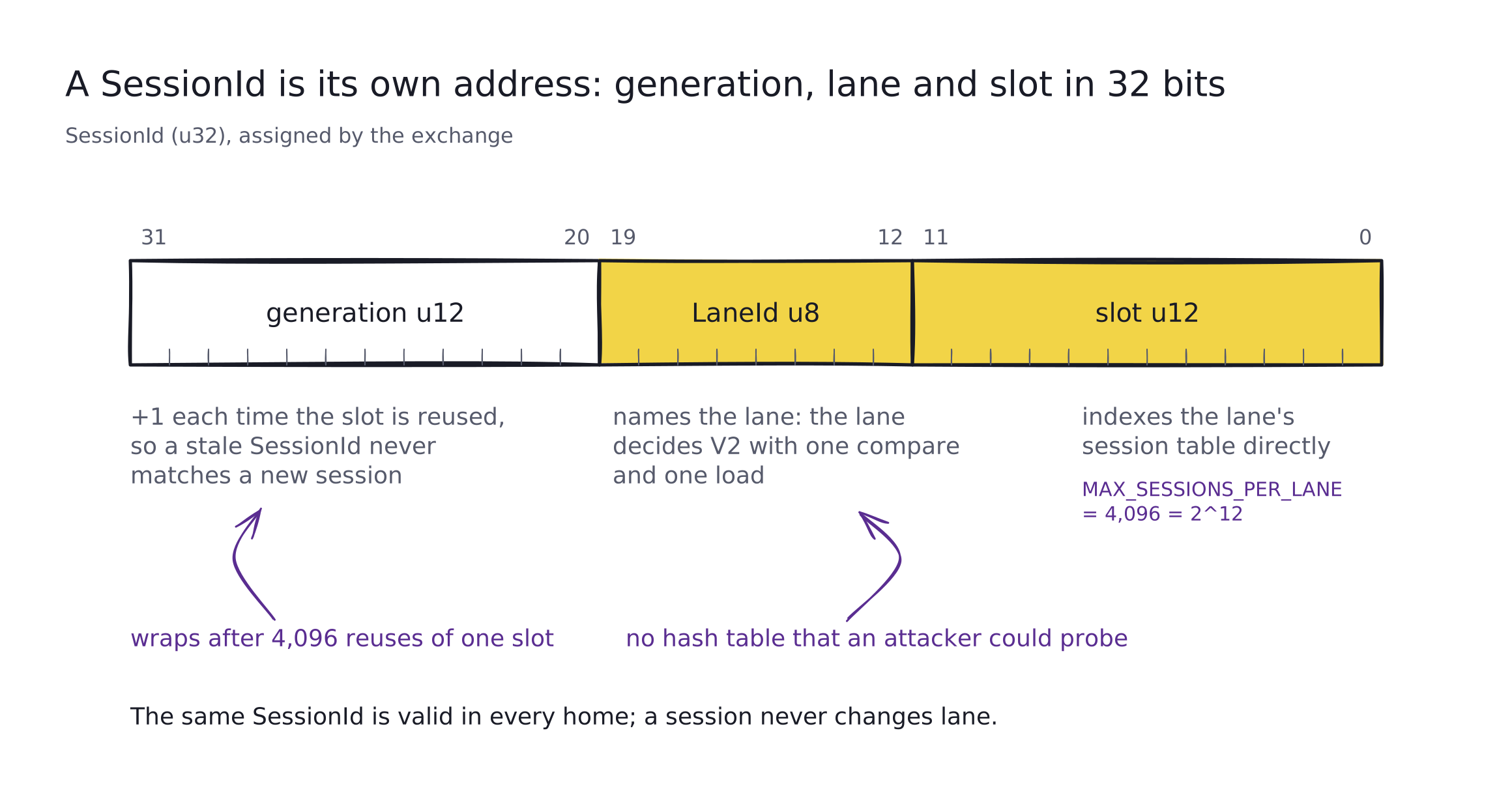
ASCII original
 31            20 19        12 11           0
┌────────────────┬────────────┬──────────────┐
│ generation u12 │ LaneId u8  │ slot u12     │
└────────────────┴────────────┴──────────────┘
slotindexes the lane's session table directly (MAX_SESSIONS_PER_LANE= 4,096 = 2^12).LaneIdnames the lane, so the lane decides V2 with one compare and one load, with no hash table that an attacker could probe.generationincreases each time a slot is reused, so a staleSessionIdnever matches a new session. It wraps after 4,096 reuses of one slot.- A session never changes lane. An account that the operator moves gets new sessions (§4.7).
- The same
SessionIdis valid in every home. Every home runs the same lane count.
4.2 Session state#
The session's lane is the only writer of every field below (INV-WRITER). Control records from
vyrn-admin or the chain reach the lane through the order stream, and the lane applies them.
| Field | Meaning |
|---|---|
id, account, books |
Identity. books is the set of BookId the session may trade, all on this box. |
state |
OPENING, ACTIVE, DRAINING, CLOSED, FREE (§4.3) |
bound |
One (IPv4 address, UDP port). The source of every accepted packet and the destination of every response. |
k_seq, k_out, k_com_hash |
Keys of the current epoch for this box; the next epoch's keys once issued (§4.6). |
expected |
Next pkt_seq to accept. Starts at 1. |
next_resp |
Next in-stream resp_seq. Starts at 1. |
ring_oldest |
Oldest resp_seq of the session still in the lane's response ring (§5.4). |
buckets |
GCRA state of the session's buckets (§9). |
cod, timeout_ms, last_rx, stale |
Cancel-on-disconnect option and liveness (§4.8). |
close_cause |
Set when the session enters CLOSED. |
Everything except ring_oldest, the lane's response ring, the counters and the out-of-stream
holdoff is part of the replicated state. The ring is derived state: in-stream responses are a
function of the order stream, so the warm standby vyrn-seq (01 §14.4) and the next home's
sequencer rebuild it by replay. It is not committed in the state root. Sessions survive epoch
boundaries (01 §14.8, H8).
4.3 State machine#
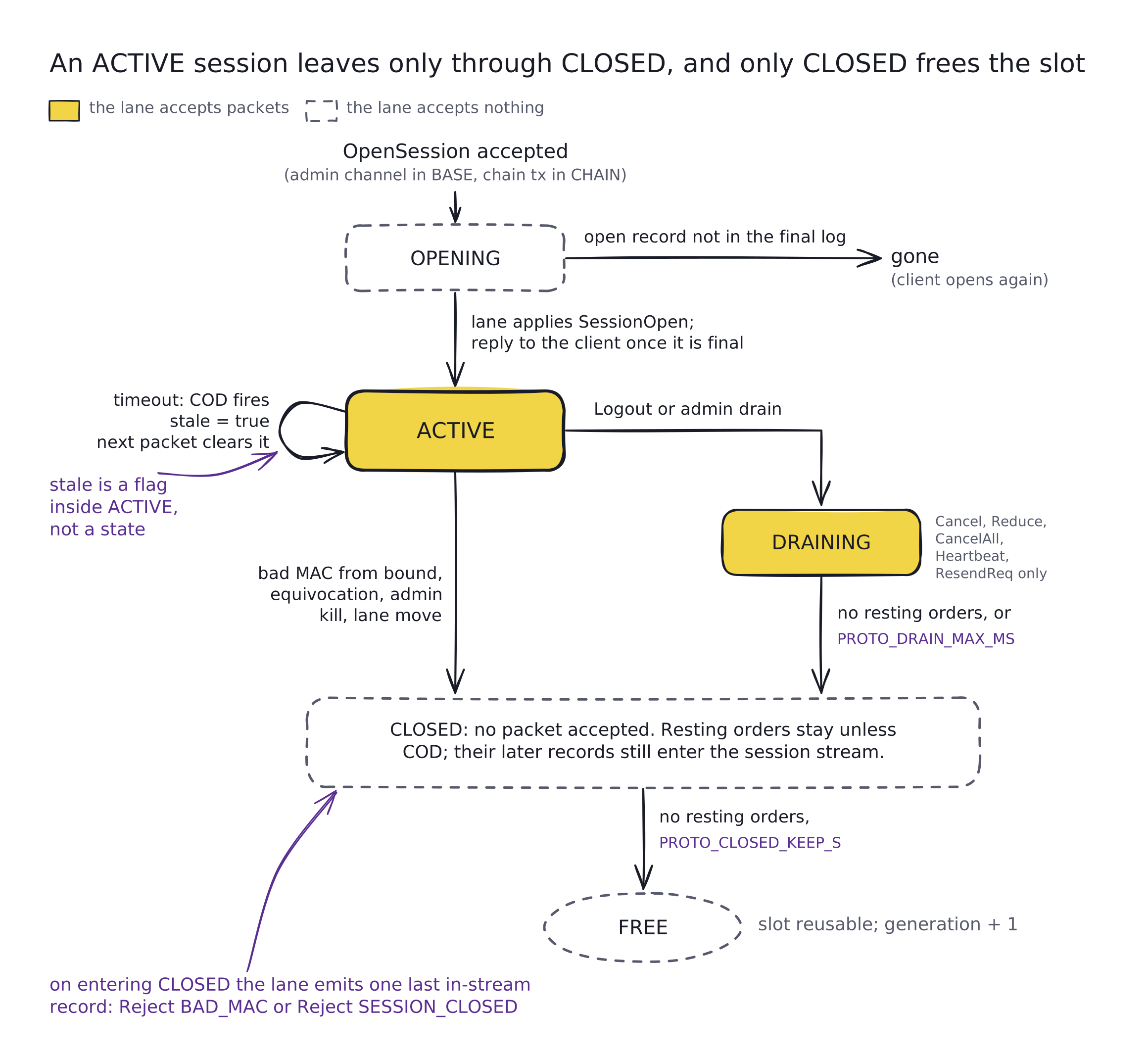
ASCII original
            OpenSession accepted (admin channel in BASE, chain tx in CHAIN)
                                  │
                                  ▼
                           ┌────────────┐  open record not in the final log
                           │  OPENING   │─────────────────────────────► gone (client opens again)
                           └─────┬──────┘
                                 │ lane applies SessionOpen; reply to the client once it is final
                                 ▼
       timeout: COD fires  ┌────────────┐  Logout or admin drain
       stale = true ┌──────│   ACTIVE   │──────────────────────┐
       next packet  └─────►│            │                      ▼
       clears it           └─────┬──────┘               ┌────────────┐
                                 │                      │  DRAINING  │── no resting orders,
          bad MAC from bound,    │                      └─────┬──────┘   or PROTO_DRAIN_MAX_MS
          equivocation, admin    │                            │                 │
          kill, lane move        ▼                            ▼                 ▼
                           ┌──────────────────────────────────────────────────────────┐
                           │ CLOSED: no packet accepted. Resting orders stay unless   │
                           │ COD; their later records still enter the session stream. │
                           └─────────────────────────┬────────────────────────────────┘
                                                     │ no resting orders, PROTO_CLOSED_KEEP_S
                                                     ▼
                                                   FREE (slot reusable; generation + 1)
| State | Lane accepts | Notes |
|---|---|---|
OPENING |
nothing (V2 fails: the slot is not yet live) | vyrn-admin does not give the client its keys until ACTIVE is final. |
ACTIVE |
everything | stale is a flag inside ACTIVE, not a state. |
DRAINING |
Cancel, Reduce, CancelAll, Heartbeat, ResendReq. New and Replace get SESSION_CLOSED. |
Lets a client leave cleanly while it still sees its last fills. |
CLOSED |
nothing; out-of-stream SESSION_CLOSED under holdoff |
The response stream still grows if resting orders trade. The recovery service serves it. |
FREE |
nothing (V2 fails) | — |
When a session enters CLOSED, the lane emits a final in-stream record: Reject BAD_MAC with
detail = the offending pkt_seq (cause BAD_MAC), or Reject SESSION_CLOSED with detail = the
close cause (every other cause). Both have index 0xFF.
Close cause (PROTO_D_*) |
Value | Trigger |
|---|---|---|
LOGOUT |
1 | the client's Logout, at the end of DRAINING |
BAD_MAC |
2 | V6 failure from the bound address with a matching epoch16 (01 §14.8) |
EQUIVOCATION |
3 | two validly tagged copies with different logical content (§2.4) |
ADMIN_KILL |
4 | operator session kill (CtlKillSession, 10-accounts-risk-md.md). An account kill does not close sessions: their New and Replace get ACCOUNT_KILLED (21), and cancels still work |
LANE_MOVED |
5 | the account moves lane at an epoch boundary (§4.7) |
BOND |
6 | CHAIN: the session bond fell below its minimum (09-chain.md) |
DRAINING |
7 | used only as the detail of a SESSION_CLOSED for New or Replace in DRAINING |
4.4 BASE mode: open over the admin channel#
In BASE mode the client opens a session over a TLS 1.3 connection to vyrn-admin, outside the
order-entry path:
- Mutual TLS. Each account has a client certificate from the exchange's CA. TLS 1.2 and earlier are refused.
- The channel stays open for the life of the session.
vyrn-adminpushes status and key bundles on it. If it drops, the client reconnects. The UDP session is not affected. - The encoding of the admin messages belongs to
vyrn-admin(11-build.md). This chapter fixes their fields.
struct OpenSessionReq {
    account: AccountId, books: Vec<BookId>, proto_version: u16,   // 1 for this chapter
    src: SocketAddrV4,                                            // becomes the bound address
    cod: Cod,                                                     // Off | On
    timeout_ms: u32,                                              // §4.8
    rate_tier: u8,                                                // §9, limits from 10
    attest: bool,                                                 // §7.5 Attest records
}
struct OpenSessionResp {
    session: SessionId, lane: LaneId, epoch: Epoch,
    bundle: KeyBundle, limits: Limits, active_from_step: StepId,
}
struct KeyBundle {
    epoch: Epoch, home: HomeCode, boundary_ts: Nanos,             // end of this epoch (TAI)
    seq_index: u8,                                                // box that is the sequencer now
    failover_order: [u8; N_MAX],                                  // order of successors
    boxes: [BoxKeys; N_MAX],                                      // every box of the home
    data: [SocketAddrV4; 8],                                      // D4 preference order
    next_home: HomeCode, lane_move: Option<LaneId>,               // §4.7
}
struct BoxKeys {
    index: u8, order: SocketAddrV4, recovery: SocketAddrV4,
    k_seq: [u8; 16], k_out: [u8; 16],
}
// Other operations: GetKeyBundle(epoch), Rebind(src), Logout, SetCod(Cod).
// Pushes: KeyBundle(e+1), DataTierStatus, SequencerStatus.
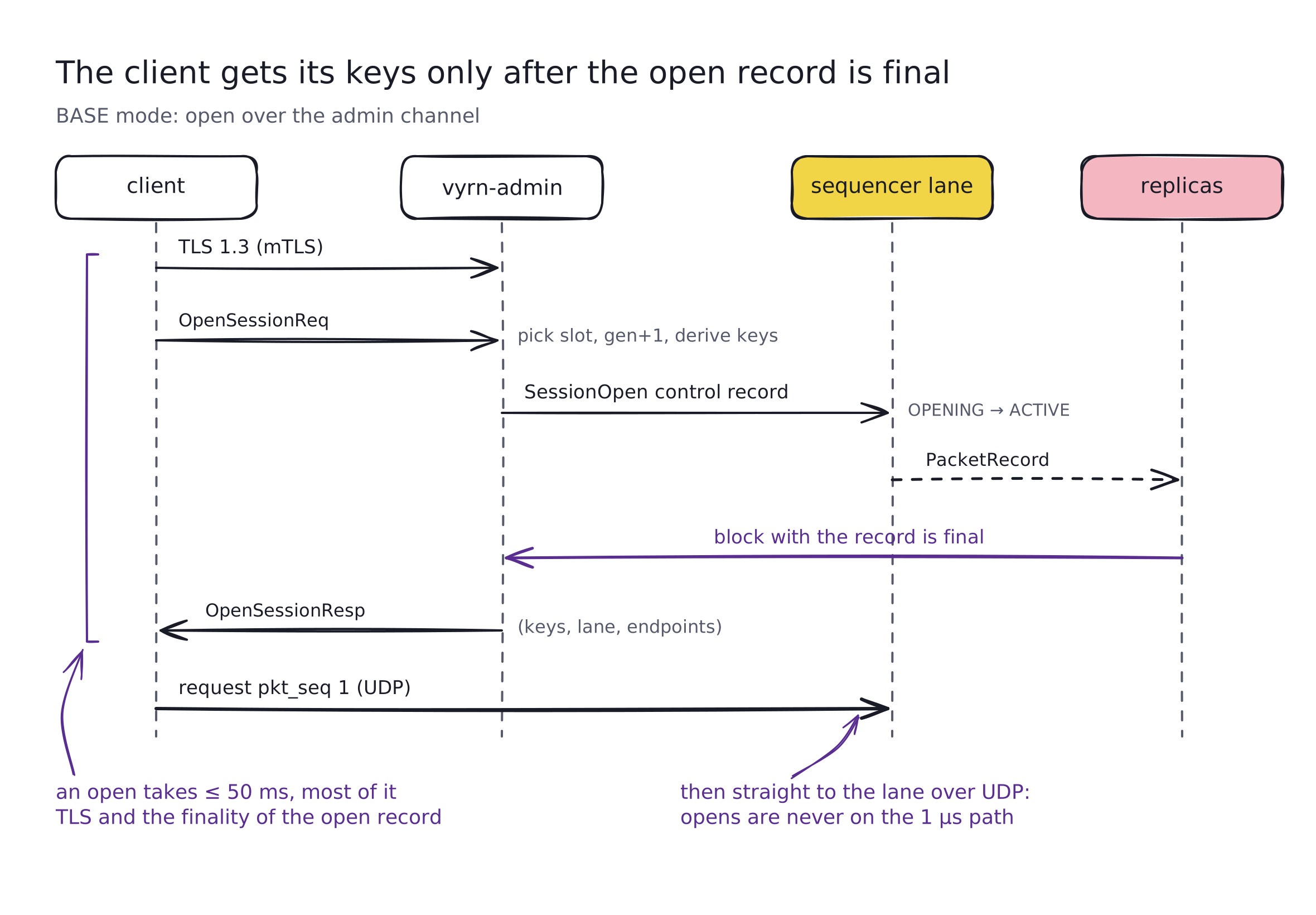
ASCII original
 client                    vyrn-admin                      sequencer lane      replicas
   │── TLS 1.3 (mTLS) ───────►│                                   │                 │
   │── OpenSessionReq ───────►│ pick slot, gen+1, derive keys     │                 │
   │                          │── SessionOpen control record ────►│ OPENING→ACTIVE  │
   │                          │                                   │── PacketRecord ►│
   │                          │◄───────────────── block with the record is final ───│
   │◄─ OpenSessionResp ───────│ (keys, lane, endpoints)           │                 │
   │── request pkt_seq 1 (UDP) ──────────────────────────────────►│                 │
Budget: an open takes ≤ 50 ms, most of it TLS and the finality of the open record. Opens are never on the 1 µs path.
vyrn-admin gives each box only the keys of that box. The replicas of the home also receive
every box's k_seq, so they can check tag_seq on the data copies they use (§2.4). BASE mode
trusts the operator with client keys. CHAIN mode does not (§4.5).
Rebind(src) changes the bound address. It reaches the lane as a control record and takes effect
at that record's place in the order stream. From then on, V3 checks the new address and responses
go to it.
4.5 CHAIN mode: open by transaction (summary)#
09-chain.md is normative for everything in this section.
- The wallet signs an
OpenSessiontransaction (Ed25519 or secp256k1, 01 §4). It carries the account, an X25519 public key of the client, the source address to bind, the COD option, the timeout, the protocol version, the bond, and the hash-chain commitments forK_com. - When the transaction is final, the state machine assigns the
SessionIddeterministically from the account's lane. The client reads it from the receipt. - Each validator
vand the client derive the per-epoch keys from X25519 between the client key andv's static key, then BLAKE3derive_keywith context"vyrn v1 session", the session and the epoch. That yieldsK_seq(e, v)andK_out(e, v). K_com(e, s)exists for each validatorsthat can be the sequencer in epoch e. Every validator exceptsholds it. A packet usesK_com(e, s)for the current sequencers. So after a failover tos', the new sequencer does not hold the commit key that its own packets use, and forging still needs two byzantine validators.K_comvalues are disclosed after the epoch's last block is final (TESLA style), so anyone can verify everytag_comin the log afterwards.- A client that cannot reach the sequencer may send the same packet to any validator's inclusion
port. The state machine places it at a block boundary. Deduplication by (
session,pkt_seq) applies there too.
4.6 Keys and rotation#
| Key | One per | Held by | Covers | Rotates |
|---|---|---|---|---|
K_seq(e, b) |
session, epoch, box b of the home |
client, box b; in BASE also the home's replicas |
tag_seq of packets sent to box b |
every epoch |
K_out(e, b) |
session, epoch, box b |
client, box b |
tag of responses sent by box b |
every epoch |
K_com(e, s) |
session, epoch, sequencer s (CHAIN only) |
client, every validator except s |
tag_com |
every epoch; disclosed after it ends |
All three are 16-byte SipHash-2-4 keys. In BASE mode tag_com is 0 and the lane ignores it. In
CHAIN mode the sequencer ignores tag_com, and the other validators check it before they vote.
Timeline around the boundary T between epoch e and e + 1:
 T − PROTO_KEY_PREISSUE_S   bundle for e+1 available (BASE: pushed over admin; CHAIN: derivable)
 T − 600 s … T − 1 s        EpochNotice countdown (§7.4)
 T                          client switches: epoch16 = e+1, K_seq(e+1, ·), new home's endpoints
 T + PROTO_KEY_GRACE_S      client may delete K_out(e, ·); the exchange has deleted K_seq(e, ·)
A client that has no bundle for e + 1 at T cannot send in e + 1. Its session stays ACTIVE and
its timeout clock is paused (§4.8) until it fetches the bundle and sends.
Key load (computed): one key handles at most 100M packets/s × 28,800 s = 2.9 × 10^12 MACs per epoch, below 2^42. A forger gets one try per session, because a bad MAC from the bound address closes the session, and the chance that one try succeeds is 2^−64.
4.7 Lane assignment#
vyrn-admin(BASE) or the state machine (CHAIN) puts every session of an account on the account's lane (01 §1: an account belongs to one lane per epoch). The top firms by volume get dedicated lanes; every other account is pooled, and its sessions name a home pool core (10 §1.3, 01 §14.15).- A pool core serves every session whose
LaneIdis in the pool (serves()in §3.1), so a packet another pool core takes from the home core's queue is notWRONG_LANE. The account token keeps one core per account at a time, and each take is logged (AcctTake, 01 §14.17.4). - An operator moves an account to another lane only at an epoch boundary, and only to rebalance
load. The move appears in the bundle for e + 1 as
lane_move. - At the boundary, the account's sessions on the old lane go
CLOSED(causeLANE_MOVED) and their resting orders end withOutcauseLANE_MOVED. The client opens new sessions on the new lane.
This rule keeps Handle and SessionId lane-local with no translation table. Moves are rare, so
their cost (one re-quote) is acceptable.
4.8 Heartbeats and timeouts#
| Rule | Value |
|---|---|
The client sends at least one packet every PROTO_HB_IDLE_MS. When it has nothing else to send, it sends a Heartbeat. |
default 100 ms |
The session timeout is chosen at open, in [PROTO_TIMEOUT_MIN_MS, PROTO_TIMEOUT_MAX_MS], and must be ≥ 3 × the client's heartbeat interval. |
default PROTO_TIMEOUT_DEFAULT_MS = 350 ms |
A packet that holds only Heartbeat messages gets an in-stream EpochNotice (R-ANSWER, §7.2). The client uses it to measure liveness and round-trip time. |
— |
Order-stream time. The lane measures the timeout on order-stream time, never on the wall clock
(01 §11 rule 3). Lane time is the larger of the rx_ts of the last packet the lane processed and
the time of the last TimerTick record. 05-engine.md and 07-replication.md provide a
TimerTick for every lane at least once per BLOCK_NS, so an idle lane still sees time pass.
On timeout: the lane sets stale. If cod = On, it cancels the session's resting orders
(§4.9). The session stays ACTIVE: the next accepted packet clears stale. UDP has no
connection to lose, so a short outage on the client side costs its orders (if COD is on) and
not its session.
The clock pauses from the end of an epoch until the new sequencer's first step, and during a failover, from the old sequencer's last record until the new one's first. The client cannot send during those windows, so they do not count against it.
Exchange silence, client side: if the client has unacknowledged packets and gets no in-stream
response for PROTO_CLIENT_SILENCE_MS, it assumes a failover is under way (§5.6). It keeps
resending with backoff, and it asks vyrn-admin for SequencerStatus if no notice arrives within
PROTO_CLIENT_FAILOVER_MS.
4.9 Cancel-on-disconnect#
Each session has a COD option, set at open and changed with SetCod (it takes effect at its
control record):
| Option | On timeout | On CLOSED (any cause) |
|---|---|---|
Off |
nothing | orders keep resting |
On |
cancel every resting order of the session, in every book of the session, auction orders included | the same |
COD cancels only orders that this session entered, not orders of other sessions of the same
account. Each canceled order gets Out with cause DISCONNECT in the session's stream. COD runs
once per stale episode. It is a deterministic op at the TimerTick or control record that
triggers it, so the replicas run it too.
5. Reliability#
5.1 Request direction: gapless pkt_seq, go-back-N#
- A session's packets carry
pkt_seq= 1, 2, 3, … with no gap and no reuse (01 §6.1). - The lane accepts only
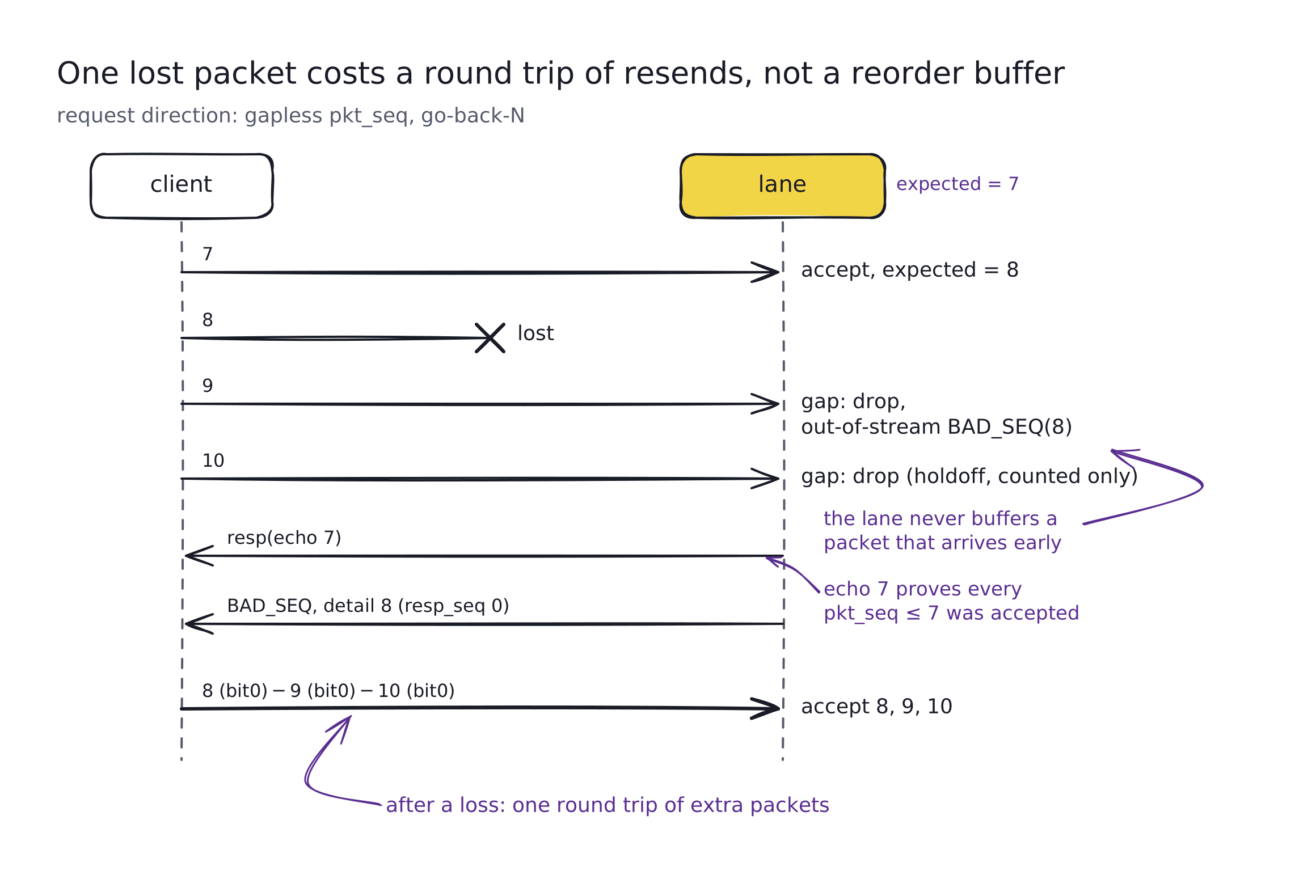
pkt_seq = expected. It never buffers a packet that arrives early. A lane with no reorder buffer has nothing to replay except the packets it accepted. - Acknowledgement is cumulative. The lane accepts in order and allocates
resp_seqin order, so any in-stream response withecho_pkt = p ≥ 1proves that everypkt_seq ≤ pwas accepted. An out-of-streamBAD_SEQwith detail x proves that everypkt_seq < xwas accepted. - Gap. If
expected < pkt_seq ≤ expected + PROTO_SEQ_AHEADand the MAC is good, the lane drops the packet and sends out-of-streamBAD_SEQwith detail =expected, under the holdoff. The client then resends every packet fromexpectedto its highest sentpkt_seq, in order, with flags bit0 = 1 (go-back-N). - Client timer. If the oldest unacknowledged packet has no acknowledgement after
PROTO_REQ_RTO_US, the client resends from it with bit0 = 1. The timer doubles on each expiry up toPROTO_REQ_RTO_MAX_MS, and resets on progress. SetPROTO_REQ_RTO_USto at least 4 × the measured round trip. - Window. The client keeps at most
PROTO_SEQ_AHEADpackets unacknowledged. A packet beyond that is dropped at V5.
ASCII original
 client                                        lane (expected = 7)
   │── 7 ──────────────────────────────────────►│ accept, expected = 8
   │── 8 ────────────────────X (lost)           │
   │── 9 ──────────────────────────────────────►│ gap: drop, out-of-stream BAD_SEQ(8)
   │── 10 ─────────────────────────────────────►│ gap: drop (holdoff, counted only)
   │◄── resp(echo 7) ───────────────────────────│
   │◄── BAD_SEQ, detail 8 (resp_seq 0) ─────────│
   │── 8 (bit0) ── 9 (bit0) ── 10 (bit0) ──────►│ accept 8, 9, 10
Go-back-N costs one round trip of extra packets after a loss. Inside a colo, the round trip is a few microseconds and loss is rare, so this is cheaper than a reorder buffer in every lane.
5.2 Duplicates and the resend flag#
A packet with a good MAC and pkt_seq < expected is a duplicate. Flags bit0 says why the
client sent it:
| bit0 | Meaning | Lane action |
|---|---|---|
| 0 | The network duplicated the packet. | drop, count PROTO_CNT_DUP |
| 1 | The client resent it because it saw no answer. | resend, with bit0 = 1, every packet with echo_pkt = pkt_seq that is still in the lane's ring. If none is left there, send out-of-stream BAD_SEQ with detail = expected, which tells the client that the packet was accepted. Both draw from the session's RESEND bucket (§9). |
Idempotency. Each (session, pkt_seq) is accepted at most once, ever. expected is
replicated state, so this holds on a new sequencer after a failover and in a new home after a
handoff. A client may therefore resend any packet at any time, and the exchange executes it
once or not at all.
A resend to the lane carries the same logical content (D3) and goes to the data tier too (D2). The lane does not compare a duplicate with the accepted packet. If the content differs, the replicas detect equivocation (§2.4).
5.3 Response direction: gapless resp_seq#
- In-stream response packets carry
resp_seq= 1, 2, 3, … per session with no gap. Out-of-stream packets carry 0 and are outside this sequence. - Two producers send a session's packets (§7.1), from different TX queues. So packets can arrive
out of order by up to about 1 µs (budget). The client buffers out-of-order packets and
processes them in
resp_seqorder. - Gap. If
resp_seqr is missing forPROTO_RESP_GAP_WAIT_USafter a higher one arrived, the client sendsResendReq(r, r')for the missing range. - Tail loss. If the last response is lost, nothing reveals the gap until the next response.
A packet that holds only a
Heartbeatgets an in-stream answer, so tail loss is found within one heartbeat interval at worst. A client that needs faster detection sends aHeartbeatsooner. - The lane serves a
ResendReqfrom its ring if the range is at mostPROTO_LANE_RESEND_MAXpackets and is still in the ring. Otherwise it rejects it withBAD_SEQ(§6.7), and the client uses the recovery service.RESEND_GONE(22) means that neither store holds the range (§5.4).
5.4 Retention: the lane ring and the recovery service#
01 §5 sets RESP_RETAIN_PKTS = 65,536 response packets per session. They cannot all live in the
lanes:
| Store | Per session | Per lane (4,096 sessions) | Per box (49 lanes) |
|---|---|---|---|
RESP_RETAIN_PKTS × 280 B (worst case) |
18.4 MB | 75 GB | 3.8 TB |
RESP_HOT_RING_BYTES (01 §14.6) |
shared | 4 GiB | 200 GiB |
(computed). So retention has two tiers (01 §14.6):
- Response ring, on the sequencer. One byte ring of
RESP_HOT_RING_BYTES= 4 GiB per lane, in the lane's DRAM, shared by its sessions: ~8 s of in-stream responses at peak (budget), about 15M packets of 280 B. The lane appends each in-stream packet as it sends it, and the oldest bytes are overwritten first. Each session'sring_oldestfollows. The standby rebuilds the ring by replay (§4.2). - Recovery service, on a replica. One
vyrn-replicaper home runs therecoveryrole. It keeps the lastRESP_RETAIN_PKTSpackets of every session, built from its own replay, on NVMe. At peak the response stream is of the same order as the request stream (budget ≤ 26 GB/s;06-platform.mdsizes the drives). It keeps the stream of aCLOSEDsession forPROTO_CLOSED_KEEP_S.
Recovery request. The client sends to the recovery address of box b, port
PROTO_RECOVERY_PORT, a request packet with:
pkt_seq = 0(never valid on the order port, so a recovery request can never be confused with order entry and never consumes apkt_seq);count = 1, oneResendReq(from, to), the currentepoch16;tag_seqwithK_seq(e, b)andtag_com = 0.
The service runs V1–V6 with the session's bound address, then sends the packets in the range with
bit0 = 1, tagged with K_out(e, b), at most PROTO_RECOVERY_PPS per session. A V6 failure here
is dropped and counted and closes nothing: the service changes no state. A range newer than
the replica's replay is cut at the newest packet it holds, and the rest gets an out-of-stream
BAD_SEQ with detail = that newest resp_seq.
RESEND_GONE (22). Both stores are functions of the order stream, so each one knows the
other's oldest resp_seq per session: the lane computes the recovery bound as next_resp − RESP_RETAIN_PKTS, and the recovery service tracks the ring's ring_oldest without storing its
bytes. A store that does not hold a range answers BAD_SEQ with detail = the oldest resp_seq
the other store holds, so the client goes there. Only a range that both stores have dropped
gets Reject RESEND_GONE, detail = the oldest resp_seq either holds. The client then rebuilds
its order state from the drop copy (10-accounts-risk-md.md).
5.5 Gaps in both directions: summary#
| Event | Who detects | Signal | Recovery |
|---|---|---|---|
| Request lost | lane (next packet) or client (timer) | out-of-stream BAD_SEQ, or no acknowledgement |
client resends from expected, bit0 = 1 |
| Request duplicated by the network | lane | — | dropped silently |
| Response lost, later ones arrive | client | resp_seq gap |
ResendReq to the lane, or recovery |
| Last response lost | client | heartbeat answer reveals the gap | ResendReq |
| Request and its responses all lost | client (timer) | — | resend with bit0 = 1; lane resends from its ring |
| Lane overloaded | lane or BBO core (test D) | Reject BUSY ≤ 1 µs |
lane shed: resend from detail; BBO shed: resend the message (§3.5) |
| Data copy lost | replicas | missing payload | 07-replication.md repair; the client does nothing |
5.6 Sequencer failover#
 t0          old sequencer sends its last frame, then dies
 t0 + 2 ms   replicas detect silence (FAILOVER_SILENCE_MS) and finalize the longest prefix they hold
 ≤ t0+20 ms  box b, the home's warm standby vyrn-seq (01 §14.4), starts as sequencer at the next step
             each lane of b emits, for every live session, one in-stream EpochNotice
             with next_epoch = current epoch (the sequencer-change variant, §7.4), resp_seq = r
 client      on that notice: switch the order endpoint and K_seq to box b,
             then resend every unacknowledged packet, bit0 = 1, to b (and to the data tier)
What the client sees, case by case:
| Case | What happens at box b |
|---|---|
The old sequencer accepted the packet and its PacketRecord is in the final log |
Duplicate. b resends the responses from its ring, rebuilt by replay, with the same resp_seq and the same records. |
| The old sequencer never accepted the packet | pkt_seq = expected at b. b executes it now, against the current book. |
| The old sequencer accepted it, but its records are not in the final log | The same as never accepted: b executes it now. |
The rewind rule. Let r be the resp_seq of the sequencer-change notice. Every in-stream
response that the client received from the old sequencer with resp_seq ≥ r is void: its
records are not in the final log, and box b will reuse those resp_seq values. The client undoes
the effect of the void records on its order state (§10) and treats their requests as unanswered.
A void response exists only if the old sequencer's frames were lost on both replication paths before it died, because every in-stream response leaves after its records left on both paths (rule R-FIRST, §7.2; 01 §14.5). A sequencer crash alone never voids a response: an acked order is never lost. DESIGN §0 point 3 gives the odds of the double loss. The protocol makes that case visible and exact. It does not make it common.
Until the notice arrives, the client keeps resending to the old box, and those packets are lost.
If no notice arrives within PROTO_CLIENT_FAILOVER_MS, the client asks vyrn-admin (BASE) or chain
state (CHAIN) for SequencerStatus.
5.7 Epoch handoff#
ASCII original
 old home (epoch e)                      client                        new home (epoch e+1)
  │── EpochNotice T−600 … T−1 s ────────►│                                  │
  │   last step S at T; then drops all   │── from T: epoch16 = e+1 ────────►│ stages packets
  │   packets                            │   new K_seq, new endpoints       │ (08-epochs.md)
  │── finalize S, cert(e, S), log tail ─────────────────────────────────────►│ state at S
  │                                      │◄── EpochNotice (epoch start) ────│ starts at S+1
  │                                      │◄── answers to staged packets ────│ auction phase
  │                                      │◄── uncross fills (liq 2) ────────│ then continuous
| ID | Rule |
|---|---|
| H1 | Before T, the client holds the key bundle for e + 1 (§4.6). |
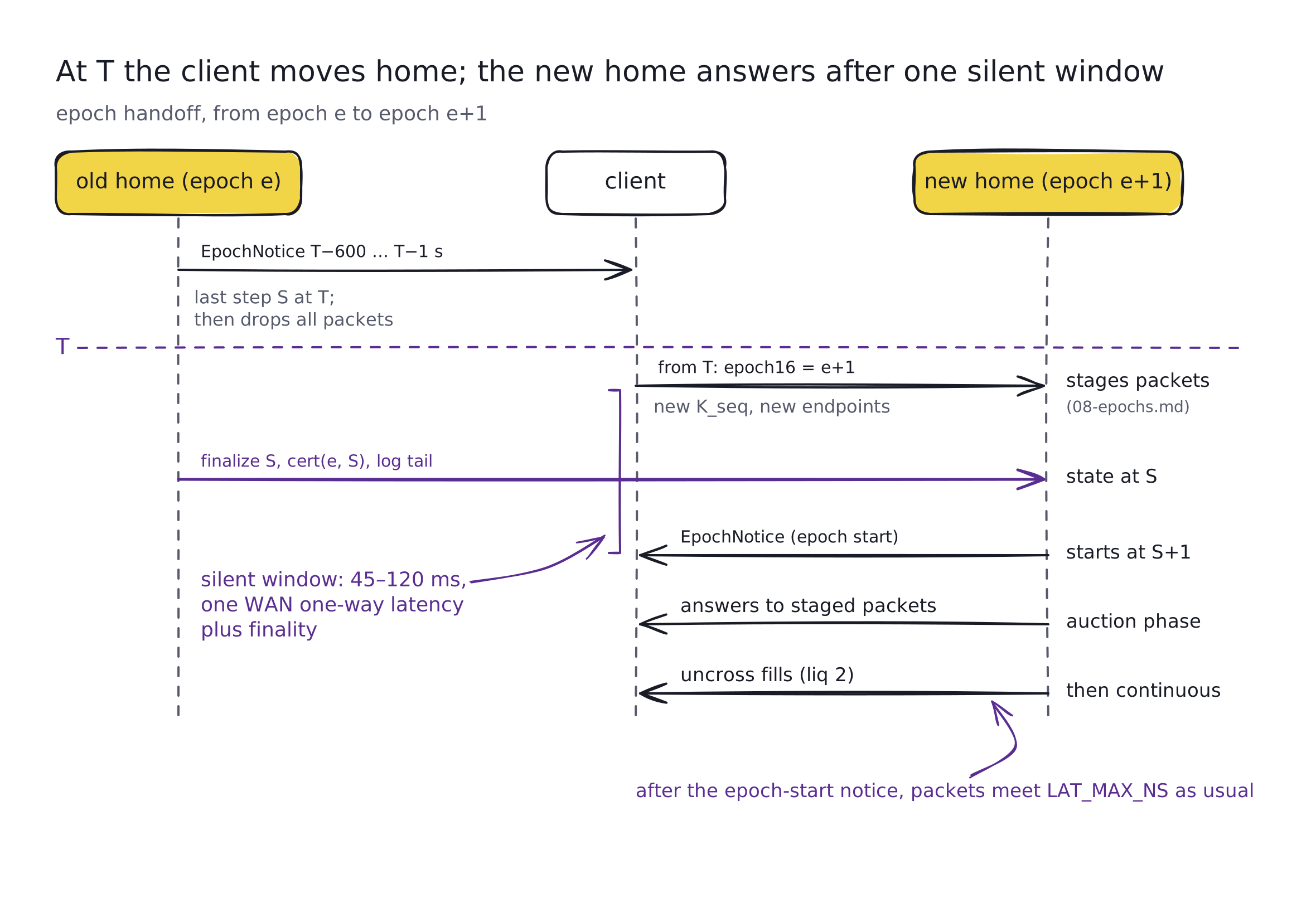
| H2 | At T, by its own clock (synchronized to ±1 ms, budget), the client stops sending to the old home. It sends every later packet to the new home's sequencer with epoch16 = e + 1, K_seq(e+1, b), and the new home's data tier. |
| H3 | It resends every packet not yet acknowledged to the new home, with bit0 = 1. Deduplication works because expected at step S is replicated state. |
| H4 | Between T and the epoch-start notice, the client sends each unacknowledged packet once and suspends its resend timer. The new home stages packets; it does not answer them yet. The silent window lasts one WAN one-way latency plus finality: 45–120 ms (DESIGN §6). |
| H5 | A packet with epoch16 = e + 1 that reaches the old home before T, or one with epoch16 = e that reaches the new home, gets out-of-stream EPOCH_MISMATCH, detail = the receiver's current epoch. |
| H6 | When the new sequencer starts, it runs §3 on the staged packets in rx_ts order. Before any other record, each session gets an epoch-start EpochNotice. Staged packets are the handoff window of 01 §14.0 item 2, the only window without a 1 µs answer: test D (§3.5) does not shed them, and the opening auction serves them. Packets sent after the epoch-start notice meet LAT_MAX_NS as usual. |
| H7 | Staged messages and messages until the uncross are in the auction phase (§6.9). |
| H8 | Sessions survive the boundary (01 §14.8): expected, next_resp, resting orders and handles carry over unchanged. A client does not reopen anything at a handoff unless its account moved lane (§4.7). |
| H9 | At the first step of each TYO epoch, before the auction, every resting Day order ends with Out cause EXPIRED (§6.2). |
6. Messages#
6.1 Rules for every message#
- Bytes 2–3 are 0 in every v1 message, and so is every field that 01 §6.2 marks 0 (M3).
client_tagis opaque. The exchange echoes it and never checks it for uniqueness.Replacehas noclient_tag; its records carry the stored tag of the order it replaces.- Handles. The lane assigns a
Handlewhen it accepts aNewor a priority-losingReplace. An operation on a handle succeeds only if the slot is live, its generation matches, and the order belongs to the session's account. Any other case isUNKNOWN_HANDLE, so a client cannot learn anything about another account's orders.PROTO_HANDLE_ALL= 0xFFFF_FFFF is never a real handle (slot 0xFF_FFFF is never allocated). - Handle reuse.
05-engine.mdallocates slots so that a slot is reused no sooner thanPROTO_HANDLE_REUSE_MIN_Safter its order ended. The client never sends a handle older than that past the order's last record. With an 8-bit generation a much older handle could match a newer order of the same account. - Effective point. Each message takes effect at one place in the total order: its
LaneSeqfor a lane op, its step for a BBO-core op. Messages of one packet take effect in index order.canceled qtyandTOO_LATEare evaluated at that place. - Order flags (01 §6.2): bit 0 side; bits 1–2 TIF (0
Day, 1IOC, 2FOK, 3AUCTION_ONLY); bit 3 post-only; bits 4–5 STP mode; bits 6–7 zero. - Invalid flag combinations get
BAD_TYPEwith detailPROTO_D_FLAGS: post-only withIOCorFOK(one must not take, the other must take or die), and post-only withAUCTION_ONLY(an auction has no maker).
6.2 New (0x01)#
Fields: flags, tick, qty, client_tag.
Validation, in M-order (§3.3):
| Check | Reason | Detail |
|---|---|---|
| phase (§6.9) | BOOK_HALTED, AUCTION_PHASE |
halt cause from 10; phase code |
tick = 0, or outside the price band of the lane's snapshot |
BAD_TICK |
nearest tick inside the band |
qty = 0, or > the book's max_order_qty |
BAD_QTY |
max_order_qty |
notional qty × price overflows u128 or the book's notional cap |
BAD_QTY |
PROTO_D_OVERFLOW |
| resting orders of the account ≥ its limit | RISK_ORDER_COUNT |
the limit |
| open exposure on that side would pass its limit | RISK_POSITION |
the limit |
reservation (buy: qty × price + max fee in quote; sell: qty in base, 01 §12.1) > free balance |
RISK_CREDIT |
shortfall, capped at u32::MAX |
| post-only and the order crosses the lane's snapshot | POST_ONLY_WOULD_CROSS |
opposite best tick of the snapshot |
Routing after validation:
| TIF | Class against the lane's snapshot | Goes to | Possible records, in order |
|---|---|---|---|
Day |
join | lane | Ack (after a cut includes it, INV-ACK-AFTER-CUT) |
Day |
improve | BBO core | Ack; or, if the true book has moved, Fill… then Ack or nothing (fully filled) |
Day |
cross | BBO core | Fill… then Ack for a rested remainder, or nothing if fully filled; Reject STP or Out STP (§6.8) |
IOC |
any | BBO core | Fill… then Out IOC_REMAINDER unless fully filled. Zero fills give Out IOC_REMAINDER with the full qty. |
FOK |
any | BBO core | Fill… summing to qty; or Reject FOK_UNFILLABLE, detail = qty available at or better than the limit (capped) |
AUCTION_ONLY |
none (auction phase only) | lane | Ack; at the uncross Fill (liq 2)… then Out AUCTION_UNFILLED for any remainder |
Notes:
IOCandFOKalways go to the BBO core, even if they look non-marketable against the lane's snapshot. A snapshot can be stale in the unsafe direction after an improve, and an IOC must trade against the true book. They are charged as crosses (§9).- A post-only improve can reach the BBO core and find that the true book crosses it. The BBO core
rejects it with
POST_ONLY_WOULD_CROSS. If a rescan (05-engine.md) finds a resting post-only order as the aggressor, that order ends withOutcausePOST_ONLY, after itsAck. - A taker gets one
Fillper price level, best level first (01 §6.4). The remainder of aDayorder rests at its own limittick, and itsAckcarries that tick. Daymeans the trading day. The trading day ends at the TYO boundary (00:00 UTC,EPOCH_BOUNDARIES_UTC). RestingDayorders survive the LDN and NYC handoffs and end withOut EXPIREDat the first step of the next TYO epoch (H9).
6.3 Cancel (0x02)#
Fields: handle, client_tag.
| Order state at the Cancel's effective point | Records |
|---|---|
| live (resting, or in the auction) | CancelAck(handle, canceled qty = open qty, client_tag) |
| ended, slot not yet reused | Reject TOO_LATE, detail = how it ended: PROTO_D_FILLED 1, PROTO_D_CANCELED 2, PROTO_D_OUT 3 |
| slot free, generation differs, or another account's order | Reject UNKNOWN_HANDLE, detail 0 |
Cancel against fill: the cut orders them (DESIGN §3). Fills at earlier steps reduce the open qty
first, so canceled qty is what was left. If nothing was left, the answer is TOO_LATE. Every
Fill of the order that precedes the Cancel in the total order has a lower resp_seq than the
CancelAck (R-HANDLE, §7.2).
6.4 Reduce (0x03)#
Fields: handle, reduce_by, client_tag.
reduce_by = 0→Reject BAD_QTY.- Live order:
canceled = min(reduce_by, open). The open qty and the order's total qty both fall bycanceled. The order keeps its handle and its time priority. Record:CancelAck(handle, canceled, client_tag). - Reduce to 0. If
reduce_by ≥ open, the order ends. The record is the sameCancelAck, withcanceled = open. The client knows the order ended because its open qty, tracked inresp_seqorder, is now 0 (§10). - Ended order →
TOO_LATE. Unknown handle →UNKNOWN_HANDLE. Both as forCancel.
6.5 Replace (0x04)#
Fields: flags (the full order flags of the replacement; the side must match), handle, new
tick, new qty.
qty is the new total quantity of the order, filled part included. Let total be the order's
quantity after earlier Reduces, cum its filled quantity, and open = total − cum. Total-qty
semantics mean that a fill racing the Replace can never make the account trade more than the new
qty.
Lane checks, in this order. Any failure gives one Reject with the order's stored client_tag
and leaves the old order untouched:
| Check | Reason |
|---|---|
| handle unknown / ended | UNKNOWN_HANDLE / TOO_LATE |
| side differs | SIDE_MISMATCH |
| phase (§6.9) | BOOK_HALTED, AUCTION_PHASE |
new tick out of band or 0 |
BAD_TICK |
new qty = 0 (use Cancel); or same tick, same total, same flags |
BAD_QTY (detail 0, or PROTO_D_NO_CHANGE) |
| invalid flag combination | BAD_TYPE (PROTO_D_FLAGS) |
| risk of the new reservation, net of the old one | RISK_* |
| post-only crosses the lane's snapshot | POST_ONLY_WOULD_CROSS |
Then one of two cases:
| Case | Condition | Effect | Records |
|---|---|---|---|
| Reduction | same tick, same flags, new qty < total |
executed as Reduce by total − qty: same handle, priority kept |
CancelAck(handle, min(total − qty, open)) |
| Priority loss | anything else | at the effective point, the old order is canceled. If qty > cum, a new order enters with a new handle, open = qty − cum, the new tick and flags, and is classified and routed like a New. If qty ≤ cum, no new order enters. |
CancelAck(old handle, open of old), then the new order's records (§6.2), all with the Replace's index |
- A priority-loss Replace whose new order goes to the BBO core has all its records, the
CancelAckof the old order included, in the B-packet (§7.1). So theCancelAckalways comes first. - Outcomes that only the BBO core can decide (fills,
STP,POST_ONLY_WOULD_CROSSagainst the true book,FOK_UNFILLABLE) happen after the old order is canceled. They are outcomes of the new order, not a rejection of the Replace. - The client tells the cases apart by the handle: the same handle in the
CancelAckand noAckmeans a reduction. A new handle means priority was lost.
6.6 CancelAll (0x12)#
Fields: client_tag. Scope: every live order that this session entered in the packet's book
and whose New or Replace precedes the CancelAll in the total order. Orders of other sessions
of the same account are not touched (use vyrn-admin for an account-wide kill).
Records, all with the CancelAll's index and client_tag:
- one
CancelAck(handle, canceled qty)per canceled order, in ascending handle order; - then a summary
CancelAck(PROTO_HANDLE_ALL, number of orders canceled). The summary is always sent, also when the count is 0, so the client knows the CancelAll is complete.
The CancelAll takes effect at once, at its effective point, with one AcctKill write
(05-engine.md §4.7): from that point no covered order can trade. So its apply cost does not grow
with the order count, and its first record leaves within LAT_MAX_NS like any message. Only the
per-order records grow with the count. They follow in later L-packets with echo_pkt = p at the
lane's record rate, and the summary comes last. CancelAll draws PROTO_CANCELALL_TOKENS
message tokens, so it cannot be used to stall a lane.
An order still at the BBO core at the CancelAll's effective point is canceled if it comes to
rest; 05-engine.md defines how the lane learns that.
6.7 Heartbeat (0x10) and ResendReq (0x11)#
Heartbeat has no fields. It produces no record of its own. A packet whose messages produce no
record gets an EpochNotice (R-ANSWER, §7.2), so a heartbeat sent alone is always answered. It consumes a pkt_seq like any packet and draws from the packet bucket.
ResendReq(from, to) asks the lane to resend in-stream packets from … to, inclusive:
| Condition | Result |
|---|---|
from = 0, or from > to |
Reject BAD_SEQ, detail = next_resp − 1 |
to ≥ next_resp (not yet sent) |
Reject BAD_SEQ, detail = next_resp − 1 |
to − from + 1 > PROTO_LANE_RESEND_MAX |
Reject BAD_SEQ, detail = from + PROTO_LANE_RESEND_MAX − 1 |
from older than the lane's ring, still held by recovery |
Reject BAD_SEQ, detail = the oldest resp_seq the recovery service holds; use recovery (§5.4) |
from older than both stores |
Reject RESEND_GONE (22), detail = the oldest resp_seq either holds (§5.4) |
| otherwise | the packets, resent with bit0 = 1 |
A resent packet keeps its resp_seq, echo_pkt, count and records. Its epoch16 and tag are
those of the epoch and the box that resends it. The resends are not in-stream records, so a
packet that holds only ResendReq messages also gets an EpochNotice (R-ANSWER). Resends draw
from the RESEND bucket (§9). The resent packets are copies and change no state.
6.8 STP#
STP prevents a trade between two orders of the same AccountId. Only the aggressor's mode
applies (the order that is later in the total order, also in a rescan).
| Mode | Resting order | Aggressor, no fill yet | Aggressor, after some fills |
|---|---|---|---|
| 0 none | trades | trades | trades |
| 1 cancel newest | untouched | Reject STP, detail = the resting handle |
Out STP, qty out = remaining |
| 2 cancel oldest | Out STP (unsolicited, to its session) |
continues matching | continues matching |
| 3 cancel both | Out STP (unsolicited) |
Reject STP |
Out STP |
Mode 0 allows self-trades. 10-accounts-risk-md.md monitors them. STP in the opening auction
uncross follows 08-epochs.md.
6.9 Book phases#
| Message | CONTINUOUS |
AUCTION (opening auction after a handoff) |
HALTED |
|---|---|---|---|
New Day |
yes | yes: rests in the auction, Ack now, fills at the uncross, then rests on |
BOOK_HALTED |
New IOC, New FOK |
yes | AUCTION_PHASE |
BOOK_HALTED |
New post-only |
yes | AUCTION_PHASE |
BOOK_HALTED |
New AUCTION_ONLY |
AUCTION_PHASE |
yes: ends at the uncross | BOOK_HALTED |
Replace |
yes | yes, with the rules of the new order's TIF | BOOK_HALTED |
Cancel, Reduce, CancelAll |
yes | yes | yes |
Heartbeat, ResendReq |
yes | yes | yes |
The AUCTION_PHASE detail is the current phase (PROTO_PHASE_*: 1 continuous, 2 auction,
3 halted). Resting orders stay in a halted book. 08-epochs.md owns the auction's timing and its
uncross. 10-accounts-risk-md.md owns halts.
7. Responses#
7.1 Producers and the resp_seq allocator#
Two kinds of core send a session's response packets: its lane and the TX cores (TX-A, TX-B,
TX-C on cores 3, 5 and 0, 01 §14.17.3). Only the lane allocates resp_seq; a TX core uses
numbers the lane reserved for it.
| Producer | Sends | resp_seq |
|---|---|---|
| The session's lane | records of lane-local messages (joins, cancels, reduces, lane rejects, CancelAll); auction fills; EpochNotice; COD and expiry Out; overflow records of the B-packet |
allocates |
| The TX core on CCD 0 | the B-packet: the records of the BBO-routed messages of one request packet (taker Fill, Ack of a rested remainder or an improve, Out, BBO-core Reject, the old-order CancelAck of a priority-loss Replace); maker packets: the maker Fill and unsolicited Out STP of a resting order, in the step that caused them |
B-packet: the value the lane reserved; maker packets: the session's maker range |
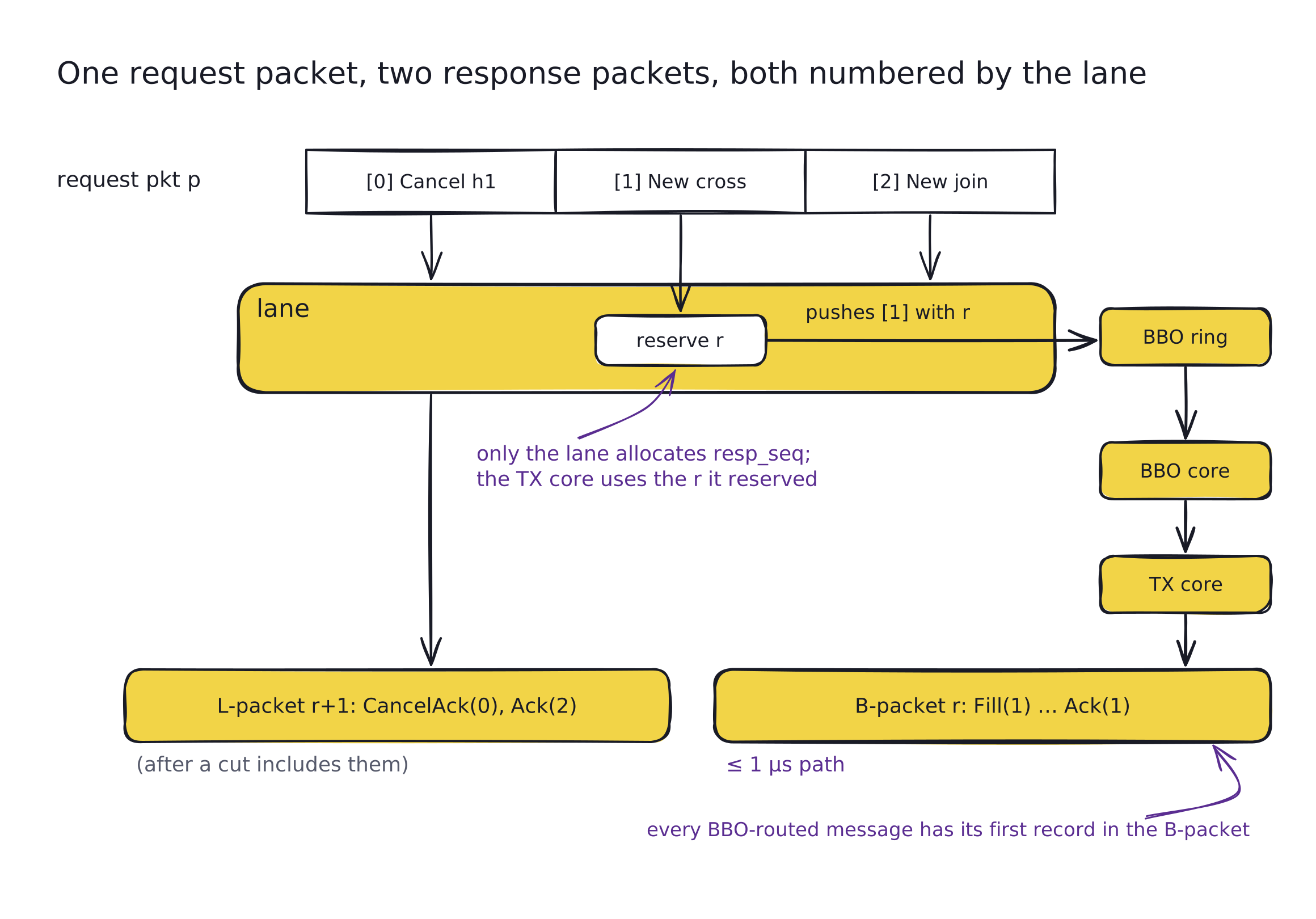
Reservation. When the lane accepts a request packet with at least one BBO-routed message, it
allocates resp_seq r for the B-packet before any other resp_seq of that packet, and passes r
with the first message it pushes to the BBO core. The lane's own packet for the same request (the
L-packet) gets r + 1. A request packet with no BBO-routed message gets only an L-packet.
ASCII original
 request pkt p:  [0] Cancel h1   [1] New cross   [2] New join
                      │               │               │
 lane:                │  reserve r ───┼──► BBO ring   │
                      ▼               │               ▼
                 L-packet r+1: CancelAck(0), Ack(2)   (after a cut includes them)
 BBO core → TX core:  └────────────► B-packet r: Fill(1) … Ack(1)   (≤ 1 µs path)
Rules:
- A B-packet is never empty: every BBO-routed message yields at least one record.
- The B-packet holds up to 16 records of the packet's BBO-routed messages, in index order. The TX
core keeps one slot free for each later BBO-routed message of the packet (the lane passes their
count with the first push), so every BBO-routed message has its first record in the
B-packet, which leaves within
LAT_MAX_NS. A message's records that do not fit are its later fills and terminal record. The lane settles the taker side from the fill events, so it knows which records did not fit. It sends them in its next packets withecho_pkt = p, before any later record of the session. The L-packet follows the same rule for lane-local messages. - Maker fills (01 §14.14, §14.17.5). The TX cores send them in the step that made them, right
after the taker's B-packet, with no hop through the maker's lane: +16 ns per maker packet on
each TX core (
PROTO_MAKER_PKT_NS, budget). The maker fills of the first steps of a sweep leave withinLAT_MAX_NSof the first bit of the taker's packet; 01 puts this at about 40 makers at index 9, more at lower indices. The maker fills of later continuation steps leave withinLAT_MAX_NSof the start of their own step. The taker's first fill is always within 1 µs. A maker fill is a notice to another client, not the response to the maker's own packet, so this exempts no response. The maker's lane still settles the balance from the fill event, off the latency path, and appends the packet to its response ring then. - Maker range. For each session with resting orders, the lane keeps a credit of
PROTO_MAKER_RANGE= 16 numbers in the session's maker-range line, which the lane writes and the TX core reads. The TX core takes the next number of the credit for each maker packet and writes its ownusedcounter. The lane refills the credit by 16 when its applied fill events show 8 used. One step writes at mostSTEP_FILL_CAP= 64 fill records (01 §14.15), so it needs at most 4 maker packets of one session, and a longer sweep continues in further steps. The credit is therefore never exceeded, and every order hit gets its maker record from the TX core. - Numbering rule (gapless, R-DET). A session's
resp_seqorder is the merge of the maker packets, in step order, with the lane-numbered packets (B-packet reservations, L-packets, unsolicited lane packets), each of which sits at a lane position q (aLaneSeq). A maker packet of step s comes before a lane packet at q exactly whencut_s[lane] < q. To place a packet at q, the lane writes(close_seq = q, n)to the maker-range line before it publishes q, so every step whose cut includes q shifts the rest of the credit up by n. The lane numbers its packet after it has applied the fill events of every step before the first cut that includes q; it already waits for that before aCancelAck(R-HANDLE). So the numbers are relative, not a fixed absolute block: an unused number of the credit is never a gap, and an order's fills always follow itsAckinresp_seqorder. - This keeps
INV-WRITER: the lane is the only writer ofnext_resp, of the credit and ofclose_seq; the TX core is the only writer ofused. Both fill paths stay inside CCD 0 as in DESIGN §4.
7.2 Rules for in-stream packets#
| ID | Rule |
|---|---|
| R-ANSWER | Every accepted request packet gets at least one in-stream record with echo_pkt = pkt_seq. If its messages produce no in-stream record (only Heartbeat and ResendReq), the lane adds one EpochNotice. |
| R-ECHO | A packet with echo_pkt = p ≥ 1 holds only records that answer request p. Unsolicited records, maker packets included, go in packets with echo_pkt = 0. No producer delays a record to fill a packet. |
| R-MAKER | In one step, the taker's B-packet leaves before any maker packet. Maker packets of the first steps of a sweep leave within LAT_MAX_NS of the taker packet's first bit; those of later continuation steps within LAT_MAX_NS of their own step's start (01 §14.17.5). A maker packet may arrive before a lower-numbered lane packet of the maker's session; the client reorders by resp_seq (§5.3). |
| R-FIRST | Every response is frame-gated (01 §14.5, INV-FRAME-FIRST). An in-stream response, acks included, leaves only after the records of every op in the cut it depends on, and the record of its step, left on both replication paths. Core 4 drains the lanes' pre-encoded order rings, so the gate is normally open already (10 ns budget for acks, 60 ns for fills). |
| R-1US | The first record of every message of an accepted packet, at every index 0–9, leaves within LAT_MAX_NS (01 §14.0). So do the whole B-packet and the first L-packet. Maker packets follow R-MAKER. Only overflow records of a message or order already answered, CancelAll's per-order records after the first, and resends follow later. |
| R-INDEX | Inside one packet, records are in ascending message index. Records of one message are in execution order: fills best level first, then the terminal record. |
| R-HANDLE | For one handle, records appear in resp_seq order in the order of their events in the total order. A CancelAck or TOO_LATE follows every Fill that precedes it. |
| R-ACROSS | Records of different messages of one request may sit in different packets (B and L) in either resp_seq order. The client matches them by index. Arrival order across B and L says nothing about execution order; the outcome is always that of index order (§3.1). |
| R-DET | The records of every in-stream packet are a function of the order stream. After a failover or a handoff, a resent packet has the same resp_seq and the same records. |
| R-MAX | At most 16 records per packet (01 §6.3). |
7.3 Records#
| Record | Emitted when | Fields as used |
|---|---|---|
Ack 0x81 |
An order comes to rest: a join after its cut, an improve at its step, the remainder of a cross, a priority-loss Replace's new order, an order that enters the auction. Never for an order that never rests. | index; handle; tick = resting tick; client_tag. The resting qty is the order qty minus the fills before the Ack. |
Fill 0x82 |
An order trades. | index = the taker's message index, or 0xFF for a maker or auction fill; liq: 0 maker, 1 taker, 2 auction fill (01 §14.10); handle; tick = execution price; qty. |
Reject 0x83 |
A message, a packet (index 0xFF) or the session (index 0xFF, final record) is refused. | index; reason (§8); detail; bytes 8–11 = 0; client_tag (0 for index 0xFF). |
CancelAck 0x84 |
A Cancel, Reduce, reduction Replace, priority-loss Replace (old order), or CancelAll takes effect. |
index; handle or PROTO_HANDLE_ALL; canceled qty, or the order count for the summary; client_tag. |
Out 0x85 |
The exchange ends an order, or the rest of one. | index = the message index if it answers a message, else 0xFF; cause (below); handle; qty out; client_tag = the order's stored tag. |
EpochNotice 0x86 |
§7.4 | — |
Bust 0x87 |
CHAIN only: a fill that cannot settle is reversed (01 §14.10, 09-chain.md). |
layout in 09 |
Attest 0x88 (01 §14.10) |
Out of stream: a cumulative durability, finality or settlement point for the session (§7.5). | §7.5 |
Reject versus Out: Reject means the message had no effect on the book. Out means an order
that was in the matching step leaves the book. Reject STP and Reject FOK_UNFILLABLE are kills
with no fill; Out STP and Out IOC_REMAINDER follow fills or a match attempt.
Out cause (PROTO_OUT_*) |
Value | When |
|---|---|---|
IOC_REMAINDER |
1 | the unfilled part of an IOC (01 §14.10) |
STP |
2 | §6.8 (01 §14.10) |
AUCTION_UNFILLED |
3 | the unfilled part of an AUCTION_ONLY order at the uncross (01 §14.10) |
EXPIRED |
4 | a Day order at the end of the trading day (H9) (01 §14.10) |
POST_ONLY |
5 | a resting post-only order that a rescan found as the aggressor (01 §14.10) |
LANE_MOVED |
6 | the account moved lane at a boundary (§4.7) (01 §14.10) |
DISCONNECT |
7 | cancel-on-disconnect (§4.9) (01 §14.10) |
ADMIN |
8 | operator or risk action, account kill included (10-accounts-risk-md.md) (01 §14.10) |
There is no FOK cause: an unfillable FOK is always Reject FOK_UNFILLABLE (01 §14.10).
7.4 EpochNotice#
Fields: bytes 4–7 next epoch (u32); bytes 8–11 the home word: byte 8 = HomeCode, byte 9
= the sequencer box index in that epoch (0xFF if not yet fixed), bytes 10–11 = 0; bytes 12–15
seconds to boundary = ⌊(boundary_ts − lane time) / 10^9⌋, saturating at 0. Lane time is
order-stream time (§4.8), so the value is deterministic.
| Variant | When | next epoch |
home word |
|---|---|---|---|
| Answer | R-ANSWER, for example a Heartbeat |
e + 1 | home and box of e + 1 |
| Countdown | unsolicited, at T − 600 s, T − 60 s, T − 10 s, T − 1 s | e + 1 | home and box of e + 1 |
| Epoch start | the first in-stream record of each session in a new epoch (H6) | e + 1 of the new epoch | home and box of that next epoch |
| Sequencer change | the first record from a new sequencer after a failover (§5.6) | e, the current epoch | current home, the new box index |
The client reads the variant from next epoch: equal to the current epoch means a sequencer
change, which also starts the rewind rule (§5.6). The current epoch is the full epoch whose low
16 bits are the packet's epoch16.
7.5 What a record attests: execution, durability, finality, settlement#
01 §14.13 item 3 separates four facts. They come in this order. The protocol never merges them into one "confirmed" flag, and a client must not either.
| Level | Fact | Holds when | The client learns it from |
|---|---|---|---|
0 EXECUTED |
The sequencer executed the op. Volatile. | The in-stream record leaves (≤ LAT_MAX_NS). By R-FIRST its frames had left on both paths, so a sequencer crash alone cannot void it. |
The record itself: Fill, Ack, CancelAck, Out, Reject. |
1 DURABLE |
At least F + 1 replicas hold the records, so no single fault can lose them. |
The replicas' frame acknowledgements (07-replication.md). |
Attest level 1; the drop copy. |
2 FINAL |
The block that holds the records has a certificate (INV-QUORUM). |
≤ FINALITY_MAX_MS = 10 ms for every accepted order (01 §14.9). |
Attest level 2; the drop copy, which is authoritative. |
3 SETTLED |
CHAIN only: the fill is settled on the ledger or the bridge. | 09-chain.md. |
Attest level 3; the drop copy; a Bust 0x87 if it cannot settle. |
Attest (0x88, 01 §14.10). An out-of-stream response packet (resp_seq 0,
echo_pkt 0) with one record:
off size field
  0   1  type      0x88
  1   1  level     1 DURABLE, 2 FINAL, 3 SETTLED
  2   2  reserved  0
  4   4  upto      every in-stream record of this session with resp_seq ≤ upto has this level
  8   4  height    low 32 bits of the block Height that reached it
 12   4  reserved  0
- The lane sends it from idle time, never on the 1 µs path, at most once per level per
BLOCK_NSper session, and only whenuptomoved. A lostAttestis replaced by the next one, so it is not retained or resent. Its frame gate is empty: it reports, it changes nothing. - A client that wants it sets
attestat open (OpenSessionReq, §4.4). Every client can get the same facts per fill from the drop copy, which labels each level separately (10). - A record at level 1 or above is never voided by the rewind rule (§5.6): a void record is one
whose frames no replica holds. A level-2 record is irreversible. In CHAIN only a
Bustcan undo a final fill, and only as settlement fails (09).
8. Reject reasons#
"In" means in-stream (accepted packet, consumes pkt_seq, retained, resendable). "Out" means
out-of-stream (resp_seq 0, not accepted, the client resends the same logical content later).
| Code | Name | Stream | Where | Detail | Client action |
|---|---|---|---|---|---|
| 1 | BAD_MAC |
in, final | V6 | offending pkt_seq |
session is CLOSED; find the key bug; open a new session |
| 2 | BAD_SEQ |
out (gap, duplicate not in ring); in (ResendReq) |
V8; §6.7 | expected, or the limit of §6.7 |
gap: resend from detail; ResendReq: fix the range or ask the other store (§5.4) |
| 3 | BAD_TYPE |
in | V9, M2, M3 | PROTO_D_UNKNOWN_TYPE, _RESERVED, _FLAGS, _BAD_HDR |
client bug; do not resend the same content |
| 4 | BAD_TICK |
in | M6 | nearest tick inside the band | reprice |
| 5 | BAD_QTY |
in | M6 | max_order_qty, PROTO_D_OVERFLOW, PROTO_D_NO_CHANGE |
fix the qty |
| 6 | RISK_CREDIT |
in | M7 | shortfall (capped) | fund the book allocation (01 §12.4) |
| 7 | RISK_POSITION |
in | M7 | the limit | reduce exposure |
| 8 | RISK_ORDER_COUNT |
in | M7 | the limit | cancel orders first |
| 9 | RATE_LIMIT |
in | V10, M1, M8 | bucket id (§9) | slow down; the bucket refills on rx_ts time |
| 10 | POST_ONLY_WOULD_CROSS |
in | M8 (lane), BBO core | opposite best tick seen | reprice |
| 11 | FOK_UNFILLABLE |
in | BBO core | qty available at or better than the limit (capped) | — |
| 12 | UNKNOWN_HANDLE |
in | M6 | 0 | check the client's handle table |
| 13 | TOO_LATE |
in | M6, BBO core | PROTO_D_FILLED, _CANCELED, _OUT |
the order already ended; its records precede this one |
| 14 | BOOK_HALTED |
in | M5 | halt cause (10) | wait for the book to reopen |
| 15 | EPOCH_MISMATCH |
out | V4 | the receiver's current epoch | switch keys and endpoints (§5.7); resend |
| 16 | STP |
in | BBO core | the resting handle that stopped it | — |
| 17 | WRONG_LANE |
out | §3.2 | the correct LaneId |
fix the port; resend |
| 18 | SESSION_CLOSED |
out (closed session); in (DRAINING, final record) |
V7, M4, close | close cause (§4.3) | open a new session, or stop sending New |
| 19 | AUCTION_PHASE |
in | M5 | PROTO_PHASE_* |
resend after the phase changes, with a TIF that fits |
| 20 | SIDE_MISMATCH |
in | M6 | 0 | cancel and send a New |
| 21 | ACCOUNT_KILLED |
in | M4 | 0 | the account is killed (10 §3.7); cancels still work; wait for an unkill |
| 22 | RESEND_GONE |
in (lane ResendReq); out (recovery) |
§6.7, §5.4 | the oldest resp_seq either store holds |
rebuild order state from the drop copy |
| 23 | BAD_BOOK |
in | V9 | the packet's book |
client bug: the session may not trade that book |
| 24 | BUSY |
out (lane shed, index 0xFF); in (BBO shed, message index) | test D (§3.5) | expected (lane); 0 (BBO) |
lane: resend from detail, same pkt_seq; BBO: resend the message in a new packet |
9. Rate limits and fee classes#
9.1 Buckets#
Every bucket is a GCRA (a token bucket written as one timestamp). All values are integers in
nanoseconds of rx_ts, so a replica that replays the PacketRecords gets the same decisions
(INV-DET). The bucket state is part of the lane's replicated state.
struct Gcra { tat: Nanos, t_ns: u64, burst: u64 }        // t_ns = 10^9 / rate, set at open
impl Gcra {
    /// Takes `cost` tokens at order-stream time `now` unless fewer than `keep` would be left.
    fn take(&mut self, now: Nanos, cost: u64, keep: u64) -> bool {
        let base = max(self.tat, now);
        let next = base + cost * self.t_ns;              // checked in the real code (01 §11 rule 4)
        if next > now + (self.burst - keep) * self.t_ns { return false; }
        self.tat = next;
        true
    }
}
| Bucket id | Bucket | Scope | Charged at | Cost | Default, tier T1 (budget) |
|---|---|---|---|---|---|
| 1 / 4 | PKT |
session / account | V10, every accepted packet | 1 | 1M/s, burst 256 |
| 2 / 5 | MSG |
session / account | M1, every message | 1; CancelAll PROTO_CANCELALL_TOKENS |
5M/s, burst 2,560 |
| 3 / 6 | BBO |
session / account | M8, after classification | cross, IOC, FOK: 5; improve: 1 |
100k cross-equivalents/s, burst 640 units |
| 7 | RESEND |
session | §5.2, §6.7 | 1 per resent packet | 100k/s, burst 1,024 |
- Cancel reserve.
Newand priority-losingReplacetake fromMSGwithkeep = PROTO_CANCEL_RESERVE(a quarter of the burst).Cancel,ReduceandCancelAllusekeep = 0. So a client at its limit can still cancel. - BBO units. The BBO core spends
BBO_CROSS_NSper cross andBBO_IMPROVE_NSper improve, a 5 : 1 ratio, so theBBObucket counts improves as 1 unit and crosses as 5. One book can take 0.6 × 10^9 / 8 = 75M units/s atBBO_MAX_LOAD(computed), which coversCROSS_CAPcrosses (50M units) plus 20M improves (DESIGN §3). - Admission.
vyrn-adminadmits a session only if the committedMSGrates of the lane's sessions sum to ≤ 0.6 × 10^9 /LANE_NS_PER_MSG= 20M/s, and the committedBBOrates of the book sum to ≤ 70M units/s (budget). Admission does not make the 1 µs hold; test D does, at any load (§3.5). Admission keepsBUSYwithin each lane class's bound (§3.6, B3). 10-accounts-risk-md.mdowns the tiers T0–T3 and their prices. The defaults above are this chapter's budget for T1.
9.2 Fee classes#
Each message gets one fee class from its routing. 10-accounts-risk-md.md owns the amounts and
how they are settled. The lane accrues the count per class in the account's lane state.
| Class | Messages | Price level |
|---|---|---|
CONTROL |
Heartbeat, ResendReq; any message rejected with RATE_LIMIT or BUSY |
free |
CANCEL |
Cancel, Reduce, CancelAll, reduction Replace |
cheap |
JOIN |
New or Replace classified as a join; any other lane-level reject |
cheap |
IMPROVE |
classified as an improve | priced |
CROSS |
classified as a cross; every IOC and FOK; BBO-core rejects |
priced |
A priority-loss Replace is charged CANCEL plus the class of its new order. A lane-level reject
is charged JOIN because it used lane time. A RATE_LIMIT reject is free because the bucket
already stops the flood.
10. The order as the client sees it#
10.1 Client state machine#
The client runs one machine per order, keyed by (pkt_seq, index) until the first record gives
it a handle, and by handle after that. It feeds records in resp_seq order (§5.3). It tracks
open = order qty − fills − canceled qty.
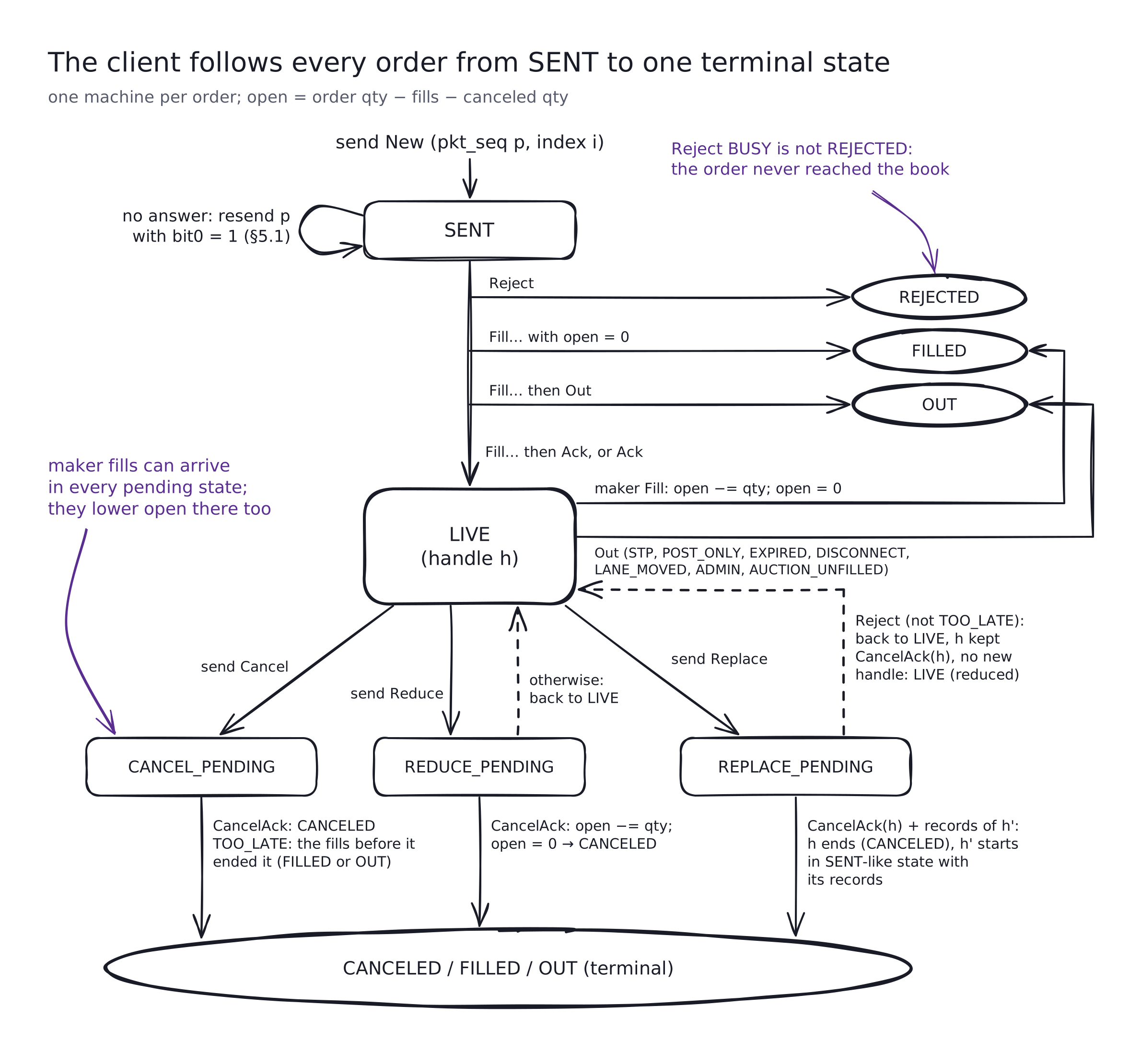
ASCII original
                    send New (pkt_seq p, index i)
                                │
                                ▼
                         ┌─────────────┐ no answer: resend p with bit0 = 1 (§5.1)
                         │   SENT      │◄──────────────┐
                         └──────┬──────┘───────────────┘
        Reject ─────────────────┼────────────────────────────────────► REJECTED
        Fill… with open = 0 ────┼────────────────────────────────────► FILLED
        Fill… then Out ─────────┼────────────────────────────────────► OUT
        Fill… then Ack, or Ack  │
                                ▼
                         ┌─────────────┐  maker Fill: open −= qty; open = 0 ──► FILLED
                         │    LIVE     │  Out (STP, POST_ONLY, EXPIRED, DISCONNECT,
                         │  (handle h) │       LANE_MOVED, ADMIN, AUCTION_UNFILLED) ──► OUT
                         └──┬───┬───┬──┘
              send Cancel   │   │   │ send Replace
                            ▼   │   ▼
                 ┌──────────────┐ │ ┌────────────────┐
                 │CANCEL_PENDING│ │ │REPLACE_PENDING │ Reject (not TOO_LATE): back to LIVE, h kept
                 └──────┬───────┘ │ └───────┬────────┘ CancelAck(h), no new handle: LIVE (reduced)
     CancelAck: CANCELED│         │         │          CancelAck(h) + records of h': h ends
     TOO_LATE: the fills│  send   │         │          (CANCELED), h' starts in SENT-like
     before it ended it │  Reduce ▼         │          state with its records
     (FILLED or OUT)    │  REDUCE_PENDING: CancelAck: open −= qty; open = 0 ──► CANCELED
                        ▼                   otherwise back to LIVE
             CANCELED / FILLED / OUT (terminal)
Maker fills can arrive in every pending state. They lower open there too. A CancelAck after
them reports only what was left. Reject BUSY is not REJECTED: the order never reached the
book, so the client may send it again (§3.5). Each terminal state is level 0 (EXECUTED) until
an Attest or the drop copy raises it (§7.5).
Rewind. On a sequencer-change notice with resp_seq r, the client drops the effects of every
record with resp_seq ≥ r that it got from the old sequencer, by replaying its own record log up
to r − 1. Then it resends its unacknowledged packets (§5.6).
10.2 What the client can rely on#
| ID | Guarantee | Source |
|---|---|---|
| G1 | Each (session, pkt_seq) is executed at most once, in every box and every home. A resend is always safe. |
§5.2 |
| G2 | Every accepted packet gets at least one in-stream record that names it. | R-ANSWER |
| G3 | Every message gets at least one record with its index. The message is complete when its records reach one of the end shapes of §6. | §6 |
| G4 | The messages of one packet take effect in index order. | §6.1 |
| G5 | The records of one handle are in resp_seq order of their events in the total order. |
R-HANDLE |
| G6 | resp_seq has no gaps. A gap is always a loss, never a skipped number. |
§5.3 |
| G7 | A resent or regenerated packet has the same records as the original. | R-DET |
| G8 | Every in-stream record left after its order-stream records left on both paths; a sequencer crash alone never voids it. It is void only after a sequencer-change notice says so, and never once it is DURABLE. |
R-FIRST, §5.6, §7.5 |
| G9 | Every message, at every index 0–9 and of every type, of every accepted packet of up to 10 messages gets its first record within LAT_MAX_NS, as a maximum; the B-packet and the first L-packet leave within it too. A packet or op that cannot meet it gets Reject BUSY within LAT_MAX_NS. No load, rate or position condition applies. |
R-1US, §3.5, 01 §14.0 |
| G10 | A paced client on a dedicated lane never gets a lane-stage BUSY; its total BUSY is ≤ 10⁻⁵ at full book load and ≤ 10⁻⁸ at ≤ 20%. A pooled client gets ≈ 10⁻³ and ≤ 10⁻⁶ (§3.6). |
LANE_PACE, 01 §14.17.2 |
| G10 | A record attests execution only. Durability, finality (≤ FINALITY_MAX_MS = 10 ms for every accepted order) and settlement are separate facts, reported by Attest and the drop copy (10-accounts-risk-md.md). |
§7.5, 07, 10 |
11. Conformance test vectors#
The script below is pure Python 3 with only the standard library. It first checks SipHash-2-4
against the reference vector of the SipHash paper (key = bytes 00..0f, message = bytes 00..0e →
0xa129ca6149be45e5) and two more vectors of the same table, then builds the packets. Run it with
python3 -I. 11-build.md turns every vector into a test of vyrn-wire.
Keys (test only, never production):
| Key | Bytes |
|---|---|
K_seq |
00 01 02 03 04 05 06 07 08 09 0a 0b 0c 0d 0e 0f |
K_out |
10 11 12 13 14 15 16 17 18 19 1a 1b 1c 1d 1e 1f |
K_com |
20 21 22 23 24 25 26 27 28 29 2a 2b 2c 2d 2e 2f |
Scenario: epoch 1000 (epoch16 = 0x03e8), book 1. Session A = slot 7, lane 3, generation 1
(0x00103007). Session B = slot 9, lane 5, generation 1 (0x00105009), another account.
Session C = slot 2, lane 0, generation 4 (0x00400002), CHAIN mode. The lane's snapshot bid is
100001 or better when V1 and V3 arrive, so both orders are joins and go in L-packets. Before V5,
the only bids are A4 (8 @ 100001) and 1 lot @ 100000. V11 answers the first transmission of V12,
which carried epoch16 = 999; V12 is the same logical content resent with epoch16 = 1000 (D3).
V12 also gets an R-ANSWER EpochNotice as resp_seq 5 (not printed), so V15 is resp_seq 6.
V16 reaches lane 3 when test D (§3.5) fails, so the lane sheds it: V17 is the out-of-stream
BUSY (resp_seq 0, echo_pkt 6, detail = expected = 6), and nothing was applied. V18 is the
client's resend of the same pkt_seq with the same logical content and bit0 = 1; the lane
accepts it as a first acceptance.
#!/usr/bin/env python3
"""VYRN      04-protocol conformance vectors. Pure Python 3, standard library only."""
import struct

MASK = (1 << 64) - 1


def rotl(x: int, b: int) -> int:
    return ((x << b) | (x >> (64 - b))) & MASK


def siphash24(key: bytes, msg: bytes) -> int:
    """SipHash-2-4, 128-bit key, 64-bit tag (as an integer; on the wire it is little-endian)."""
    if len(key) != 16:
        raise ValueError(f"SipHash key must be 16 bytes, got {len(key)}")
    k0, k1 = struct.unpack("<QQ", key)
    v = [k0 ^ 0x736F6D6570736575, k1 ^ 0x646F72616E646F6D,
         k0 ^ 0x6C7967656E657261, k1 ^ 0x7465646279746573]

    def rnd() -> None:
        v[0] = (v[0] + v[1]) & MASK; v[1] = rotl(v[1], 13); v[1] ^= v[0]; v[0] = rotl(v[0], 32)
        v[2] = (v[2] + v[3]) & MASK; v[3] = rotl(v[3], 16); v[3] ^= v[2]
        v[0] = (v[0] + v[3]) & MASK; v[3] = rotl(v[3], 21); v[3] ^= v[0]
        v[2] = (v[2] + v[1]) & MASK; v[1] = rotl(v[1], 17); v[1] ^= v[2]; v[2] = rotl(v[2], 32)

    end = len(msg) - len(msg) % 8
    for i in range(0, end, 8):
        m = struct.unpack_from("<Q", msg, i)[0]
        v[3] ^= m; rnd(); rnd(); v[0] ^= m
    b = ((len(msg) & 0xFF) << 56) | int.from_bytes(msg[end:], "little")
    v[3] ^= b; rnd(); rnd(); v[0] ^= b
    v[2] ^= 0xFF
    for _ in range(4):
        rnd()
    return v[0] ^ v[1] ^ v[2] ^ v[3]


# Reference vectors from the SipHash paper (key 00..0f, message 00..len-1).
for n, want in [(15, 0xA129CA6149BE45E5), (0, 0x726FDB47DD0E0E31), (8, 0x93F5F5799A932462)]:
    got = siphash24(bytes(range(16)), bytes(range(n)))
    if got != want:
        raise SystemExit(f"SipHash-2-4 self-test FAILED for len {n}: {got:#018x}")
print("siphash24(00..0f, 00..0e) = 0xa129ca6149be45e5  reference vector OK (also len 0, 8)")

K_SEQ = bytes(range(0x00, 0x10))   # test keys only
K_OUT = bytes(range(0x10, 0x20))
K_COM = bytes(range(0x20, 0x30))


def sid(slot, lane, gen): return slot | lane << 12 | gen << 20          # section 4.1
def hdl(slot, gen): return slot | gen << 24                             # 01 section 3
def of(side, tif=0, post=0, stp=0): return side | tif << 1 | post << 3 | stp << 4
def rec(t, b1=0, w=0, a=0, b=0, c=0): return struct.pack("<BBHIII", t, b1, w, a, b, c)


def new(f, tick, qty, tag): return rec(0x01, f, 0, tick, qty, tag)
def cancel(h, tag): return rec(0x02, 0, 0, h, 0, tag)
def reduce(h, by, tag): return rec(0x03, 0, 0, h, by, tag)
def replace(f, h, tick, qty): return rec(0x04, f, 0, h, tick, qty)
def heartbeat(): return rec(0x10)
def resend_req(lo, hi): return rec(0x11, 0, 0, lo, hi, 0)
def cancel_all(tag): return rec(0x12, 0, 0, 0, 0, tag)
def ack(i, h, tick, tag): return rec(0x81, i, 0, h, tick, tag)
def fill(i, liq, h, tick, qty): return rec(0x82, i, liq, h, tick, qty)
def reject(i, why, detail, tag): return rec(0x83, i, why, detail, 0, tag)
def cancel_ack(i, h, qty, tag): return rec(0x84, i, 0, h, qty, tag)
def out(i, cause, h, qty, tag): return rec(0x85, i, cause, h, qty, tag)
def epoch_notice(e, home, secs): return rec(0x86, 0, 0, e, home, secs)


def request(s, seq, e16, book, msgs, k_com=None, flags=0):
    body = struct.pack("<IIBBHHH", s, seq, len(msgs), flags, e16, book, 0) + b"".join(msgs)
    tag_com = siphash24(k_com, body) if k_com else 0                    # 0 in BASE mode
    return body + struct.pack("<QQ", siphash24(K_SEQ, body), tag_com)


def response(s, rseq, e16, echo, recs, flags=0):
    body = struct.pack("<IIBBHI", s, rseq, len(recs), flags, e16, echo) + b"".join(recs)
    return body + struct.pack("<Q", siphash24(K_OUT, body))


def verify_request(pkt, key):
    n = pkt[8]
    end = 16 + 16 * n
    ok_len = 1 <= n <= 10 and len(pkt) == end + 16
    return ok_len and siphash24(key, pkt[:end]) == struct.unpack_from("<Q", pkt, end)[0]


def dump(name, pkt, req):
    print(f"\n{name} ({len(pkt)} B)")
    for off in range(0, len(pkt), 16):
        print(f"  {off:03x}: " + " ".join(f"{x:02x}" for x in pkt[off:off + 16]))
    tags = struct.unpack_from("<QQ", pkt, len(pkt) - 16) if req else struct.unpack_from("<Q", pkt, len(pkt) - 8)
    print("  " + "  ".join(f"{n}={t:#018x}" for n, t in zip(("tag_seq", "tag_com") if req else ("tag",), tags)))


E, B = 1000, 1                                   # epoch 1000 (epoch16 0x03e8), book 1
A, Bs, C = sid(7, 3, 1), sid(9, 5, 1), sid(2, 0, 4)
A1, A2, A3, A4, B1 = hdl(42, 1), hdl(43, 1), hdl(44, 1), hdl(45, 1), hdl(7, 3)
V = [
    ("V1 req  A: New buy Day 5 @ 100000, STP 1", request(A, 1, E, B, [new(of(0, stp=1), 100_000, 5, 0x11111111)]), True),
    ("V2 resp A: Ack (lane, L-packet)", response(A, 1, E, 1, [ack(0, A1, 100_000, 0x11111111)]), False),
    ("V3 req  A: Cancel A1, Reduce A2 by 2, Replace A3 -> buy 8 @ 100001",
     request(A, 2, E, B, [cancel(A1, 0x22222222), reduce(A2, 2, 0x33333333), replace(of(0, stp=1), A3, 100_001, 8)]), True),
    ("V4 resp A: CancelAck, CancelAck, CancelAck(old) + Ack(new), stored tag 0x44444444",
     response(A, 2, E, 2, [cancel_ack(0, A1, 5, 0x22222222), cancel_ack(1, A2, 2, 0x33333333),
                           cancel_ack(2, A3, 4, 0x44444444), ack(2, A4, 100_001, 0x44444444)]), False),
    ("V5 req  B: New sell IOC 10 @ 100000", request(Bs, 1, E, B, [new(of(1, tif=1), 100_000, 10, 0x55555555)]), True),
    ("V6 resp B: B-packet Fill 8 @ 100001, Fill 1 @ 100000, Out IOC_REMAINDER 1",
     response(Bs, 1, E, 1, [fill(0, 1, B1, 100_001, 8), fill(0, 1, B1, 100_000, 1), out(0, 1, B1, 1, 0x55555555)]), False),
    ("V7 resp A: maker Fill of A4 from the TX core, maker range (echo_pkt 0)", response(A, 3, E, 0, [fill(0xFF, 0, A4, 100_001, 8)]), False),
    ("V8 req  A: Heartbeat", request(A, 3, E, B, [heartbeat()]), True),
    ("V9 resp A: EpochNotice (answer): next 1001, LDN box 1, 3600 s",
     response(A, 4, E, 3, [epoch_notice(E + 1, 2 | 1 << 8, 3600)]), False),
    ("V10 req C: CHAIN mode, New sell post-only 3 @ 100002",
     request(C, 1, E, B, [new(of(1, post=1), 100_002, 3, 0x66666666)], k_com=K_COM), True),
    ("V11 resp A: out-of-stream Reject EPOCH_MISMATCH, detail 1000",
     response(A, 0, E, 4, [reject(0xFF, 15, E, 0)]), False),
    ("V12 req A: ResendReq(1, 1)", request(A, 4, E, B, [resend_req(1, 1)]), True),
    ("V13 resp A: resend of V2 (flags bit0, same resp_seq, new tag)",
     response(A, 1, E, 1, [ack(0, A1, 100_000, 0x11111111)], flags=1), False),
    ("V14 req A: CancelAll", request(A, 5, E, B, [cancel_all(0x77777777)]), True),
    ("V15 resp A: CancelAck x2, summary CancelAck(HANDLE_ALL, 2)",
     response(A, 6, E, 5, [cancel_ack(0, A2, 3, 0x77777777), cancel_ack(0, hdl(46, 1), 6, 0x77777777),
                           cancel_ack(0, 0xFFFFFFFF, 2, 0x77777777)]), False),
    ("V16 req A: New buy IOC 2 @ 100000 (arrives in overload)",
     request(A, 6, E, B, [new(of(0, tif=1), 100_000, 2, 0x88888888)]), True),
    ("V17 resp A: out-of-stream Reject BUSY (lane shed), index 0xFF, detail = expected 6",
     response(A, 0, E, 6, [reject(0xFF, 24, 6, 0)]), False),
    ("V18 req A: resend of V16, same pkt_seq and content, bit0 = 1",
     request(A, 6, E, B, [new(of(0, tif=1), 100_000, 2, 0x88888888)], flags=1), True),
]
for name, pkt, req in V:
    dump(name, pkt, req)

v1, v10 = V[0][1], V[9][1]
bad = bytearray(v1); bad[32] ^= 0x01                                    # one bit of tag_seq
for what, ok in [("V1 verifies with K_SEQ", verify_request(v1, K_SEQ)),
                 ("V1 fails with K_OUT", not verify_request(v1, K_OUT)),
                 ("V1 with one tag bit flipped fails (bound source: close session)",
                  not verify_request(bytes(bad), K_SEQ)),
                 ("V10 tag_com = SipHash(K_COM, bytes 0..32)",
                  struct.unpack_from("<Q", v10, 40)[0] == siphash24(K_COM, v10[:32])),
                 ("V13 tag differs from V2 tag", V[12][1][-8:] != V[1][1][-8:]),
                 ("V17 is out of stream (resp_seq 0), reason BUSY 24, echo_pkt 6",
                  struct.unpack_from("<I", V[16][1], 4)[0] == 0 and V[16][1][16:18] == b"\x83\xff"
                  and struct.unpack_from("<H", V[16][1], 18)[0] == 24
                  and struct.unpack_from("<I", V[16][1], 12)[0] == 6),
                 ("V18 has V16's logical content (D3) and verifies", V[17][1][16:32] == V[15][1][16:32]
                  and V[17][1][:9] == V[15][1][:9] and verify_request(V[17][1], K_SEQ))]:
    if not ok:
        raise SystemExit(f"FAILED: {what}")
    print(f"check OK: {what}")
Output of python3 -I vyrn_proto_vectors.py on 2026-11-13 (all checks pass):
siphash24(00..0f, 00..0e) = 0xa129ca6149be45e5  reference vector OK (also len 0, 8)

V1 req  A: New buy Day 5 @ 100000, STP 1 (48 B)
  000: 07 30 10 00 01 00 00 00 01 00 e8 03 01 00 00 00
  010: 01 10 00 00 a0 86 01 00 05 00 00 00 11 11 11 11
  020: ce a6 ae 0c 10 82 13 8e 00 00 00 00 00 00 00 00
  tag_seq=0x8e1382100caea6ce  tag_com=0x0000000000000000

V2 resp A: Ack (lane, L-packet) (40 B)
  000: 07 30 10 00 01 00 00 00 01 00 e8 03 01 00 00 00
  010: 81 00 00 00 2a 00 00 01 a0 86 01 00 11 11 11 11
  020: 7b 0a dd 3a 35 20 db 3c
  tag=0x3cdb20353add0a7b

V3 req  A: Cancel A1, Reduce A2 by 2, Replace A3 -> buy 8 @ 100001 (80 B)
  000: 07 30 10 00 02 00 00 00 03 00 e8 03 01 00 00 00
  010: 02 00 00 00 2a 00 00 01 00 00 00 00 22 22 22 22
  020: 03 00 00 00 2b 00 00 01 02 00 00 00 33 33 33 33
  030: 04 10 00 00 2c 00 00 01 a1 86 01 00 08 00 00 00
  040: 21 7c cc dc 1c 1c 91 3a 00 00 00 00 00 00 00 00
  tag_seq=0x3a911c1cdccc7c21  tag_com=0x0000000000000000

V4 resp A: CancelAck, CancelAck, CancelAck(old) + Ack(new), stored tag 0x44444444 (88 B)
  000: 07 30 10 00 02 00 00 00 04 00 e8 03 02 00 00 00
  010: 84 00 00 00 2a 00 00 01 05 00 00 00 22 22 22 22
  020: 84 01 00 00 2b 00 00 01 02 00 00 00 33 33 33 33
  030: 84 02 00 00 2c 00 00 01 04 00 00 00 44 44 44 44
  040: 81 02 00 00 2d 00 00 01 a1 86 01 00 44 44 44 44
  050: 17 d2 51 0e 46 ae 13 4a
  tag=0x4a13ae460e51d217

V5 req  B: New sell IOC 10 @ 100000 (48 B)
  000: 09 50 10 00 01 00 00 00 01 00 e8 03 01 00 00 00
  010: 01 03 00 00 a0 86 01 00 0a 00 00 00 55 55 55 55
  020: 23 7b 64 e3 77 6d 4d 3f 00 00 00 00 00 00 00 00
  tag_seq=0x3f4d6d77e3647b23  tag_com=0x0000000000000000

V6 resp B: B-packet Fill 8 @ 100001, Fill 1 @ 100000, Out IOC_REMAINDER 1 (72 B)
  000: 09 50 10 00 01 00 00 00 03 00 e8 03 01 00 00 00
  010: 82 00 01 00 07 00 00 03 a1 86 01 00 08 00 00 00
  020: 82 00 01 00 07 00 00 03 a0 86 01 00 01 00 00 00
  030: 85 00 01 00 07 00 00 03 01 00 00 00 55 55 55 55
  040: 42 85 5c 79 88 cf e3 f2
  tag=0xf2e3cf88795c8542

V7 resp A: maker Fill of A4 from the TX core, maker range (echo_pkt 0) (40 B)
  000: 07 30 10 00 03 00 00 00 01 00 e8 03 00 00 00 00
  010: 82 ff 00 00 2d 00 00 01 a1 86 01 00 08 00 00 00
  020: b6 25 c0 08 da 1d e7 d1
  tag=0xd1e71dda08c025b6

V8 req  A: Heartbeat (48 B)
  000: 07 30 10 00 03 00 00 00 01 00 e8 03 01 00 00 00
  010: 10 00 00 00 00 00 00 00 00 00 00 00 00 00 00 00
  020: 15 e1 48 48 1e f2 ba bf 00 00 00 00 00 00 00 00
  tag_seq=0xbfbaf21e4848e115  tag_com=0x0000000000000000

V9 resp A: EpochNotice (answer): next 1001, LDN box 1, 3600 s (40 B)
  000: 07 30 10 00 04 00 00 00 01 00 e8 03 03 00 00 00
  010: 86 00 00 00 e9 03 00 00 02 01 00 00 10 0e 00 00
  020: 4d f2 47 1a ea 6b 28 80
  tag=0x80286bea1a47f24d

V10 req C: CHAIN mode, New sell post-only 3 @ 100002 (48 B)
  000: 02 00 40 00 01 00 00 00 01 00 e8 03 01 00 00 00
  010: 01 09 00 00 a2 86 01 00 03 00 00 00 66 66 66 66
  020: 2f 67 e7 30 b4 b6 e4 b2 9c a5 89 aa 10 23 6a 3a
  tag_seq=0xb2e4b6b430e7672f  tag_com=0x3a6a2310aa89a59c

V11 resp A: out-of-stream Reject EPOCH_MISMATCH, detail 1000 (40 B)
  000: 07 30 10 00 00 00 00 00 01 00 e8 03 04 00 00 00
  010: 83 ff 0f 00 e8 03 00 00 00 00 00 00 00 00 00 00
  020: 2d f4 0f bc 51 46 ce 1a
  tag=0x1ace4651bc0ff42d

V12 req A: ResendReq(1, 1) (48 B)
  000: 07 30 10 00 04 00 00 00 01 00 e8 03 01 00 00 00
  010: 11 00 00 00 01 00 00 00 01 00 00 00 00 00 00 00
  020: 44 52 2e b1 e1 40 0c 9c 00 00 00 00 00 00 00 00
  tag_seq=0x9c0c40e1b12e5244  tag_com=0x0000000000000000

V13 resp A: resend of V2 (flags bit0, same resp_seq, new tag) (40 B)
  000: 07 30 10 00 01 00 00 00 01 01 e8 03 01 00 00 00
  010: 81 00 00 00 2a 00 00 01 a0 86 01 00 11 11 11 11
  020: cb 0a 1c 2c f0 0b 2f 66
  tag=0x662f0bf02c1c0acb

V14 req A: CancelAll (48 B)
  000: 07 30 10 00 05 00 00 00 01 00 e8 03 01 00 00 00
  010: 12 00 00 00 00 00 00 00 00 00 00 00 77 77 77 77
  020: c4 17 c2 a9 56 95 1a ee 00 00 00 00 00 00 00 00
  tag_seq=0xee1a9556a9c217c4  tag_com=0x0000000000000000

V15 resp A: CancelAck x2, summary CancelAck(HANDLE_ALL, 2) (72 B)
  000: 07 30 10 00 06 00 00 00 03 00 e8 03 05 00 00 00
  010: 84 00 00 00 2b 00 00 01 03 00 00 00 77 77 77 77
  020: 84 00 00 00 2e 00 00 01 06 00 00 00 77 77 77 77
  030: 84 00 00 00 ff ff ff ff 02 00 00 00 77 77 77 77
  040: f5 85 d4 43 dd fd c5 b5
  tag=0xb5c5fddd43d485f5

V16 req A: New buy IOC 2 @ 100000 (arrives in overload) (48 B)
  000: 07 30 10 00 06 00 00 00 01 00 e8 03 01 00 00 00
  010: 01 02 00 00 a0 86 01 00 02 00 00 00 88 88 88 88
  020: fd 45 e4 3b dc 2a da 03 00 00 00 00 00 00 00 00
  tag_seq=0x03da2adc3be445fd  tag_com=0x0000000000000000

V17 resp A: out-of-stream Reject BUSY (lane shed), index 0xFF, detail = expected 6 (40 B)
  000: 07 30 10 00 00 00 00 00 01 00 e8 03 06 00 00 00
  010: 83 ff 18 00 06 00 00 00 00 00 00 00 00 00 00 00
  020: 70 0e fd 35 ea 4e de dc
  tag=0xdcde4eea35fd0e70

V18 req A: resend of V16, same pkt_seq and content, bit0 = 1 (48 B)
  000: 07 30 10 00 06 00 00 00 01 01 e8 03 01 00 00 00
  010: 01 02 00 00 a0 86 01 00 02 00 00 00 88 88 88 88
  020: 37 e2 a3 17 d7 27 2c 64 00 00 00 00 00 00 00 00
  tag_seq=0x642c27d717a3e237  tag_com=0x0000000000000000
check OK: V1 verifies with K_SEQ
check OK: V1 fails with K_OUT
check OK: V1 with one tag bit flipped fails (bound source: close session)
check OK: V10 tag_com = SipHash(K_COM, bytes 0..32)
check OK: V13 tag differs from V2 tag
check OK: V17 is out of stream (resp_seq 0), reason BUSY 24, echo_pkt 6
check OK: V18 has V16's logical content (D3) and verifies
Expected lane behaviour for the negative vector: the flipped tag_seq comes from A's bound
address, so the lane closes session A at V6 and sends Reject BAD_MAC (index 0xFF, detail 1) as
the final in-stream record. The same bytes from any other address are dropped at V3 and counted,
and A stays open. The same bytes with epoch16 = 999 get EPOCH_MISMATCH at V4 and close nothing
(01 §14.8). For V17, the expected client action is: keep expected = 6, resend from 6 (V18), and
do not count V16 as acknowledged.
12. Versioning#
The wire carries no version field. The protocol version is fixed per session at open
(proto_version in BASE, the open transaction in CHAIN). This keeps the header at
PKT_HDR_BYTES and the lane never branches on a per-packet version. This chapter is version 1.
| ID | Rule |
|---|---|
| VR1 | A receiver rejects every nonzero reserved field or bit (BAD_TYPE, PROTO_D_RESERVED or PROTO_D_BAD_HDR). A v1 client therefore cannot set a reserved bit by accident and see it ignored, and a later version can give that bit a meaning with no ambiguity. |
| VR2 | A new version adds meaning only in new type codes or in fields that v1 reserves. It never changes the meaning of a v1 field, for any session. |
| VR3 | The exchange sends a session only the record types and field values of that session's version. A client treats an unknown record type or value as a protocol error: it stops sending New and alerts its operator. |
| VR4 | The set of accepted versions changes only at an epoch boundary. The key bundle for e + 1 lists the versions that the new home accepts. A session changes version by opening a new session. |
| VR5 | The byte layouts change only by an edit of 01 §6. |
Code space: request types 0x01–0x0F are order messages, 0x10–0x1F control, 0x20–0x7F reserved. Response types are 0x80–0xFF; v1 uses 0x81–0x86.
Planned use of reserved fields (informative; not part of v1):
| Field | v1 | Planned |
|---|---|---|
request header reserved (bytes 14–15) |
0 | v2: isolated-margin bucket of the account for perpetuals (01 §12.1) |
request header flags bits 1–7 |
0 | bit 1: the packet carries a v2 extension block |
| order flags bits 6–7 | 0 | bit 6: reduce-only (v2 perpetuals) |
| message bytes 2–3 | 0 | New: an STP group (u16) so that STP can span the accounts of one firm; Replace: the low 16 bits of a new client_tag |
response flags bits 1–7 |
0 | bit 1: more records for the same request follow in the next packet |
Out cause 2 (FOK) |
never sent | free for v2 |
| transport | IPv4 | the same payloads over IPv6/UDP |
13. Interfaces to other chapters#
Consumes:
| From | What |
|---|---|
| 01 | The layouts of §6, the constants of §5, the invariants of §7, the decisions of §12. |
| 02 | REQ-LAT-1, REQ-LAT-4 (maker fills), REQ-LAT-5 per lane class and its pacing analysis (02 §4.4.1), and the security and epoch requirements that this chapter serves. |
| 05 | Classification against a versioned snapshot; the BBO-core ring with the reserved resp_seq; the BBO → lane fill-event ring; B-packet records and their overflow; slot allocation with PROTO_HANDLE_REUSE_MIN_S; CancelAck only after the fill events of all earlier steps are applied (R-HANDLE); Out POST_ONLY from rescans; CancelAll against orders still at the BBO core; the other-lane SPSC ring on AWS; TimerTick; two-pass lanes with the dependency list (01 §14.2); test D for forwarded ops and the Shed step with its fill-event answer to the lane; ops that depend on a shed op shed with it; AcctKill for CancelAll; the later-message count with the first push (§7.1). |
| 06 | NIC steering by destination port; the lane → NIC-port map that fills the key bundle; RX hardware timestamps; recovery-node NVMe; edge ACLs and policers (E1–E3). |
| 07 | The PacketRecord at acceptance, with flags bit 0 SHED (bit 1 ADVANCE is engine-only, 01 §6.6); the data-home rule (never in the sequencer's facility); R-FIRST for every response (01 §14.5); frame acknowledgements for DURABLE (§7.5); payload repair; equivocation detection by logical content (D3); control records SessionOpen, SessionClose, Rebind, SetCod, AdminKill, SequencerChange; failover_order. |
| 08 | boundary_ts; staging at the new home; the auction phase, its uncross and STP inside it. |
| 09 | The CHAIN open transaction, key derivation, K_com(e, s), TESLA disclosure, the inclusion port, the bond, close evidence. |
| 10 | Risk checks and limits, rate tiers, fee amounts, max_order_qty, price bands, halts, drop copy, self-trade surveillance, the penalty for late data copies. |
| 11 | The vyrn-admin encoding; benchmark B2 for the costs in §3; tests built from §11. |
Provides:
| To | What |
|---|---|
| 05 | The check order (V1–V11, M1–M9), routing (IOC and FOK always to the BBO core), Replace semantics, the resp_seq reservation, the B-packet rules, LANE_PACE and its margin (lane background slices ≤ 10 ns), serves() for the pool. |
| 07 | Client obligations D1–D6, the definition of logical content, the list of control records. |
| 08 | Client handoff rules H1–H9 and the EpochNotice variants. |
| 09 | The session state machine, the key roles, the out-of-stream rules. |
| 10 | Fee classes, bucket ids, Out causes, reject details; the four attestation levels that the drop copy labels separately (§7.5). |
| 11 | Vectors V1–V18, the script, and the negative checks. |
14. Local definitions#
All values are budgets unless marked otherwise.
| Name | Value | Meaning |
|---|---|---|
PROTO_LANE_PORT_BASE |
20000 | UDP port of lane 0; lane l listens on base + l |
PROTO_DATA_PORT |
19998 | vyrn-data ingest port |
PROTO_RECOVERY_PORT |
19999 | recovery service port |
PROTO_INCLUSION_PORT |
19997 | CHAIN inclusion port (09) |
PROTO_RESP_MAX_BYTES |
280 | largest response payload (computed from 01 §6.3) |
PROTO_SEQ_BACK |
65,536 | how far behind expected a packet is still checked as a duplicate |
PROTO_SEQ_AHEAD |
1,024 | client window; how far ahead a packet is still checked as a gap |
PROTO_LANE_RESEND_MAX |
16 | packets per ResendReq that the lane serves |
PROTO_RECOVERY_PPS |
100,000 | recovery pacing per session |
PROTO_RESP_GAP_WAIT_US |
20 | client wait before it asks for a missing resp_seq |
PROTO_REQ_RTO_US, PROTO_REQ_RTO_MAX_MS |
200, 20 | client resend timer, initial and maximum |
PROTO_OOS_HOLDOFF_US |
100 | one out-of-stream response per (session, reason) per holdoff |
PROTO_WRONG_LANE_PPS |
1,000 | other-lane slow-path budget per lane |
PROTO_DATA_LAG_MAX_US |
100 | data copy at most this long after the sequencer copy |
PROTO_MAKER_RANGE |
16, refilled at 8 used | maker-range credit per session (01 §14.14, §7.1) |
PROTO_SHED_NS |
20 | lane work to shed one packet (01 §14.1) |
PROTO_BUSY_TAIL_NS |
460 | logged cut 170 + LaneCut poll 20 + frame gate 10 + lane TX 20 + NIC TX 240, after a shed |
LANE_PACE |
rule (§3.6) | SDK pacing on a dedicated lane: gap ≥ lane_ns(prev) + margin + jitter |
PROTO_PACE_MARGIN_NS, PROTO_PACE_JITTER_NS |
10, 25 | pacing margin for lane background slices; leaf-switch gap compression (B3 measures it) |
PROTO_RESP_BUILD_NS |
20 | lane response build, the last term of lane_ns |
PROTO_MAKER_PKT_NS |
16 | per maker packet on one TX core (§7.1; 02 REQ_MAKER_PKT_NS) |
PROTO_ATTEST_* |
1 DURABLE, 2 FINAL, 3 SETTLED |
Attest level (§7.5); 0 EXECUTED is the record itself |
Attest |
record 0x88 (01 §14.10) | field layout of the attestation record (§7.5) |
PROTO_HB_IDLE_MS |
100 | client sends at least this often |
PROTO_TIMEOUT_MIN_MS, _DEFAULT_MS, _MAX_MS |
10, 350, 10,000 | session timeout range |
PROTO_CLIENT_SILENCE_MS, PROTO_CLIENT_FAILOVER_MS |
5, 50 | client failover detection (§4.8) |
PROTO_DRAIN_MAX_MS |
1,000 | longest DRAINING |
PROTO_CLOSED_KEEP_S |
86,400 | a closed session's slot and stream are kept this long |
PROTO_KEY_PREISSUE_S, PROTO_KEY_GRACE_S |
900, 60 | key bundle lead time; old-key grace |
PROTO_HANDLE_ALL |
0xFFFF_FFFF | "all orders" in the CancelAll summary; slot 0xFF_FFFF is never allocated |
PROTO_HANDLE_REUSE_MIN_S |
60 | minimum time before an ended order's slot is reused |
PROTO_CANCELALL_TOKENS |
16 | MSG tokens per CancelAll |
PROTO_CANCEL_RESERVE |
burst / 4 | MSG tokens kept for cancels |
PROTO_PHASE_* |
1 continuous, 2 auction, 3 halted | AUCTION_PHASE detail |
PROTO_OUT_* |
1–8 (01 §14.10) | Out cause names (§7.3) |
PROTO_D_* (close causes) |
1–7, §4.3 | SESSION_CLOSED detail |
PROTO_D_* (BAD_TYPE) |
1 UNKNOWN_TYPE, 2 RESERVED, 3 FLAGS, 4 BAD_HDR; 5 retired (now BAD_BOOK 23) |
detail |
PROTO_D_* (BAD_QTY) |
OVERFLOW 0xFFFF_FFFF, NO_CHANGE 0xFFFF_FFFE; otherwise max_order_qty |
detail |
PROTO_D_* (TOO_LATE) |
1 FILLED, 2 CANCELED, 3 OUT |
detail |
PROTO_CNT_* |
MALFORMED, UNKNOWN_SESSION, UNBOUND_SRC, EPOCH, SEQ_WINDOW, BAD_MAC, CLOSED, DUP, GAP, BAD_HDR, RATE, DATA_LATE, BUSY |
per-lane and per-session counters, exported by the control core |
Types: the SessionId bit layout (§4.1); OpenSessionReq, OpenSessionResp, KeyBundle,
BoxKeys (§4.4); Cod = Off | On; Gcra (§9.1); bucket ids 1–7 (§9.1); the B-packet and
L-packet (§7.1); the Attest record (§7.5).
15. Requests to 01#
Resolved by 01 §14 and dropped from this list: the bad-MAC close rule (now with epoch16, §14.8),
Out causes 5–8, Attest 0x88 and DURABLE (§14.10, §14.13), BBO-core Shed scope and the
E4 policer (§14.1), maker fills within 1 µs (§14.14) and in long sweeps (§14.17.5), the maker
credit bound (STEP_FILL_CAP, §14.15), PacketRecord.flags (§6.6),
INV-FRAME-FIRST for every response (§14.5), Fill.liq = 2 (§14.10), the FOK cause (§14.10),
RESP_RETAIN_PKTS ownership and the lane ring (§14.6), and BAD_BOOK (§14.10).
- §4 vs §12.5. §4 still says "the first failed MAC on a session closes the session". Reword
it to §12.5 plus §14.8: bound address and matching
epoch16. INV-DETsays "every response". Out-of-stream responses other thanBUSYdepend on packets that the order stream does not hold. Restrict it to in-stream responses andBUSY.PktHash. A resend (flags bit0) and a resend into a new epoch (epoch16) change the hashed bytes. ComputePktHashwithflagsbit0 andepoch16set to 0, so that every transmission of onepkt_seqhashes the same and equivocation is exactly aPktHashmismatch. Until then, 07 compares logical content (D3).- Reserved sequence values. State in §6.1 and §6.3:
pkt_seq = 0is a recovery request (§5.4);resp_seq = 0is an out-of-stream response (§3.2). Responseflagsbits 1–7 are 0. EpochNotice. Define the home word (byte 8HomeCode, byte 9 box index) and the sequencer-change variant (next epoch= current epoch).BUSYstream. State in §14.1 that a laneBUSYis out of stream (resp_seq0, no holdoff) and a BBO-coreBUSYis in stream at the message index (§3.5).- Maker numbering. State in §14.14 that the 16-number range is a relative credit placed by
the merge rule of §7.1, not a fixed block: a fixed block leaves gaps when a maker stops trading,
and lets a fill number below its order's
Ack. - Promote the
SessionIdlayout,PROTO_HANDLE_ALL(and the reserved slot 0xFF_FFFF), the reject detail codes of §14, theDaydefinition (the trading day ends at 00:00 UTC), and aTimerTickrecord in §6.6 with the control records listed in §13. LANE_PACEwording. §14.15 says a paced client leaves "at leastpredicted_path_ns" between packets.predicted_path_nsis the remaining path to the wire (~560–645 ns), which would cap a dedicated lane at ~1.6M packets/s and 1B msgs/s would not close. §3.6 paces by the lane's occupancylane_nsplus margin and jitter; say so in §14.15.- Maker count. §14.17.5's ~40 makers at index 9 needs ≤ 7.5 ns per maker packet per TX core;
PROTO_MAKER_PKT_NS= 16 gives 18 on three TX cores. State the cost the 40 assumes. - Pool sessions. Say in §14.15 that a pooled
SessionIdnames its home pool core and that every pool core accepts the pool's sessions (§4.7), and thatWRONG_LANEis never sent inside the pool.
16. Open questions#
| # | Question | Owner | Settled by |
|---|---|---|---|
| Q1 | Do V1–V8 with SipHash-2-4 over a 10-message packet fit the 45 ns of LANE_PASS1_NS, and M1–M8 the 5 ns per message? |
05 | B2 with the packet-size sweep |
| Q2 | Is every index 0–9 and every type under LAT_MAX_NS as a maximum, with 880 ns (cross) and 965 ns (ack) at index 9 against the 980 ns threshold, and does cancels-first give cancels ~100 ns of slack? |
05 | B3 with the cross position swept 0–9; one sample over 1 µs fails |
| Q3 | Is the reorder between B-packet and L-packet below 1 µs, and is PROTO_RESP_GAP_WAIT_US = 20 µs right? |
05, 06 | capture-NIC test in 11-build.md on the B3 rig |
| Q4 | How many makers of a sweep's first steps meet LAT_MAX_NS from the taker's first bit (01: ~40; 16 ns per packet on three TX cores: 18), do continuation-step makers meet it from their step's start, and does a lane packet's wait for earlier steps' fill events fit the 965 ns ack budget? |
05 | B3 extended to time maker fills and acks under maker-heavy load |
| Q5 | In CHAIN mode a BAD_MAC close rests on the sequencer's word. What evidence goes into the close record so that a byzantine sequencer cannot close sessions at will? |
09 | vyrn-sim scenario with a byzantine sequencer |
| Q6 | Can one recovery replica per home write the response stream at peak (≤ 26 GB/s)? | 06, 07 | recovery soak test at B3 load |
| Q7 | Does slot allocation guarantee PROTO_HANDLE_REUSE_MIN_S at 20M allocations/s per lane (16M slots, 8-bit generation)? |
05 | vyrn-sim allocation trace at peak rate |
| Q8 | Do the E1–E2 ACLs and the E4 per-lane policers (40M/s, burst 8) fit the edge switch, and does E4 drop ≤ 10⁻⁶ of packets at the reference load? | 06 | switch lab test with the full ACL at B3 load |
| Q9 | Is closing sessions on a lane move acceptable to market makers, or does 05 need handle translation? | 10, 05 | vyrn-sim re-quote time after a move, reviewed with ops |
| Q10 | Until Request 3 lands, does 07 detect equivocation by logical content across resends and epochs with no false positive? | 07 | vyrn-sim resend-across-handoff test |
| Q11 | Does every BUSY, lane and BBO-core, leave within 1 µs at 2× overload, and does each lane class meet §3.6 at the reference load? |
05 | B3 overload sweep with the capture NIC; per-class curves |
| Q12 | Does the leaf switch keep a paced gap within PROTO_PACE_JITTER_NS = 25 ns at 60% port load, and is a 35 ns pacing overhead per packet acceptable to market makers? |
06, 10 | B3 rx-gap histogram per dedicated lane; review with MM firms |