05. Matching engine: lanes, cut, BBO core
Draft 0.2, 2026-11-13. Source: DESIGN.md §3 and §4, revised to 01-conventions.md §14
(binding). Normative names, types, constants, layouts and invariants come from 01. New names in
this chapter start with ENG_ and are listed in §16.
LAT_MAX_NS is a maximum for every accepted packet, every message type and every message
index 0–9 (01 §14.0). This chapter has no percentile budget on any latency path. Where a path
cannot be bounded, the design sheds the work before it is accepted (§6.8), or it splits the work
into bounded steps (§8.5, §8.6, §8.8).
This chapter specifies one book on one sequencer box. It defines:
- The sequential specification: the reference semantics that
vyrn-vx-oracleimplements (§2). - The linearization: the total order of all ops that the parallel engine produces (§3).
- The data structures, with byte layouts and the writer core of every cache line (§4–§5).
- The algorithms of the lane, the cut core and the BBO core, with budgets (§6–§8).
- The proof that the parallel engine equals the sequential specification (§9).
- Replay, performance, fairness, book parameters and failures (§10–§14).
0. Decisions in one page#
| # | Decision | Reason |
|---|---|---|
| D1 | The sequential specification is "apply every op in the linear order L; every New matches on entry". Steps of kind Rescan, Depletion and Idle are no-ops in it. |
One simple rule that a 150-line oracle can implement. Everything else is an optimization that must not change the result. |
| D2 | L orders lane ops by the first step whose cut includes them, then by priority key (prio_ts, rank_e(lane), lane_seq). A forwarded op and its in-packet dependencies are ordered at the op's own step (explicit positions). |
The cut and the step sources are logged, so L is a function of the order stream. |
| D3 | A step's cut is the two newest half-cuts, clamped below each lane's oldest unexecuted dependency range, and for the source lane also clamped at q. It never exceeds what the lanes published. |
A forwarded op and its dependencies never enter L before their step, and no step sees an op that its lane has not written. |
| D4 | Every order gets an immutable queue position (segment, pos) in its lane FIFO in pass 1, in key order (01 §14.13). Visibility to the BBO core is decided by ins_seq ≤ cut[lane], or by the BBO core's own mark for explicit positions. |
The BBO core never writes an order record (INV-WRITER). Positions never move. |
| D5 | Slots are copy-on-write. Reduce writes a new version slot at the same position; Replace that loses priority is a cancel plus a new position. Every lane-written field that the BBO core reads is written once, or is a mask bit whose change is stamped with a LaneSeq. |
No field changes under a BBO step that uses an older cut. |
| D6 | The BBO core keeps bounds B ≥ true best bid and A ≤ true best ask. Published snapshots are these bounds. |
Cancels only widen the true spread, so the bounds stay valid without the BBO core seeing cancels. This is the "safe direction". |
| D7 | The crossing lemma gives a price band [lo, hi] per step from the snapshot versions that the batch's lanes may have used. An empty band proves that the batch cannot cross. A non-empty band triggers a Rescan step that processes the band's batch entries in key order. |
The slow path is exact and bounded by the band. |
| D8 | IOC and FOK orders are always forwarded. Post-only orders are forwarded when they cross the snapshot. | Their outcome needs a decision that only the BBO core can make. A lane's snapshot is only a routing hint (INV-ENG-1). |
| D9 | A lane settles a local op t (sends its Ack or CancelAck, releases reservations) at the first boundary with t ≤ C_f[lane], where f is the boundary's fills_applied. A boundary can sit between packets or inside one (§6.2). |
f and the boundary's position are in the PacketRecord, and C_f is in the StepRecord, so settlement is replayable. |
| D10 | Responses for forwarded ops, their dependencies and every maker fill go out from the fill TX cores (A, B) in the step's own packets (01 §14.14). The lane reserves resp_seqs ahead. All other responses go out from the lane. |
Takers and makers meet LAT_MAX_NS. resp_seq keeps one writer per number. |
| D11 | Backpressure stalls a core. Lateness is answered by deadline admission: Reject BUSY at the lane, or a Shed step at the BBO core. Both are logged. |
A timing decision is replayable only if it is in the order stream (01 §14.1). |
| D12 | A lane that stalls past ENG_LANE_DEAD_NS fail-stops the sequencer. Spare cores (57, 59–63) take lanes only through a cooperative handover. |
A wedged writer cannot be fenced inside one coherence domain without killing the process. |
| D13 | The lane processes a packet in two passes. Pass 1 validates, reserves, classifies and pushes each forwarded op at once with its in-packet dependency list. Pass 2 applies the independent joins and cancels (01 §14.2). | A cross at index 9 waits for 9 × 5 ns, not 9 × 14 ns. |
| D14 | Every BBO step is ≤ ENG_STEP_MAX_NS = 15 ns: a sweep stops after one level or ENG_STEP_FILLS = 8 fills (≤ STEP_FILL_CAP = 64) and continues in the next step; a Rescan takes a partial cut with warm lines; an uncross runs in chunks under a freeze. |
A long step would delay every lane's acks past LAT_MAX_NS (§7.7). |
| D15 | Lanes are dedicated (one firm per core, lanes 0–41) or pooled (a 7-core pool on CCD 7, lanes 42–48) (01 §14.15). Pooled cores share account state under per-account tokens and steal packets; each is still a lane of the cut (§6.9). | A shared single-server lane sheds ~23% at 1B/s; a paced dedicated lane never queues, and a 7-server pool queues far less. |
1. Overview#
1.1 Cores and data flow#
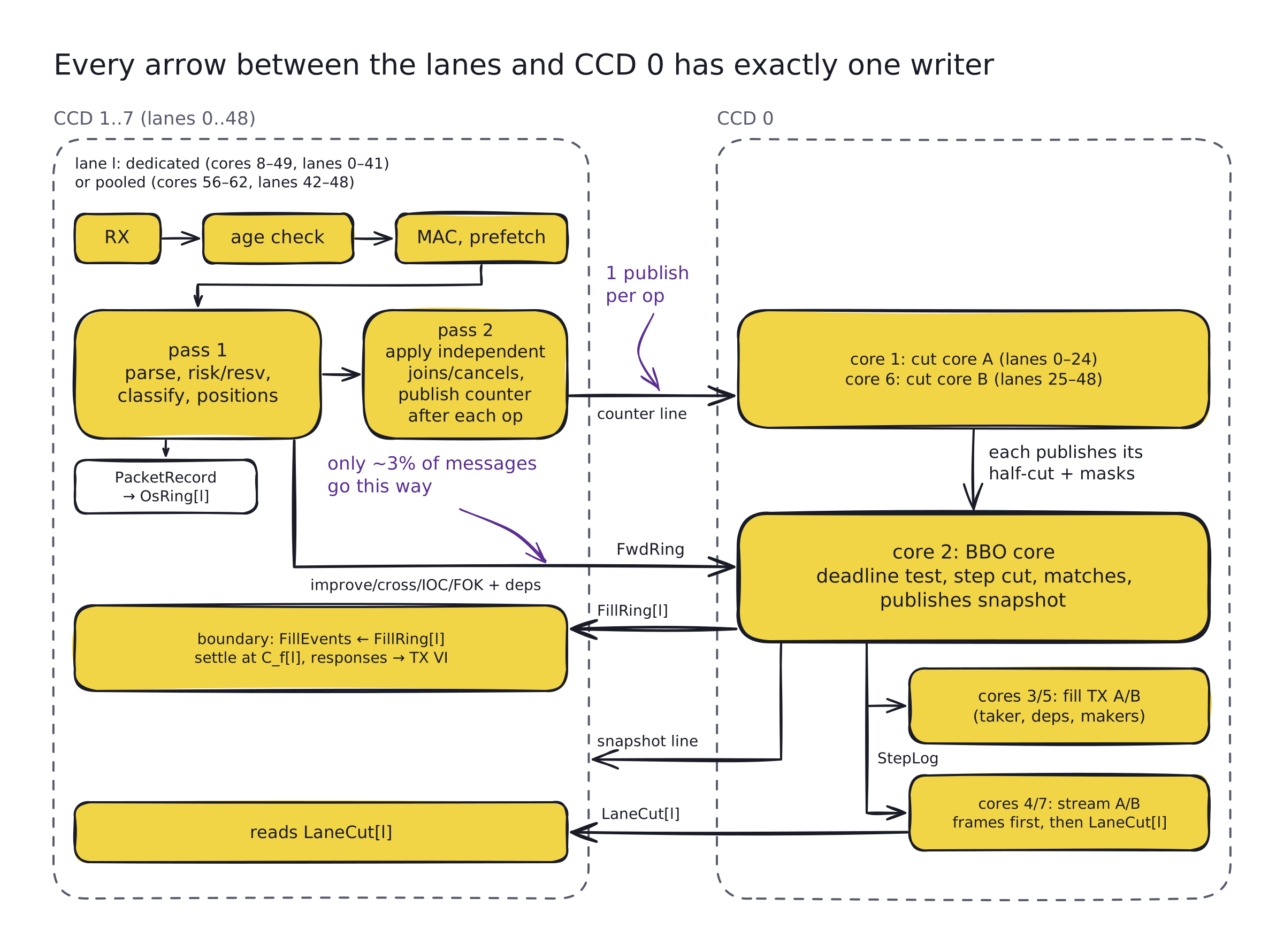
ASCII original
             CCD 1..7 (lanes 0..48)                                CCD 0
 ┌───────────────────────────────────────────┐        ┌───────────────────────────────────────┐
 │ lane l: dedicated (cores 8–49, lanes 0–41)│        │ core 1: cut core A (lanes 0–24)       │
 │  or pooled (cores 56–62, lanes 42–48)     │        │ core 6: cut core B (lanes 25–48)      │
 │  RX ─► age check ─► MAC, prefetch         │ counter│                                       │
 │  pass 1: parse, risk/resv, classify,      │ line ──┼─► each publishes its half-cut + masks │
 │   positions, PacketRecord ─► OsRing[l]    │        │                                       │
 │   improve/cross/IOC/FOK + deps: FwdRing ──┼────────┼─► core 2: BBO core                    │
 │  pass 2: apply independent joins/cancels, │        │   deadline test, step cut, matches,   │
 │   publish counter after each op           │        │   publishes snapshot                  │
 │  boundary: FillEvents ◄── FillRing[l] ◄───┼────────┼── StepLog ─┬─► cores 3/5: fill TX A/B │
 │   settle at C_f[l], responses ─► TX VI    │snapshot│            │   (taker, deps, makers)  │
 │  reads LaneCut[l] ◄───────────────────────┼─line◄──┼────────────┴─► cores 4/7: stream A/B  │
 │                                           │        │   frames first, then LaneCut[l]       │
 └───────────────────────────────────────────┘        └───────────────────────────────────────┘
Every arrow is a single-writer structure. Table 4.1 lists each one with its writer.
1.2 Message classes#
| Class | Who decides the outcome | Path |
|---|---|---|
| Join (passive, at or behind the lane's snapshot on its side) | sequential semantics; in practice nothing happens at entry | lane only |
| Cancel, Reduce, CancelAll | the cut position of the op | lane only |
| Improve (strictly inside the snapshot spread) | BBO core | FwdRing |
| Cross (at or through the opposite side of the snapshot) | BBO core | FwdRing |
| IOC, FOK (any price) | BBO core | FwdRing |
| Replace to a new tick, or to a larger qty | classified on its new tick and qty | lane or FwdRing |
| Dependency of a forwarded op (an earlier join or cancel of the same packet, §6.6) | BBO core, at the forwarded op's step | FwdRing (with the op) |
| Heartbeat, ResendReq | 04-protocol.md |
lane only, no LaneSeq |
| Late packet (§6.8) | the lane: Reject BUSY, nothing applied |
lane only, no LaneSeq |
1.3 Two clocks#
The engine has two orders of events. Both are functions of the order stream.
- Book order L (§3). It orders every op that changes the book. Matching follows it.
- Lane order. Each lane applies its ops in
LaneSeqorder and applies fill events at packet boundaries given byPacketRecord.fills_applied. Ledger checks (risk, reservations) follow it.
A fill changes the book at its step in L. It changes the ledgers of its two accounts at the
next packet boundary of each account's lane whose fills_applied reaches that step. Between those
two points the fill is "in flight" and the reservation covers it (§2.6).
2. The sequential specification#
This section is the reference semantics. vyrn-vx-oracle implements it with linear scans. The
parallel engine must produce the same responses and the same state hash (§9, B4).
2.1 State#
struct Book {
    phase:  Phase,                    // Continuous | Auction | Halted
    band:   Band,                     // { lo: Tick, hi: Tick }, inclusive (§13.2)
    orders: Vec<Order>,               // all resting orders, any order is fine for the oracle
    accts:  Map<AccountId, Ledger>,   // ordered map (01 §11.2)
    step:   StepId,                   // id of the step being applied
}
struct Order {
    handle: Handle, lane: LaneId, account: AccountId, session: SessionId,
    side: Side, tick: Tick, tif: Tif, post_only: bool, stp: Stp,
    key: PrioKey,                     // (prio_ts, rank_e(lane), lane_seq), §3.2
    total: Qty,                       // filled + open; Reduce lowers it, Replace sets it
    filled: Qty,                      // cumulative over every version of the order
    client_tag: u32,
}
struct Ledger {
    base_free: u64, base_resv: u64,   // base atomic units
    quote_free: u64, quote_resv: u64, // quote atomic units
    open_orders: u32,                 // orders with open > 0 or a pending settle
    fee: FeeTier,                     // { maker_bps: u16, taker_bps: u16 }, 10-accounts-risk-md.md
}
enum Phase { Continuous, Auction, Frozen, Halted }   // Frozen: auction close, §8.8
open(o) = o.total − o.filled. An order with open(o) = 0 is not in orders.
2.2 Inputs#
The oracle consumes the order stream and the data (01 §6.6). From them it builds:
- For each lane
l, the ordered list of lane ops(l, q)forq = 1, 2, …. Op(l, q)is messageq − first_lane_seqof thePacketRecordwithfirst_lane_seq ≤ q < first_lane_seq + count. Heartbeats and resend requests do not take aLaneSeq(§3.1). - For each op its priority key
key(l, q) = (prio_ts, rank_e(l), q)(§3.2, §12). - The list of steps
s = 1, 2, …with their cutsC_sand sources. - The linear order L (§3.3).
2.3 Ops#
Each op is one of these. "Reject" means: no state change except the response.
New(o) at its position in L, with the ledger as of its lane order (§1.3):
fn op_new(bk: &mut Book, o: Order, led: &mut Ledger) -> Result<(), Reject> {
    check_wire(o)?;                              // 04: type, flags, reserved bits
    match bk.phase { Halted => return Err(BOOK_HALTED), Frozen => return Err(AUCTION_PHASE), _ => {} }
    if o.tif == AuctionOnly && bk.phase != Auction { return Err(AUCTION_PHASE) }
    if matches!(o.tif, Ioc | Fok) && bk.phase != Continuous { return Err(AUCTION_PHASE) }
    if o.tick < bk.band.lo || o.tick > bk.band.hi { return Err(BAD_TICK) }
    if o.qty < ENG_MIN_QTY || o.qty > ENG_MAX_ORDER_QTY { return Err(BAD_QTY) }
    if led.open_orders >= ENG_MAX_OPEN_PER_ACCT { return Err(RISK_ORDER_COUNT) }
    reserve(led, o.side, o.tick, o.qty)?;        // RISK_CREDIT, §2.6
    led.open_orders += 1;
    match bk.phase {
        Continuous => match_on_entry(bk, o),     // §2.4
        Auction | Halted => rest(bk, o),         // no matching outside Continuous
    }
}
The lane-side checks (wire, band, qty, count, reservation) use the lane-order view of the
ledger, the band and the phase (§1.3, §13.2). The book-side part (match_on_entry or rest)
uses the book at the op's position in L. If the phase seen by the BBO core at the op's step
differs from the phase the lane saw, the BBO core applies §2.5 rule P1.
Cancel(h): if h names no order of the session's account, reject UNKNOWN_HANDLE. If the
order has open = 0 at the op's position in L, reject TOO_LATE. Otherwise remove it, release its
reservation remainder, and answer CancelAck { canceled: open }.
Reduce(h, r): as Cancel for the checks. If r ≥ open, remove the order and answer
CancelAck { canceled: open }. Otherwise set total −= r, keep key, release r lots of
reservation, and answer CancelAck { canceled: r }.
Replace(h, tick', qty'): reject SIDE_MISMATCH if the side bit differs. If tick' = tick
and qty' < total, it is a Reduce(h, total − qty') (01 §6.2). Otherwise: if open = 0, reject
TOO_LATE. Otherwise remove the old order and enter a new order with the same Handle,
tick', total = qty', filled carried over, a new key (the replace op's key) and a new queue
position. If qty' ≤ filled, the order is finished and the answer is CancelAck { canceled: open } (01 §14.10 has no Out cause for it). The new order then runs match_on_entry with
open = qty' − filled. The reservation is adjusted by §2.6.
CancelAll: cancel every resting order of the session, in key order, each with its own
CancelAck. If the session has none, answer one CancelAck { handle: 0, canceled: 0 }.
Step s of kind Cross or Improve: apply the source op's dependencies (§3.7) in index
order, then New or Replace for the source op. The step kind is Cross if the op produced a
fill, else Improve (§8.1). A Cross step whose sweep reached the per-step cap (§8.5) leaves the
taker in flight: not resting, not visible as a maker, reservation held. The next step is then
a continuation (Cross with the same source) and resumes match_on_entry on the book at its own
point of L. No other source runs between them.
Step of kind Shed: the source op and its dependencies are answered Reject BUSY and
release their reservations. Nothing else changes (01 §14.1).
Step of kind Rescan, Depletion, Idle: no-op.
Step of kind Control: change phase (including Frozen, §8.8) or band. Uncross:
one chunk of the auction allocation (§8.8). Seal: the last step of the epoch; nothing
after it is in the epoch's L (08). Halts and phase changes are defined by 08-epochs.md and
10-accounts-risk-md.md.
2.4 Matching on entry#
fn match_on_entry(bk: &mut Book, mut t: Order) {
    if t.post_only && crosses(bk, &t) { kill(t, Reject(POST_ONLY_WOULD_CROSS)); return }
    if t.tif == Fok && fillable(bk, &t) < open(&t) { kill(t, Reject(FOK_UNFILLABLE)); return }
    let mut ordinal = 0u32;
    while open(&t) > 0 {
        let Some(m) = best_maker(bk, &t) else { break };    // best price, then smallest key
        if m.account == t.account && t.stp != Stp::None {
            match t.stp {
                CancelNewest => { kill(t, Out(STP)); return }
                CancelOldest => { remove(bk, m, Out(STP)); continue }
                CancelBoth   => { remove(bk, m, Out(STP)); kill(t, Out(STP)); return }
            }
        }
        let q = min(open(&t), open(&m));
        fill(bk, &mut t, m, q, m.tick, bk.step, &mut ordinal);  // price = maker's tick
    }
    match t.tif {
        Ioc | Fok if open(&t) > 0 => kill(t, Out(IOC_REST)),
        _ if open(&t) > 0          => rest(bk, t),               // Ack { handle, tick }
        _                          => {}                         // fully filled
    }
}
best_makerreturns the resting order on the opposite side with the best price that the taker can trade with (tick ≤ t.tickfor a buy,≥for a sell), and among those the smallestkey.crosses(bk, t)is true whenbest_makerreturnsSome.fillable(bk, t)walks the same sequence as the loop without changing anything. It counts each maker's open qty, skips makers thatCancelOldestwould remove, and stops at the first maker thatCancelNewestorCancelBothwould hit.Stp::Nonecounts own makers.- The taker's STP mode governs. The maker's STP mode is not used.
filladdsqto both orders'filled, records a fill(StepId = bk.step, ordinal), and queues one settlement event per side (§2.6). It removes a maker whoseopenreaches 0.- A taker gets one
Fillrecord per price level and a maker gets one per fill (01 §6.4). The taker'sFillrecords for one level are merged:qtyis the sum over that level.
2.5 Phases and the positions of lane decisions#
The lane decides admission with its lane-order view of phase and band. The BBO core decides
matching with the phase at the step. They can differ for an op whose lane had not yet applied a
phase change. The rules are:
- P1. The book side uses the phase at the op's position in L. A
Newpositioned inHaltedis rejectedBOOK_HALTEDand its reservation is released. ANewpositioned inAuctionrests without matching; an IOC or FOK positioned there getsOut { cause: AUCTION }. - P2. An auction-only order is never visible to a step of kind
Cross,ImproveorRescan. It is visible only to the uncross. After the uncross that follows its entry, its open quantity is dead and its lane sendsOut { cause: AUCTION }(§8.8). - P3. Band checks use the band as of the lane order. A
ReplaceorNewthat passed the lane band check is matched at any price inside its own limit. The band only limits limits. - P4. In
Frozenevery book op (New,Cancel,Reduce,Replace,CancelAll) is rejectedAUCTION_PHASEin lane order. A book op that a lane admitted before it applied theFrozenevent, and whose position is after the freeze step, is rejectedAUCTION_PHASEat its settle. The lane tombstones those ops withtomb_seq = ins_seq(never visible) before it reports its histogram (§8.8). So the book is constant from the freeze cut to the lastUncrossstep.
2.6 Ledger: reservation, settlement, release#
v1 is fully collateralized spot (01 §12.1). All amounts are integers. All arithmetic is checked
(01 §11.4). Overflow is reject RISK_CREDIT at entry and is impossible afterwards, because every
later amount is bounded by the reservation.
// quote atomic units per lot at a tick; book parameter (§13.1)
fn px(t: Tick) -> u64 { t as u64 * QUOTE_PER_TICK_LOT }            // checked
// reservation per lot for a buy at limit t: price plus the maximum fee, rounded up per lot
fn rpl(t: Tick) -> u64 { px(t) + ceil_div(px(t) * ENG_MAX_FEE_BPS as u64, 10_000) }
fn fee(t: Tick, q: Qty, bps: u16) -> u64 { ceil_div(q as u64 * px(t) * bps as u64, 10_000) }
| Event | Buy order (limit t) |
Sell order |
|---|---|---|
| Entry | quote_free −= qty × rpl(t); quote_resv += same. Reject RISK_CREDIT if short. |
base_free −= qty; base_resv += qty. |
Fill of q at tick f |
quote_resv −= q × rpl(t); pay q × px(f) + fee(f, q, bps); quote_free += q × rpl(t) − paid; base_free += q. |
base_resv −= q; quote_free += q × px(f) − fee(f, q, bps). |
Order ends with open = o |
quote_resv −= o × rpl(t); quote_free += same. |
base_resv −= o; base_free += o. |
bpsis the taker or maker rate of the account's tier. It is at mostENG_MAX_FEE_BPS.paid ≤ q × rpl(t)always holds:f ≤ t,bps ≤ ENG_MAX_FEE_BPS, andceil(q·x) ≤ q·ceil(x). So a fill never needs more than the lots it consumes from the reservation.- Fees are credited to the lane's fee accumulator
fee_acc[lane](10 sums them). - Replace of a buy: the lane reserves
max(0, need − resv(o))at once, whereneed = (qty' − F) × rpl(tick')andFis the filled qty the lane knows. It never releases at the replace. At the settle of the replace op (§7.6), the exactopenis known and the lane releasesresv(o) − open × rpl(tick'). A fill of the old version that arrives after the replace consumesq × rpl(old tick); the "reserve now, release at settle" rule keeps the reservation sufficient for both versions. - Reduce releases at its settle. Cancel releases at its settle.
- Rule L1: a reservation increases only at entry; it decreases only at a fill event or at a settle. Both happen at points fixed by the order stream (Lemma 9.12).
2.7 Responses#
| Op | Responses, in this order |
|---|---|
New resting |
Fill per level traded (if any), then Ack { handle, tick } |
New fully filled |
Fill per level |
New IOC/STP end |
Fill per level (if any), then Out { cause, qty out } |
New FOK unfillable |
Reject { FOK_UNFILLABLE } (01 §14.10) |
New rejected |
Reject { reason } |
| packet late at the lane, or op shed at the BBO core | Reject { BUSY } for every affected message |
Cancel, Reduce, CancelAll |
CancelAck per order, or Reject |
| maker fill | Fill { index: 0xFF, liq: 0 } (liq: 2 in an uncross), unsolicited, echo_pkt = 0 |
| maker STP removal | Out { index: 0xFF, cause: STP }, unsolicited |
Packetization and resp_seq are part of the specification, because 01 §7 INV-DET covers every
response byte. The rules are in §8.10.
2.8 What the oracle exports#
pub fn oracle_new(stream: &OrderStream, data: &DataStore) -> Oracle;
pub fn oracle_step(o: &mut Oracle) -> Option<Vec<ResponsePacket>>;   // one element of L
pub fn oracle_state_hash(o: &Oracle) -> Hash;                        // BLAKE3 of canonical state
The canonical state is: every resting order sorted by (side, tick, key), every ledger sorted by
AccountId, phase, band, the last StepId, the per-session resp_seq. 11-build.md defines
the byte encoding. vyrn-sim diffs oracle_state_hash against the engine after every element of L.
3. The linearization#
3.1 Lane ops and LaneSeq#
- A lane gives one
LaneSeqto every message that isNew,Cancel,Reduce,ReplaceorCancelAll, including a message that it rejects. Numbers are gapless per lane and start at 1 each epoch (01 §3). HeartbeatandResendReqtake noLaneSeq. They change only session state that04owns, and they never touch the book.- The lane assigns
LaneSeqs in pass 1, in message index order, before it applies anything. - A packet that fails the MAC or sequence checks of
04takes noLaneSeqand produces noPacketRecord. It never enters the order stream. - A packet that deadline admission rejects (§6.8) takes no
LaneSeq, does not advance the session'spkt_seq, and produces aPacketRecordwithflags.SHEDandpkt_hash = 0. The record is needed because theBUSYresponse consumes aresp_seq. PacketRecord.first_lane_seqis theLaneSeqof the packet's first message with a number. If no message of the packet takes a number, the record carriescount = 0andfirst_lane_seq= the next unused number (04decides whether such packets are recorded).
An op is local if the lane completes its book part itself (join, cancel, reduce, cancel-all,
a replace whose new version is a join, every reject). An op is forwarded if the lane pushes it
to its FwdRing. An op is a dependency of forwarded op (l, q) if the lane lists it in
q's FwdEntry (§6.6). The BBO core executes a forwarded op, with its dependencies, as the source
of one step, or of one step and its continuations (§8.5).
3.2 Priority key#
struct PrioKey { ts: Nanos, rank: u8, seq: LaneSeq }   // compared lexicographically
fn rank_e(e: Epoch, l: LaneId) -> u8 { ((l as u32 + e) % N_LANES as u32) as u8 }
tsof aNewis the packet'sprio_ts(§6.3): the NIC RX timestamp, raised to the lane's previousprio_tsif it is smaller. Soprio_tsis non-decreasing inLaneSeqwithin a lane.- The key of an op is unique:
(rank, seq)is unique per op inside an epoch. - A
Reduceversion keeps the key of the order it reduces. AReplaceto a new price or a larger quantity takes the key of the replace op. - Within one lane, key order equals
LaneSeqorder. Lemma 9.1 uses this.
3.3 Step cuts#
Let K be the newest cut, read at the start of step s: lanes 0–24 from cut core A's newest
half-cut, lanes 25–49 from cut core B's (§7.1). The two halves may come from passes taken at
different times; each half is monotone on its own (INV-CUT-MONO per half, 01 §14.3), and
nothing below needs the halves to be simultaneous. Let h[l] be the dependency floor of
lane l's oldest FwdRing entry that no step has executed yet: its lane_seq minus its largest
dependency offset (§6.6), read after K, or ∞ if the ring is empty. For a step whose source is
the forwarded op (src, q):
C_s[l]   = max(C_{s−1}[l], min(K[l], h[l] − 1))                 for l ≠ src
C_s[src] = max(C_{s−1}[src], min(max(K[src], a), h'[src] − 1, q))
           a  = q − FwdEntry.applied_back: the lane's `applied` when it pushed q
           h' = floor of src's next unexecuted entry
a lets pass barriers (§6.6), published before the push, enter the source step's batch before
the cut core has read them.
A Shed step and a continuation use the source rule. For a step without a source (Rescan,
Depletion, Idle, Control, Uncross, Seal), every lane uses the first line.
C_0 = [0; N_LANES]. The BBO core may also
choose any C_s[l] between C_{s−1}[l] and the value above (a partial cut, §8.6); the cut is
logged, so replay does not repeat the choice.
The source op and its dependencies are explicit: their position in L is step s by
definition, whatever the cut. Pass 2 never applies them; the BBO core decides them and the lane
writes their effects after the step (§6.6, §7.4). CounterLine.seq counts them as done, so the
clamp h − 1 is what keeps them out of earlier cuts.
Three facts follow from the construction. §9 proves them.
- F1 (monotone).
C_s ≥ C_{s−1}pointwise. That isINV-CUT-MONO. - F2 (explicit ops at their step). If
(l, x)is the source or a dependency of steps, thenC_{s'}[l] < xfor everys' < s. - F3 (published). Every op inside
C_s[l]that is not explicit was applied and published by its lane before the step started:C_s[l] ≤ K[l], or≤ afor the source, or≤ C_{s−1}[l]. A lane withC_s[l] > K[l](a lag lane, only ever a recent source lane) has published ops that the masks may not show yet; the BBO core probes it like a wild lane (Lemma 7.1).
Draft 0.1 raised C_s[src] to q; with early dispatch that would put ops that pass 2 has not
applied into every later cut. The clamp at a and q plus explicit positions removes the case.
3.4 The position of an op and the linear order L#
pos(l, x) = s                    if (l, x) is the source or a dependency of step s
          = min { s : C_s[l] ≥ x }  otherwise
B_s       = { (l, x) : pos(l, x) = s, not explicit }     // the batch of step s
L         = B_1 · S_1 · B_2 · S_2 · …      // S_s: the step's dependencies, then its own action
While the specification applies B_s and S_s, bk.step = s. So a fill made by a crossing op
inside B_s has StepId s; the engine makes that fill in its Rescan step s (§8.6).
Inside B_s the ops are sorted by key. If step s has a source (src, q), S_s applies, in
index order, the lane part and book part of each dependency, then the lane part (the checks and
the reservation) and the book part (match_on_entry) of q. The lane parts were computed in
pass 1 in lane order; §3.7 shows that this is the same as computing them at S_s.
Why sort by key and not by lane: two ops of different lanes in one batch commute unless one of
them crosses (Lemma 9.5). Only a Rescan step contains crossing ops, and there the key order
decides who is maker and who is taker. Key order is also lane order within each lane, so L
respects every lane's program order.
3.5 Example#
lane 3 ops:   (3,41) join bid 100   (3,42) cancel (3,17)   (3,43) cross buy 102
lane 7 ops:   (7,90) join ask 103   (7,91) join ask 102
cut core:     K = { 3: 42, 7: 91 }  published before step 12 starts
FwdRing[3]:   (3,43)  → h[3] = 43           FwdRing[7]: empty → h[7] = ∞

step 12 (src = (3,43), Cross, no dependencies):
  C_12[3] = max(C_11[3], min(42, ∞, 43)) = 42,  C_12[7] = max(C_11[7], min(91, ∞)) = 91
  B_12 sorted by key: (3,41) (7,90) (3,42) (7,91)                       (ts order assumed)
  S_12: (3,43) is explicit; the buy at 102 trades with (7,91) at 102 if (7,91) is the best ask
The step log records C_12 and the source. A replica rebuilds B_12 from the cut and the
PacketRecords, and applies S_12 from StepRecord.src_lane and src_lane_seq; the
dependencies are a function of the packet's bytes (§10).
3.6 The step's batch cannot hold another lane's explicit op#
If (l, x) is forwarded or a dependency and l ≠ src, then h[l] ≤ x until its own step
executes it. So C_s[l] ≤ h[l] − 1 < x, and (l, x) is not in B_s. Each batch holds only
local, independent ops. This is what lets S_s treat (l, x)'s reserved position as empty
(§5.3) although the lane has already assigned it (D4).
3.7 Lemma: a packet's outcome is its index-order outcome#
Let packet P of lane l hold book ops p_0 … p_{k−1} with LaneSeqs x_0 < … < x_{k−1}
(session-only messages and rejects have no book effect and are left out). The sequential
outcome of P is the result of applying p_0, …, p_{k−1} in this order to the book at the
point of L where P's first op stands, each New matching on entry. For forwarded op p_j let
D_j be its dependency list and I_j = { p_i : i < j, p_i ∉ D_j, p_i not explicit }.
Lemma 3.7. The engine's book, ledgers, fills (with execution IDs) and response records for
the ops of P equal its sequential outcome, with every op of a shed p_j and its D_j
replaced by Reject BUSY.
Proof sketch. (1) Lane parts. Pass 1 runs every check and reservation in index order
against the lane-order ledger. A boundary inside P (§6.2) applies fill events at a logged
position, so the order of ledger events is the same in replay. (2) Ops after p_j. For
i > j, x_i > x_j ≥ h[l] until step s_j, so pos(p_i) ≥ s_j and p_i follows S_{s_j} in
L: program order. (3) I_j may follow S_{s_j} in L although it precedes p_j in P. By
§6.6 an op of I_j is on p_j's own side or outside its price range (an earlier op on
p_j's own handle is on its own side), and it is not a CancelAll or an opposite-side Reduce
in range (those are pass barriers, applied and published before the push, so they precede
S_{s_j} in L). match_on_entry of p_j reads only opposite-side orders inside its range (the
sweep, the FOK dry run, the post-only test and STP all stay inside it); replace_ok reads only
pred_total, which pass 1 set from the pending version. So p_j and an op of I_j touch
disjoint orders, and they commute as in Lemma 9.5; their reservations were taken in index order
in (1). (4) D_j is applied at S_{s_j}, in index order, before p_j, with
the conflict cases:
- Cancel of the account's own opposite-side order
Vin range (p_i ∈ D_j, aCancel). The BBO core setskilledonV's root before the sweep (§8.5), sop_jnever meetsV, which is what index order gives. TheCancelAckcarriesopen(V)atS_{s_j}: every fill ofVis from a step< s_j(later steps seekilled), as in Lemma 9.11. - Own join
Win range (p_i ∈ D_j, aNewor new-priorityReplacethat rests).Whas the key(prio_ts(P), rank_e(l), x_i), larger than every older order of lanelat its level, and its position was assigned in pass 1 behind them. The BBO core insertsWas a leaf of lanelat that key (§5.4), sop_jmeetsWexactly where index order puts it among all lanes' makers. - STP. Every op of
Pbelongs top_j's account. Whenp_jmeetsWor an older own order, §2.4's branch forp_j.stpapplies:CancelNewestkillsp_j;CancelOldestsetskilledonW;CancelBothdoes both;NonefillsWas a maker. The BBO core writes onlyfilledandkilled(INV-WRITER).W's records (Ack, thenFillorOut { STP }) go into the step's dependency packet in index order (§8.10), as index order gives.
(5) Shed. A Shed step applies neither p_j nor D_j, the lane never writes their
positions or tombstones, and their records are Reject BUSY. The ops of I_j are already
applied (01 §14.1). Applying P in index order with those messages rejected gives the same
result, because by (3) I_j never depended on them. (6) Continuations of p_j (§8.5) run
before any other source, and the batches between them hold only ops of other lanes or later
ops of l, which follow p_j in program order. ∎
Corollary (the step-cut rule). The clamp of §3.3 is exactly what (2) and (4) need: h keeps
D_j and every later op of l out of earlier batches, and min(K, q) keeps unapplied ops out of
every cut.
4. Shared structures: the writer map#
Every structure below is preallocated in 1 GB huge pages before seal() (INV-NOALLOC). Every
line that two cores touch is aligned to CACHE_LINE and has one writer (INV-WRITER). Sizes
are for CACHE_LINE = 64. On Apple M-series (128) every padded line doubles; field offsets do
not change.
4.1 Table#
| Structure | Per | Size | Writer | Readers | Lives in | Write rate (budget, at 1B msgs/s) |
|---|---|---|---|---|---|---|
OrderSlot arena |
lane | ENG_SLOT_CAP × 64 B |
lane | BBO | lane's NUMA memory | 1 line per New/Reduce/Replace, 1 per tombstone |
Segment16 arena |
lane | ENG_SEG_CAP × 192 B |
lane | BBO | lane | 1 entry (3 stores) per position, 1 mask word per change |
SlotAux arena |
lane | ENG_SLOT_CAP × 16 B |
lane | lane | lane | private |
| level heads (dense window ×2 dirs) | lane, side | 2 × 4096 × 4 B | lane | BBO, cut cores | lane | on empty↔non-empty and head segment reclaim |
| level tails (segment, next pos) | lane, side | 4096 × 8 B | lane | lane | lane | private |
| overflow pages | lane, side | ENG_OVF_PAGES × 16.5 KB |
lane | BBO (slow path) | lane | far levels only |
| occupancy bitmap | lane, side | 512 B + 8 B summary | lane | cut cores, BBO (slow path) | lane | on empty↔non-empty |
AcctKill |
lane | accounts × 16 B | lane | BBO | lane | per CancelAll |
| journal | lane | ENG_JOURNAL × 16 B |
lane | BBO (Rescan only) | lane | 1 entry per independent book op |
CounterLine |
lane | 64 B | lane | cut cores, control role | lane | 1 publish per op |
FwdRing |
lane | ENG_FWD_RING × 64 B |
lane | BBO | lane | ~3% of messages, + dependency lines |
FwdCons |
lane | 64 B | BBO | lane | CCD 0 | per consumed entry |
FillRing |
lane | ENG_FILL_RING × 32 B |
BBO | lane | CCD 0 | per fill event |
FillCons |
lane | 64 B | lane | BBO | lane | per drained batch |
OsRing |
lane | ENG_OS_RING × 64 B |
lane | stream core of its half (4 or 7) | lane | 1 per packet, pre-encoded in pass 1 |
MakerSeq |
session | 16 B | lane | fill TX core of its half | lane | 1 per 8 TX-core packets of the session |
CutPub ×4, half A / half B |
box | 2 × 4 × 8 lines | cut core A / cut core B | BBO | CCD 0 | 1 per ~CUT_REFRESH_NS per half |
| occupancy masks, half A / half B | box, side | 2 × 4096 × 4 B | cut core A / cut core B | BBO | CCD 0 | on SET/CLEAR events |
BboFloor |
box | 64 B (two half floors) | BBO | cut cores | CCD 0 | 1 per step |
SnapshotLine |
box | 64 B | BBO | lanes, TX | CCD 0 | 1 per step |
BboSlotState |
lane | ENG_SLOT_CAP × 4 B |
BBO | BBO | CCD 0 memory | per fill |
BboVer |
lane | ENG_SLOT_CAP × 1 B |
BBO | BBO | CCD 0 memory | per Replace version, per explicit op |
Pend |
box | ENG_PEND_CAP × 32 B |
BBO | BBO | CCD 0 | per explicit op that the lane has not yet written |
| head cache | box, side | 2 KB | BBO | BBO | CCD 0 | private |
| snapshot history | box | ENG_SNAP_HIST × 8 B |
BBO | BBO | CCD 0 | 1 per version |
StepLog |
box | ENG_STEP_LOG × 64 B |
BBO | stream cores, fill TX cores | CCD 0 | 1–8 lines per step |
TxRing A, B |
box | 2 × ENG_TX_RING × 64 B |
BBO | fill TX core A (core 3) / B (core 5) | CCD 0 | 1+ per forwarded step, 1 per maker session hit |
LaneCut |
box | 13 lines (4 lanes per line; lines of half A and half B disjoint) | stream core of the lane's half | lanes | CCD 0 | ≤ 1 per lane per step, after the step's frame |
FramesOut A, B |
box | 2 × 64 B | stream core A / B | fill TX cores, other stream core | CCD 0 | per step sent |
AuctionCtl |
box | 64 B | BBO | lanes | CCD 0 | per uncross |
AuctionHist |
lane | 2 × ENG_AUCTION_TICKS × 8 B + 64 B |
lane | BBO | lane | per uncross |
HandoverCtl |
lane | 64 B | control role (core 0) | lane | CCD 0 | per handover (§14.1) |
| control ring | box | 256 × 64 B | control role (core 0) | BBO | CCD 0 | per halt, phase or band command |
Lane memory is on the box's one NUMA node (06-platform.md); "lives in" names the cache that
holds the line in steady state.
4.2 Handle and slots#
Handle (u32):  bits 0..23 = root slot (1 ..= ENG_SLOT_CAP − 1; 0 is null)
               bits 24..31 = generation of that root slot
- Slot 0 of every arena is the null slot. It is never allocated.
- A slot's generation increments each time the slot is allocated as a root. A version slot
(§4.4) is never named by a
Handle. - A handle is valid when
slot < ENG_SLOT_CAP,aux[slot].state == Root, the generation matches, andaux[slot].session == session. Anything else isUNKNOWN_HANDLE.
4.3 OrderSlot (64 B, lane-written, BBO-read)#
off size field       type     meaning
  0   8  prio_ts     Nanos    merge key part 1 (§3.2)
  8   8  ins_seq     LaneSeq  op that created this version
 16   8  ins_ts      Nanos    KeepPrio: ts of the Reduce op. Other kinds: bytes 16–19 =
                              pred_total (NewPrio: total of the version it replaces), 20–23 = 0
 24   8  tomb_seq    LaneSeq  op that ended this version; 0 = live. Written once.
 32   8  tomb_ts     Nanos    ts of that op; written before tomb_seq
 40   4  next_ver    u32      the KeepPrio version that follows this one; 0 = none. Written once
 44   4  tick        Tick
 48   4  total       Qty      total of the order as of this version (filled + open)
 52   4  acct_ix     u32      lane-local account index (STP compares (lane, acct_ix))
 56   4  root        u32      root slot of the order; equals own index for kind = Original
 60   1  flags       u8       wire flags: side, TIF, post-only, STP (01 §6.2)
 61   1  gen         u8       generation of the root slot
 62   1  kind        u8       0 Original, 1 KeepPrio (Reduce), 2 NewPrio (Replace)
 63   1  tomb_lane   u8       lane whose LaneSeq tomb_seq is (≠ own lane only in a pool, §6.9)
For kinds other than KeepPrio, the op's ts is prio_ts, so visible_at (§5.2) uses prio_ts
as the insertion ts.
Write-once rule (INV-ENG-2). The lane writes offsets 0–39 and 44–63 before the slot's
position becomes active (§4.6). It writes tomb_ts, then tomb_seq with Release, at most
once, and next_ver at most once (before tomb_seq of the same op). No other write happens
while the slot is reachable.
4.4 Versions#
Reduce and Replace never change a reachable slot's quantity or tick. They write a new slot.
Reduce(h, r) at op q, current version V:
    W = alloc();  W := V with { kind: KeepPrio, ins_seq: q, ins_ts: ts(q), total: V.total − r }
    V.next_ver = W                                     // W keeps V's queue position
    seg.vmask |= bit(pos)                               // the position now has a version chain
    V.tomb_ts = ts(q); V.tomb_seq = q                  // same seq: never both visible

Replace(h, tick', qty') at op q (new priority) = cancel of the old position + a new position:
    W = alloc();  W := { kind: NewPrio, prio_ts: ts(q), ins_seq: q, ins_ts: ts(q),
                         tick: tick', total: qty', root: V.root, gen: V.gen, … }
    W gets the next position at the tail of FIFO(side, tick')          (01 §14.13.2)
    V.tomb_ts = ts(q); V.tomb_seq = q; clear V's position bit (§4.6)
The BBO core computes open = total − filled[root] for every version, where filled lives in
BboSlotState[root] (§4.11). Fills of every version add to the same counter. This gives the
FIX semantics of §2.3 (leaves = qty' − cum_filled) with no read of lane state that can change.
4.5 SlotAux (16 B, lane-private)#
off size field     meaning
  0   4  seg       Segment16 of the order's position (position slot only); free-FIFO link when free
  4   4  client_tag
  8   4  session   SessionId of the owner
 12   1  state     Free | Root | Version | Dead
 13   1  pend      number of unsettled ops that name this order
 14   1  pos       position 0–15 in seg
 15   1  rsv
The root's aux also needs the current version and the session list links. They live in a
parallel lane-private array RootAux { cur: u32, sess_next: u32, sess_prev: u32, resv: u64 }
(24 B, padded to 32 B), indexed by root slot.
4.6 Segment FIFOs and the level directory (01 §14.13)#
A lane FIFO at one (side, tick) is a chain of Segment16 blocks. It replaces draft 0.1's
intrusive list of slots: no pointer is chased inside a segment, and an order's queue position
never moves.
Segment16 (192 B = 3 lines, CACHE_LINE-aligned, lane-written, BBO-read)
line 0   0  64  slot[16]  u32   position slot (first version) of each position; 0 = unused
line 1  64  64  qty[16]   u32   total of the position slot (write-once with the slot)
line 2 128   4  mask      u32   bits 0–15 active, bits 16–31 pend (one aligned store)
       132   4  gen       u32   segment generation, +1 on every reuse
       136   4  succ      u32   next segment of this FIFO; 0 = end
       140   4  tick      Tick
       144   1  side      u8
       145   1  rsv       u8
       146   2  vmask     u16   positions that need the slot line (NewPrio, Reduce); set once
       148   4  rsv       u32
       152   8  base_ts   Nanos prio_ts of position 0
       160  32  dts[16]   u16   prio_ts − base_ts of each position (key part 1, §3.2)
- Position assignment (pass 1). The lane keeps a private tail
(seg, next_pos)per level. ANewor a new-priorityReplacetakes the next position, inLaneSeqorder, which is key order (§3.2). If the segment is full, orprio_ts − base_ts > u16::MAX, the lane takes a new segment from its free FIFO and links it withsucc. Positions are assigned to explicit ops too, so a position whose op is shed, rejected or never rests stays empty forever. - Writing a position. The lane writes
slot[i],qty[i],dts[i]and the slot line, then setsactive | pendforiin one store tomask(Release), then publishes the op's counter. Independent ops are written in pass 2; explicit ops after their step (§7.4). - Cancel = clear one bit. A cancel writes the version's tombstone (its
LaneSeq, §4.7), then storesmaskwithactivecleared andpendset fori. A fill that the lane learns has emptied the order, or a BBO kill, clearsactivewith nopend: the order is dead at every cut. pendmeans "check the slot". The lane clearspendforionceLaneCut[l].cutcovers the position's insertion and tombstone (§7.8). A step readsmaskonce and computescand = active | pend; for apendbit it compares the slot'sins_seqandtomb_seqwith its cut (§5.1). For every other bit,activeis the answer at every cut that a current or later step can use, because that cut is at leastLaneCut[l].cut.vmaskmarks positions that need the slot line: aNewPrioposition slot (its root is notslot[i]), or an order that was reduced (the BBO core walksnext_verto the version visible at its cut, §5.1). For every other positionslot[i]is the root, soqty[i] − filled[slot[i]]is the open quantity without touching the slot line.
Lane l, side S:
  dir[0], dir[1]       two dense directories; CounterLine.dir_sel picks the live one
     .center: Tick     window center c (copied from SnapshotLine.win_center when built)
     .head: [u32; TICK_HOT_WINDOW]       first Segment16 of the level; 0 = empty
  tail: [(u32, u8); TICK_HOT_WINDOW]     lane-private, for the live dir
  ovf:  page_of: [u16; ENG_LADDER_PAGES], pages: [OvfPage; ENG_OVF_PAGES]
        OvfPage { base: Tick, head: [u32; 4096], tail: [u64; 4096], bits: [u64; 64] }

  window(S, c):  bids [c − 3072, c + 1024),  asks [c − 1024, c + 3072)      (4096 ticks each)
  index(t)    :  t − (c − 3072) for bids,    t − (c − 1024) for asks
- The head word changes only when the level goes empty → non-empty or when the lane reclaims the head segment (§7.8). So the BBO core's cached copy of a head word stays valid for long periods.
- A level outside the window lives in an overflow page. Pages come from a preallocated pool.
page_of[t >> 12]names the page or isu16::MAX. - The lane's logical cap on distinct far pages holding orders is
ENG_FAR_PAGES_MAXper side. ANewthat would exceed it is rejectedBAD_TICK. The cap is logical, so the reject is replayable. Running out of physical pages despite the cap is a fault (§14.3).
4.7 Tombstones and AcctKill#
A tombstone is the pair (tomb_seq, tomb_ts) in the version slot. It carries the LaneSeq of
the op that wrote it, so the BBO core decides visibility against any cut without asking the lane.
CancelAll writes one record, not one tombstone per order:
AcctKill (16 B, 4 per line, lane-written, BBO-read; index = acct_ix)
  0  8  kill_seq   LaneSeq of the newest CancelAll of this account; 0 = none
  8  8  kill_ts    its ts
A version V of account a is killed at cut C when kill_seq(a) ≤ C[l] and
V.ins_seq < kill_seq(a). The lane writes the real tombstones lazily in idle time. Before it
overwrites kill_seq with a newer CancelAll, it finishes writing the tombstones of the older
one. Then a step whose cut lies between the two still sees the older one's effect through the
tombstones (Lemma 9.4).
CancelAll is per session in 04. The engine implements it per account when the account has
one session, and with per-order tombstones (bounded by ENG_CANCELALL_EAGER) when it has more.
4.8 Occupancy bitmaps#
Per lane and side, a 4096-bit bitmap over the live window (bit = level head ≠ 0) and a 64-bit summary (bit = word ≠ 0). Lane-written. The cut core reads them to rebuild a lane's column of the occupancy masks (§7.3). The BBO core reads them only when a lane is "wild" or a level is outside the window.
4.9 Journal (lane-written, BBO-read in Rescan only)#
JEnt (16 B):  0 8 seq LaneSeq | 8 4 tick Tick | 12 3 slot u24 | 15 1 kind u8
kind: 1 New, 2 KeepPrio, 3 NewPrio, 4 Tomb (slot = the ended version), 5 AcctKill (slot = acct_ix)
One entry per independent op that changes the book, written in pass 2 before the op's counter
publish (rejects, session ops and explicit ops write none: explicit ops are never batch
entries, §3.6). The ring has
ENG_JOURNAL entries. The lane must not overwrite an entry whose seq > LaneCut[l].cut (it may
still be in a batch). If the ring is full of such entries, the lane stalls (§14.2).
4.10 CounterLine (64 B, lane-written, seqlocked)#
off size field     type      meaning
  0   8  lock      u64       seqlock: odd while the lane writes
  8   8  seq       LaneSeq   every op ≤ seq is applied, or explicit (forwarded or a dependency)
 16   4  snap_ver  u32       snapshot version loaded now (wrapping); every op > seq uses ≥ it
 20   4  f_lo      u32       low 32 bits of fills_applied (wrapping; retires Pend, §8.5)
 24   8  fwd_pend  LaneSeq   dependency floor of the oldest FwdRing entry not seen consumed; 0 = none
 32   4  n_ev      u32       cumulative number of occupancy events
 36   1  dir_sel   u8        live level directory (0 or 1)
 37   1  state     u8        0 Running, 1 Parking, 2 Parked (§14.1)
 38   2  rsv       u16
 40  24  ev[3]     OccEvent  the three newest events, newest last

OccEvent (8 B):  0 4 tick Tick | 4 2 back u16 (seq − event seq, saturating) | 6 2 bits
bits: bit 0 side (0 bid, 1 ask), bit 1 kind (0 SET, 1 CLEAR)
The lane publishes after every op: lock += 1 (odd), fields, lock += 1 (even, Release).
The cut core reads with the usual seqlock retry. lock also serves as the watchdog heartbeat:
the lane republishes it at least every ENG_BEAT_NS while idle.
4.11 BBO-private per-order state#
BboSlotState[lane][root] : u32 bits 0..30 filled (cumulative over versions), bit 31 killed
BboVer[lane][slot]     : u8      bit 0: this NewPrio version passed replace_ok (§8.5)
                                 bit 1: explicit, decided at a step ≤ the current one: visible
                                        whatever the cut (§5.1)
killed is set by a BBO decision that ends an order while its position stays assigned: IOC or
FOK residual, post-only reject, STP removal, a dependency Cancel (§3.7), BOOK_HALTED at the
step, auction-only after uncross.
ENG_MAX_ORDER_QTY ≤ 2^31 − 1 keeps filled in 31 bits.
4.12 Rings#
FwdEntry (64 B, lane → BBO)                     FillEvent (32 B, BBO → lane)
off size field                                  off size field
  0   8  lane_seq    (written last, Release)      0   8  step      StepId (written last, Release)
  8   8  prio_ts                                  8   4  handle    root slot + gen
 16   4  snap_ver  (u32, wrapping)               12   4  vslot     version slot that traded
 20   4  deadline  latest BBO step start, low    16   4  tick      fill price, or limit for Out
              32 bits of PTP ns (§6.8)           20   4  qty
 24  16  msg   (the 16-B message; byte 2 =      24   1  kind      Fill | Rested | Out | Reject |
              index, byte 3 = n_dep)                         Dep | Phase | Band | Uncross
 40   4  handle  root + gen                     25   1  liq       0 maker, 1 taker, 2 auction
 44   4  vslot   version slot written for it    26   2  cause     Out cause / Reject reason
 48   4  session                                28   4  ordinal   fill ordinal in the step
 52   4  resp_seq  first of 1 or 2 reserved
 56   4  pkt_seq   echo_pkt
 60   2  acct_ix
 62   2  applied_back  lane_seq − the lane's `applied` at push (§3.3)

FwdDep (16 B, 4 per line; ceil(n_dep / 4) lines follow their FwdEntry in the ring)
  0  1 back    lane_seq − dep's LaneSeq (1..=9)  |  1 1 kind: 1 Join, 2 Cancel
  2  1 flags   wire flags of the order (side, TIF, post-only, STP)   |  3 1 pos (0–15)
  4  4 tick    the order's tick              |   8 4 qty    total (Join) or 0 (Cancel)
 12  4 slot    Join: its new slot (written in pass 1); Cancel: the position slot it ends
- Both rings are SPSC. An entry is new when its first word is greater than the consumer's last
seen value;
lane_seqandstepgrow strictly, so no separate producer index exists. The consumer skipsceil(n_dep / 4)lines after an entry, so dependency lines are never parsed as entries. The lane writes them before the entry'slane_seq(Release). - The BBO core prefetches the two ring lines after every polled head, so dependency lines arrive with their entry in one cross-CCD round trip (§8.4).
- A
Depevent reports a dependency's outcome to its lane (rested, filled, STP-killed, canceled withopen, orBUSY); the lane writes the dependency's position or tombstone from it (§7.4). FwdConsandFillConshold the consumer index. A producer reads it only when the ring looks full.- One step emits its fill events to a lane as one contiguous run, in ordinal order.
Phase,BandandUncrossevents carry control data intick,qtyandcause(§8.8, §13). They go to every lane's ring at the step that makes the change.
4.13 CutPub half-cuts and occupancy masks (cut-core-written, 01 §14.3)#
CutPub[h] for half h ∈ {A, B} (ring of 4 per half; one is "newest"; h = A: lanes 0–24, B: 25–49):
  line 0:    lock u64 | pub_id u64 | wild u32 (lanes of the half not trusted) | occ_center Tick
             | newest u64 | rsv
  lines 1–7: entry[l] (16 B) = { seq: LaneSeq, snap_ver: u32, f_lo: u32 }   25 entries

occA[side][i] : u32   bit l set ⇒ lane l (0–24) may have a non-empty FIFO at window index i
occB[side][i] : u32   bit l − 25 likewise for lanes 25–49
occ(side, i)  = occA[side][i] as u64 | (occB[side][i] as u64) << 25        (BBO core, 2 loads)
BboFloor      : { done_A: u64, done_B: u64 }  written by the BBO core: every step it starts from
                                              now on uses half-cuts ≥ (done_A, done_B)
Each cut core is the only writer of its half's lines and its mask array, so no line has two
writers (INV-WRITER). The BBO core reads both newest publications with their seqlocks. It
reads the masks without a lock: Lemma 7.1 proves that every mask word it can read is conservative
for the cut it uses.
4.14 SnapshotLine (64 B, BBO-written, lane-read)#
off size field       meaning
  0   8  lock        seqlock
  8   8  version     snapshot version, +1 per change of bid, ask or phase
 16   4  bid         bound B (0 = no bid)
 20   4  ask         bound A (u32::MAX = no ask)
 24   8  done_step   last completed step
 32   4  win_center  window center c for level directories
 36   1  phase       0 Continuous, 1 Auction, 2 Halted, 3 Frozen
 37   1  flags       bit 0: this version is an auction version (envelope rule, §8.6)
 38  26  rsv
4.15 StepLog, TxRing, LaneCut#
StepEntry (64-B header + delta lines, BBO → both stream cores and both fill TX cores):
  0  8 step | 8 1 kind | 9 1 src_lane | 10 1 n_delta | 11 1 n_tx | 12 4 n_fills
  16 8 src_lane_seq (0 = no source) | 24 4 pub_A (low 32) | 28 4 pub_B (low 32)
  32 4 band_lo | 36 4 band_hi (Rescan only) | 40 8 fill_lanes u64 | 48 1 flags (bit 0 CONT)
  49 15 rsv
  then ceil(n_delta / 4) lines of { lane: u8, rsv: [u8;7], seq: LaneSeq } × 4

TxEntry (64-B header + 16-B records, BBO → the fill TX core of the session's lane half):
  0 8 step | 8 4 session | 12 4 resp_seq (0 = take the next number of MakerSeq[session])
  16 4 pkt_seq (0 = unsolicited) | 20 1 lane | 21 1 n_rec | 22 1 role (0 taker, 1 deps, 2 maker)
  23 41 rsv
  then n_rec response records exactly as 01 §6.4

MakerSeq[session] (16 B, lane-written, fill-TX-read; 01 §14.14):
  0 4 base_cur | 4 4 base_next | 8 4 gen | 12 4 rsv      two ranges of 16 numbers each

LaneCut[l] (16 B, 4 per line, stream core of l's half → lane l):  { step: StepId, cut: LaneSeq }
  one 16-B aligned store; the lane reads it with one 16-B aligned load
-
Two stream cores, frame gating (01 §14.15.3, §14.16). Stream core A (core 4) frames the
PacketRecords of lanes 0–24 and everyStepRecord; stream core B (core 7) frames lanes 25–48. Each publishesFramesOut_A/B = sonce its records for stepsare in both replication TX queues. Stepsis framed whenmin(FramesOut_A, FramesOut_B) ≥ s; each core writesLaneCut[l] = (s, C_s[l])for its own lanes only after that. So a lane that readsLaneCutforsknows the gate for its acks is open, and only checks it (~10 ns budget). -
A 16-B aligned SSE/AVX load or store is single-copy atomic on x86-64 CPUs with AVX (vendor: Intel SDM vol. 3A §9.1.1; AMD APM vol. 2 §7.3.2). On aarch64 the pair is an
STP/LDPwith FEAT_LSE2. A target without either uses a per-entry seqlock (3 entries per line). -
Each stream core keeps the full cut and expands the deltas into
StepRecord.cut(01 §6.6). After stepsis framed, it writesLaneCut[l]whenC_s[l]changed or when bitlofStepEntry.fill_lanesis set (lanes that received fill events ins). It may skip or batch writes; Lemma 9.12 shows that the output does not depend on the schedule. -
MakerSeq. The lane fillsbase_nextwith 16 fresh numbers of the session'sresp_seqwhenever it sees (from fill events) that 8 numbers ofbase_curwere used, and bumpsgen. The fill TX core numbers the session's TX-core packets in step order: thek-th such packet of the session gets numberk mod 16of the⌊k / 16⌋-th range. Both sides count the same packets, so the numbers are a function of the step outputs (INV-DET), and each number has one writer (01 §14.14).
5. Visibility and the merged level FIFO#
5.1 Visibility at a cut#
// V is a version slot of lane l; C is the step's cut. Reads only write-once fields (INV-ENG-2).
fn visible(V: &OrderSlot, l: LaneId, C: &Cut) -> bool {
    (V.ins_seq <= C[l] || bbo_ver[l][V.slot] & EXPLICIT != 0)      // §3.3 explicit positions
        && !(V.tomb_seq != 0 && V.tomb_seq <= C[V.tomb_lane])       // = C[l] outside a pool
        && !killed_by_acct(V, l, C)                  // AcctKill rule, §4.7
}
// The version of position (g, i) visible at C: the position slot, or a KeepPrio successor.
fn version_at(g: &Segment16, i: usize, l: LaneId, C: &Cut) -> Option<&OrderSlot> {
    let mut V = slot(l, g.slot[i]);
    while g.vmask & bit(i) != 0 && V.tomb_seq != 0 && V.tomb_seq <= C[l] && V.next_ver != 0 {
        V = slot(l, V.next_ver);                     // ≤ one hop per Reduce of the order
    }
    visible(V, l, C).then_some(V)
}
fn killed_by_acct(V: &OrderSlot, l: LaneId, C: &Cut) -> bool {
    let k = acct_kill(l, V.acct_ix).kill_seq;        // Acquire
    k != 0 && k <= C[l] && V.ins_seq < k
}
fn live(V: &OrderSlot, l: LaneId, C: &Cut, st: &BboSlotState) -> bool {
    let s = st[l][V.root];
    visible(V, l, C) && s & KILLED == 0 && (V.total as u64) > (s & FILLED_MASK) as u64
        && !(V.flags.tif() == AuctionOnly && step_kind != Uncross)   // §2.5 P2
}
fn open(V: &OrderSlot, l: LaneId, st: &BboSlotState) -> Qty { V.total − filled(st[l][V.root]) }
A position whose op has ins_seq > C[l] may be written already (an op the cut has not reached).
visible hides it. A read that sees tomb_seq = 0 while the lane is writing a tombstone with
seq > C[l] gives the same answer as a read after it, because that tombstone is not in the cut
either. A tombstone with seq ≤ C[l] was written before the lane published seq, so the BBO
core, which acquired the cut, sees it (Lemma 9.4).
The segment mask is the fast path in front of these checks. A bit that is clear and not pend
is dead at every cut ≥ LaneCut[l].cut; a bit that is active and not pend is inserted and
not tombstoned at every such cut; only pend bits and vmask bits need the slot. An explicit
op the lane has not yet written is not in any segment: the BBO core holds it in Pend (§8.5)
and merges it as a leaf of its lane.
5.2 Visibility at a key (Rescan only)#
Inside a Rescan batch the ops are ordered by key, not by cut. For a batch entry with key k:
fn visible_at(V: &OrderSlot, l: LaneId, C: &Cut, Cprev: &Cut, k: PrioKey) -> bool {
    let ins  = if V.ins_seq <= Cprev[l] { PrioKey::MIN } else { key(ins_ts(V), l, V.ins_seq) };
    // ins_ts(V) = V.ins_ts if V.kind == KeepPrio, else V.prio_ts (§4.3)
    let tomb = if V.tomb_seq == 0 || V.tomb_seq > C[l] { PrioKey::MAX }
               else if V.tomb_seq <= Cprev[l] { PrioKey::MIN }
               else { key(V.tomb_ts, l, V.tomb_seq) };
    let kill = acct_kill_key(l, V, C, Cprev);         // same three cases for AcctKill
    V.ins_seq <= C[l] && ins < k && !(tomb < k) && !(kill < k)
}
An op's effect is visible to every later op in the batch and to none earlier. That is §3.4's
order inside B_s.
5.3 A lane's head at a level: one segment at a time#
// A cursor names a queue position. It carries the segment generation (ABA check, §7.8).
struct Cursor { seg: u32, gen: u32, pos: u8 }
fn lane_head(l: LaneId, side: Side, t: Tick, C: &Cut, from: Option<Cursor>) -> Option<Cursor> {
    let (mut x, mut p0) = match from {
        Some(c) if seg(l, c.seg).gen == c.gen => (c.seg, c.pos),   // resume inside a segment
        _ => (head_word(l, side, t), 0),                           // reused or new: restart
    };
    while x != 0 {
        let g = seg(l, x);                            // lines 0 and 2 (line 1 when a bit hits)
        let m = g.mask.load(Acquire);
        let mut cand = ((m | m >> 16) & 0xFFFF) as u16 & !((1u16 << p0) - 1);
        while cand != 0 {
            let i = cand.trailing_zeros() as usize;
            let fast = m & (1 << (16 + i)) == 0 && g.vmask & bit(i) == 0;
            if fast { if m & bit(i) != 0 && open_pos(g, i, l) > 0 { return Some(cur(x, g, i)) } }
            else if let Some(V) = version_at(g, i, l, C) {
                if V.ins_seq > C[l] && !explicit(l, V) { return None }     // tail beyond the cut
                if live(V, l, C, st) { return Some(cur(x, g, i)) }
            }
            cand &= cand - 1;
        }
        x = g.succ; p0 = 0;
    }
    None
}
The stop rule is exact: positions are assigned in LaneSeq order, so every position after one
whose op has ins_seq > C[l] (and is not explicit) also has ins_seq > C[l]. A KeepPrio
version is not a position, so it never stops the walk. open_pos(g, i, l) = g.qty[i] − filled(st[l][root]) for a position without a version chain.
5.4 The merged level FIFO#
The level FIFO at (side, t) for cut C is the merge of lane_head sequences of all lanes by
(prio_ts, rank_e(l)). Within one lane, FIFO order is used. It is never stored (01 §1).
BBO head cache, one per side, for the touch level T (bid side: T = B; ask side: T = A)
  tick       Tick
  built_pub  (u64, u64)           half-cut ids it was last reconciled with
  present    u64                  lanes whose leaf is non-empty
  leaf[64]   Leaf (32 B)          { cur: Cursor, run: u16 (live positions of cur's segment
                                    at or after cur, as a mask), prio_ts: Nanos, lane: u8,
                                    rank: u8, pend: u8 (leaf comes from Pend), pad }
  node[64]   u8                   loser tree: node[0] = winner lane, node[1..63] = losers
                                  (N_LANES ≤ 64; empty leaves hold key = MAX)
- One leaf per lane, one segment per leaf. A lane's leaf is its first live position at
T; it caches the segment's live maskrunfrom there and itsdts, so the lane's next position istzcnt(run)with keybase_ts + dts[i], with no memory access. - Pop a run. The winner
wstays on top while its next key is below the runner-up'sk2, so one AVX-512 pass overw's segment (§8.5) yields every live position ofwwith key< k2, in order. Only when the run ends does the tree replayw's path (6 comparisons). - New lanes. Before using the tree,
new = occ(T) & !present, plus wild and lag lanes and the lanes withPendentries atT, get alane_headprobe. Lanes inpresentneed none: new positions go behind the head and never move (01 §14.13.2). Pendleaves. An unwritten explicit op that rests is a leaf of its lane at its own key, behind the lane's physical positions (§3.7). When the lane writes it, the walk skips thatslotwhile thePendentry exists, so nothing is counted twice.- No stale leaves. Keys are immutable; a cursor whose segment
genchanged restarts from the lane's head word (§7.8). Deeper levels build a temporary tree the same way (§11.4).
rank_e(l) is fixed for the epoch, so trees built in different steps of one epoch agree.
5.5 Window re-centering#
The window center c moves when the touch drifts. Re-centering changes where levels are stored,
never which orders exist, and no output (Lemma 9.14).
BBO core:  if |mid(B, A) − c| > ENG_RECENTER_DRIFT, publish SnapshotLine.win_center = c' (mid,
           rounded to a multiple of 64) with the next snapshot.
Lane l:    1. build dir[1 − dir_sel] for c' (copy heads/tails; far levels to or from overflow
              pages; do not clear the old places), in idle slices (~10 µs of lane time)
           2. publish CounterLine.dir_sel = 1 − dir_sel with the next op's publish
           3. after done_step ≥ σ + ENG_QSBR_LAG (σ read at 2), clear the old places
Cut core:  on a dir_sel change, mark the lane wild, rebuild its mask column for c', clear wild.
A step reads dir_sel after it acquires the cut: if C[l] includes an op after the flip, it sees
the new directory; otherwise either directory is correct, because both point into the same
segment chains and nothing a step can reach is retired (§7.8). Between 1 and 3 the lane updates
both places. The collar (§13.2) keeps every cross inside the window within that drift.
6. The lane#
6.1 Main loop#
fn lane_main(l: &mut Lane) -> ! {
    loop {
        let pkt = l.rx.peek_by_ts();                    // smallest rx_ts among 4 VI heads
        if l.boundary_due() { l.boundary(Between) }     // §6.2; Advance record if no packet
        match pkt {
            Some(p) => l.process_packet(p),             // §6.3: admission, passes 1 and 2
            None    => l.idle_work(),                   // §7.8: reclaim, tombstones, beat
        }
    }
}
// Polled between work units of at most ENG_UNIT_NS = 20 ns: before each message of pass 1 and
// pass 2, between 64-B blocks of the MAC, and in idle slices. One 16-B load (an L1 hit while
// LaneCut[l] is unchanged).
fn boundary_due(l: &Lane) -> bool {
    let lc = l.lane_cut.load();                         // (f, c) with c = C_f[l]
    lc.step > l.fills_applied
        && (l.fill_ring.has_through(lc.step) || l.pend.front_seq() <= min(lc.cut, l.applied))
}
The lane never waits on another core in this loop except when a ring is full (§14.2). The poll
inside a packet is what bounds "the lane notices LaneCut" to ENG_UNIT_NS on the ack path: a
lane in the middle of another packet's 185 ns of work still settles within 20 ns (§11.1).
6.2 The boundary (the replayable point)#
Every PacketRecord, including an Advance record, marks one boundary. A boundary sits between
two packets, or inside a packet before the pass-1 or pass-2 step of one op. At a boundary
with f = lc.step the lane does, in this order:
B1  apply every FillEvent with step in (fills_applied, f], in (step, ordinal) order      §7.4
B2  settle every pending op t with t ≤ min(C_f[l], applied), in LaneSeq order            §7.6
B3  send the response packets that B1 and B2 produced (§8.10); set fills_applied = f
applied is the largest LaneSeq whose op and all earlier ones were applied by pass 2 or are
explicit; inside a packet it is the op before the boundary's position. A boundary between packets
precedes B4, the next packet's processing (§6.3). The record written for the boundary carries
fills_applied = f. A replica's lane runs the same steps with f from the record and C_f[l]
from StepRecord f (§10). So the lane's ledger, its slots and its responses are the same in both.
Advance record. PacketRecord { lane, count: 0, session: 0, pkt_seq: 0, rx_ts: last prio_ts, pkt_hash: 0, first_lane_seq: next seq, fills_applied: f, flags }. It reads no
clock (01 §11.3). flags.MID (bit 2) marks a boundary inside the packet whose record precedes it;
first_lane_seq is then the op before whose step it runs, and flags.PASS2 (bit 3) says which pass; an Advance record also has flags.ADVANCE (bit 1, 01 §6.6).
The lane writes one only when B1 or B2 has work, so its rate is at most the rate at which
LaneCut[l] changes while the lane has pending settles; at full load most boundaries ride on
packets (§11.5).
6.3 Processing one packet#
fn process_packet(l: &mut Lane, p: RxPkt) {
    // 0. Pre-pass: read-only. Admission at dequeue (§6.8), MAC, parse, prefetch.
    let cls = l.class_of(&p);                           // (count, Local | Order), §6.8
    if l.late(p.rx_ts, cls, Dequeue) { return l.answer_busy(&p) }        // ~20 ns, no MAC
    let sess = match wire::check_packet(l, &p) {        // 04: session, MAC, pkt_seq, epoch16,
        Ok(s) => s,                                     //     book, bound address, rate limits
        Err(e) => { wire::on_bad_packet(l, &p, e); return }   // takes no LaneSeq
    };
    l.prefetch_packet(&p);                              // handles, accounts, tails (§11.3)
    l.wait_lines(&p);                                   // cold lines arrive here, not in pass 1
    if l.late(p.rx_ts, cls, Commit) { return l.answer_busy(&p) }         // nothing applied yet
    // Commit point. Everything below is applied and logged.
    let prio_ts = max(p.rx_ts, l.last_prio_ts);         // §3.2; rx_ts from the NIC only
    l.last_prio_ts = prio_ts;
    l.os_ring.push(PacketRecord { lane: l.id, count: p.count, session: sess.id,
        pkt_seq: p.pkt_seq, rx_ts: p.rx_ts, pkt_hash: p.hash, first_lane_seq: l.seq + 1,
        fills_applied: l.fills_applied, flags: 0 });    // pre-encoded first (01 §14.5)
    // 1. Pass 1, index order: LaneSeq, checks, reservation, class, position, early dispatch.
    let mut ops = OpList::new();                        // ≤ 10 entries, lane-private
    for (ix, m) in p.msgs().enumerate() {
        if l.boundary_due() { l.boundary(Mid { pass: 1, next: l.seq + 1 }) }    // §6.2
        if m.is_session_only() { wire::session_msg(l, sess, m); continue }       // no LaneSeq
        l.seq += 1;
        let op = l.pass1_msg(sess, ix as u8, m, prio_ts, &mut ops);             // §6.4
        if op.barrier { l.pass2_through(&mut ops, l.seq) }                        // §6.6
        ops.push(op);
    }
    // 2. Pass 2, index order: apply independent ops, publish the counter after each.
    l.pass2_through(&mut ops, l.seq);
    l.flush_immediate(sess);                            // rejects go out now (§8.10)
}
fn pass2_through(l: &mut Lane, ops: &mut OpList, upto: LaneSeq) {
    for op in ops.unapplied_through(upto) {
        if l.boundary_due() { l.boundary(Mid { pass: 2, next: op.seq }) }
        if op.is_independent() { l.pass2_apply(op) }    // §6.4; explicit ops are skipped
        l.applied = op.seq;
        l.publish_counter();                            // §4.10, Release: seq = op.seq
    }
}
pkt_hash is computed by 04's check, which already reads every byte for the MAC. Pass 2 is
wait-free: every slot, position, journal entry, OsRing entry and FwdRing line it needs was
reserved in pass 1, so pass 2 never waits on another core, and a BBO step never waits on pass 2.
6.4 One message: pass 1 and pass 2#
fn pass1_msg(l: &mut Lane, s: &Session, ix: u8, m: Msg, ts: Nanos, ops: &OpList) -> Op {
    let a = &mut l.acct[s.acct_ix];
    let r: Result<Op, Reject> = (|| match m.kind() {
        New => {
            let o = wire::decode_new(m)?;                         // BAD_TYPE, flag checks
            l.admit(a, &o)?;                                      // phase, band, qty, count,
                                                                  //   ACCOUNT_KILLED (10)
            l.reserve(a, &o)?;                                    // §2.6, RISK_CREDIT
            let v = l.alloc_root(s, &o, ts)?;                     // slot index, gen, aux; §7.8
            let pos = l.assign_position(o.side, o.tick, v, ts);   // §4.6, key order
            Ok(Op::join(v, pos, l.classify(&o)))
        }
        Cancel => {
            let r = l.resolve(s, m.handle())?;                    // UNKNOWN_HANDLE, TOO_LATE
            Ok(Op::cancel(r, l.root_aux(r).cur))                  // target side and tick known
        }
        Reduce => { let r = l.resolve(s, m.handle())?; Ok(Op::reduce(r, m.qty()?)) }
        Replace => {
            let r = l.resolve(s, m.handle())?;
            let v = l.root_aux(r).cur;
            if m.side() != slot(v).side() { return Err(SIDE_MISMATCH) }
            if m.tick() == slot(v).tick && m.qty() < slot(v).total {     // a Reduce (01 §6.2)
                return Ok(Op::reduce(r, slot(v).total − m.qty()))
            }
            l.admit_replace(a, &m)?; l.reserve_replace(a, r, &m)?;      // §2.6
            let w = l.alloc_version_slot(v, NewPrio, m.qty(), ts)?;
            let pos = l.assign_position(m.side(), m.tick(), w, ts);
            Ok(Op::replace(r, v, w, pos, l.classify_replace(&m)))
        }
        CancelAll => Ok(Op::cancel_all(s.acct_ix)),
        _ => Err(BAD_TYPE),
    })();
    let mut op = match r { Ok(op) => op, Err(rej) => { l.stage_immediate(s, ix, rej);
                                                       return Op::reject(l.seq) } };
    op.seq = l.seq; op.ix = ix;
    op.barrier = l.is_barrier(&op, ops);                  // §6.6: CancelAll, opposite Reduce
    if op.route == Forward { l.forward(s, ix, m, &mut op, ops) }   // §6.6: push now
    op
}
fn pass2_apply(l: &mut Lane, op: &Op) {                   // only independent ops come here
    match op.kind {
        Join    => { l.write_slot(op.v); l.write_position(op.pos, op.v); l.journal(New, op);
                     l.pend_push(Ack, op) }
        Cancel  => { l.tombstone(op.v); l.clear_bit(op.target_pos); l.journal(Tomb, op);
                     l.pend_push(CancelAck, op) }
        Reduce  => { let w = l.alloc_version(op.v, KeepPrio, op.total_after, op.ts);
                     l.write_version(op.v, w); l.tombstone(op.v); l.journal(KeepPrio, op);
                     l.pend_push(ReduceAck, op) }
        Replace => { l.tombstone(op.v); l.clear_bit(op.old_pos); l.write_slot(op.w);
                     l.write_position(op.pos, op.w); l.journal(NewPrio, op);
                     l.pend_push(ReplaceAck, op) }
        CancelAll => { l.cancel_all(op); l.pend_push(CancelAllAck, op) }
        Reject  => {}
    }
    l.prebuild_response(op);                              // §8.10 rule 3: record and MAC state
}
resolvechecks the handle (§4.2). It rejectsTOO_LATEwhen the lane already knows the order is finished (its fill events showopen = 0, a settle ended it, or an earlier op, of this packet or a pending one, ends it). That knowledge is a function of boundaries at logged positions, so it is replayable, and it keeps every tombstone write-once. A cancel of an order that the BBO core filled but whose events the lane has not applied is answered at settle (§7.6).- Pass 1 touches only lane-private lines, the account line, the packet's prefetched lines and
the
FwdRing, all warm afterwait_lines:LANE_PASS1_NS= 5 per message. Pass 2 writes the shared lines:LANE_APPLY_NS= 9 per message, including the response pre-build. tombstone(v)writestomb_tsthentomb_seq = op.seq(Release), then the mask; the journal entry and the mask precedepublish_counter.cancel_allwritesAcctKill { kill_seq, kill_ts }after it has finished the previousCancelAll's tombstones (§4.7).
6.5 Classification#
fn classify(l: &Lane, o: &NewOrder) -> Route {
    let s = &l.snap;                                       // (bid, ask, version, phase)
    if s.phase != Continuous { return Local }              // auction and halt: no matching
    if matches!(o.tif, Ioc | Fok) { return Forward }       // D8
    if o.tif == AuctionOnly { unreachable!() }             // rejected by admit in Continuous
    match o.side {
        Buy  => if o.tick >= s.ask { Forward }             // cross (also post-only: D8)
                else if o.tick > s.bid { Forward }         // improve
                else { Local },                            // join: tick ≤ bid
        Sell => if o.tick <= s.bid { Forward }
                else if o.tick < s.ask { Forward }
                else { Local },                            // join: tick ≥ ask
    }
}
bid = 0 means no bid and ask = u32::MAX means no ask, so with an empty side every passive
order on that side is an improve. A Halted-phase snapshot never reaches classify for a New,
because admit rejects it with BOOK_HALTED.
The lane records l.snap.version in CounterLine.snap_ver at every refresh. Every later op uses
that version or a newer one. The BBO core needs only this lower bound (§8.6).
6.6 Forwarding#
fn forward(l: &mut Lane, s: &Session, ix: u8, m: Msg, op: &mut Op, ops: &mut OpList) {
    let deps = ops.deps_of(op);                            // earlier joins/cancels it depends on
    for d in &deps {                                       // pass 2 will skip them
        ops.mark_explicit(d);
        if d.is_join() { l.write_slot(d.v) }               // root and key for the BBO core
    }
    let n_rs = if deps.is_empty() { 1 } else { 2 };        // deps packet + source packet (D10)
    let rs = s.next_resp_seq; s.next_resp_seq += n_rs;
    l.write_slot(op.v);                                    // the BBO core may read it (§8.5)
    let e = FwdEntry { lane_seq: op.seq, prio_ts: op.ts, snap_ver: l.snap.version as u32,
                       deadline: l.bbo_deadline(op, &deps),            // §6.8
                       msg: m.with_index(ix).with_ndep(deps.len()), handle: root_handle(op.v),
                       vslot: op.v, session: s.id, resp_seq: rs, pkt_seq: cur_pkt_seq,
                       acct_ix: s.acct_ix as u16,
                       applied_back: (op.seq − l.applied) as u16 };
    while l.fwd_ring.free_lines() < 1 + ceil_div(deps.len(), 4) {
        l.drain_fill_ring_only()                           // §14.2: never block the BBO core
    }
    l.fwd_ring.push_with_deps(e, &deps);                   // FwdDep lines, then lane_seq (Release)
    if l.fwd_pend == 0 { l.fwd_pend = op.seq − deps.max_back() }      // CounterLine.fwd_pend
    l.pend_push(Forwarded, op);
}
The dependency list of forwarded op j (01 §14.2) is every earlier, not yet explicit op of
the same packet that is a resting New or new-priority Replace (Join) on j's opposite
side inside j's price range (tick ≤ j.tick for a buy, ≥ for a sell), or a Cancel
(Cancel) of an order there (resolve knows its side and tick in pass 1).
Earlier forwarded ops are not dependencies: they run at earlier steps of the same ring. An
earlier op on j's own handle is not one either: it is on j's side, and pass 1 tracks the
pending version in OpList, so j's pred_total (§4.3) is already right. A CancelAll, and a
Reduce or old-priority Replace of an opposite-side order in range, are pass barriers:
pass 1 runs pass 2 through them before it continues, so a later j sees them through the cut.
That delays a later forwarded op by ≤ 81 ns, and its absolute deadline sheds it if that makes it
late; joins after a barrier (the "cancel all, requote" packet) are not delayed.
The source slot and each Join dependency's slot are written before the push, so the Release of
lane_seq publishes them; their queue positions are written after the step, from its events
(§7.4). drain_fill_ring_only buffers events without applying them (applied only at B1).
6.7 Lane budget#
Budget for one packet of 10 messages at the reference mix (DESIGN §3: 50% joins, 47% cancels or reduces, 3% forwarded), 01 §14.2. 5 GHz clock (vendor: EPYC 9575F boost).
| Work | When | ns per packet |
|---|---|---|
RX poll, age check, 04 checks (session, SipHash-2-4 over 176 B, pkt_seq, rate limit), prefetch issue, PacketRecord pre-encode |
pre-pass (45 per packet of LANE_PASS1_NS) |
45 |
| decode, admit, reserve, resolve, classify, position, deps, push (5 per message) | pass 1 | 50 |
| slot and position write, tombstone, journal, response pre-build, counter publish (9 per message) | pass 2 (LANE_APPLY_NS) |
90 |
| packet path | 185 | |
| boundary B1–B3 (amortized: 0–2 events, 3–8 settles, finalize and send ≤ 1 response packet) | boundary | 25 |
settling maker fills from events (off the latency path, 01 §14.14), MakerSeq refill |
boundary | 5 |
| idle work: pend-bit clears, segment reclaim, lazy tombstones (amortized) | idle | 10 |
| Total | 225 = 22.5 per message |
LANE_NS_PER_MSG = 30 stays the all-in budget: the table leaves 7.5 ns per message of slack.
The lane's busy fraction at 1B msgs/s (20M msgs/s per lane) is 0.37 on the packet path
(185 × 2M packets/s) and 0.45 in total (§11.7).
A cancel whose lines are cold in DRAM costs ~90 ns (vendor DDR5 latency). The pre-pass issues
every prefetch of the packet at once and waits for them before the commit point, so a packet pays
one DRAM latency, not one per cancel, and the wait is measured by the admission check at the
commit point (§6.8). It can cause BUSY; it can never make an accepted packet late. B2
(DESIGN §9 #2) measures this table on one lane.
6.8 Deadline admission (01 §14.1)#
The lane decides at two points whether the packet can still be answered within LAT_MAX_NS. No
state has changed at either point.
const DEADLINE_GUARD_NS: u64 = 30;                        // 01 §14.1
fn late(l: &Lane, rx_ts: Nanos, cls: Class, at: Point) -> bool {
    let now = l.clock.now_ns();                           // TSC → PHC mapping (06), ~3 ns
    let rest = l.cfg.path_ns[cls.count][cls.kind] − if at == Commit { l.cfg.prepass_ns } else { 0 };
    now − rx_ts + rest > LAT_MAX_NS − DEADLINE_GUARD_NS
}
-
predicted_path_ns=path_ns[n][kind], a table in the book's configuration (10BookSpec), indexed by message countn= 1..=10 and class:Local(noNeworReplace, read from the message types at dequeue) orOrder. Each entry is the worst §11.1 path over the packet's indices, without NIC RX (the age contains it), rounded up to 5 ns. The ack term uses the worst cut arrow of §7.7 (170, with 15 ns steps), plus the 20 ns poll; the cross term uses the §11.1 BBO budget, because the BBO core's own test turns BBO-side lateness into aShed:nLocal= 505 + 14nOrder= max(510 + 5n, 505 + 14n)admitted if age ≤1 520 520 450 10 645 645 325 (5 ns above the 320 ns RX budget, §11.8) 11checks each entry against B3's measured maxima before a configuration is accepted. -
At dequeue, a late packet costs ~20 ns: session lookup, bound-address check, one
Reject { BUSY }per message in one response packet, no MAC verification. It does not advancepkt_seq(the client resends) and cannot change book state; its record isPacketRecord { flags: SHED, pkt_hash: 0 }. At the commit point (after the MAC and the prefetch wait) the same test runs without the pre-pass part, so a cold-line wait becomesBUSY, never lateness. -
The BBO core's test.
FwdEntry.deadline = rx_ts + 970 − 355, where 355 ns is the §11.1 path from a step's start to the first bit out (step 15, gate 60, TX 40, NIC TX 240). Ifnow > deadlinewhen the op would start, the BBO core emits aShedstep (§8.1): the op and its dependencies getReject { BUSY }from the fill TX core in the op's reserved packet, their lane releases their reservations from theRejectevents, and the packet's independent ops, which pass 2 applied, are untouched (01 §14.1). -
Logging (
INV-DET). TheSHEDflag and theShedstep are in the order stream; replay reads them and never reads a clock (§10, Lemma 9.15). -
Backlog bound. The leaf switch polices each lane to
LANE_POLICE_PPS= 40M packets/s, burstLANE_POLICE_BURST= 8 (01 §14.1). A 20 ns shed is shorter than the 25 ns policed interval, so a lane in overload drains faster than it fills;04§3.5 proves that everyBUSYthen leaves withinLAT_MAX_NS. -
Target. Dedicated, paced lanes:
BUSY = 0. Pooled lanes:BUSY ≤ 1e-3at full book load and≤ 1e-6at ≤ 20% book load (01 §14.15.5, B3). §11.8 gives the model.
6.9 Dedicated lanes and the pooled lane group (01 §14.15)#
Dedicated lanes (lanes 0–41, cores 8–49). A lane serves the accounts of one firm only, so
only that firm's packets queue on it. LANE_PACE: the firm's SDK leaves at least
path_ns[n][kind] of the previous packet (§6.8) between two packets to the same lane. Then a
packet finds the lane idle except for at most one work unit of boundary or idle work
(ENG_UNIT_NS), and its age at dequeue is its RX time plus ≤ ENG_UNIT_NS: BUSY = 0 whenever
RX + ENG_UNIT_NS ≤ 970 − path (§11.8 states the margin). Only the firm's own bursts can make it
wait.
Pooled lanes (lanes 42–48, cores 56–62, one CCD). Every pool core is a full lane: its own
LaneSeq, CounterLine, entry in the cut vector, FwdRing, OsRing, journal, slot arena and
Segment16 blocks. What the pool shares, in CCD 7's L3:
AcctTok[a] (16 B, 4 per line)  { holder: u8 (0xFF = free), rsv: [u8; 3], ver: u32, rsv: u64 }
PoolAcct[a]                    the account's ledger, sessions, RootAux of its orders, AcctKill
RxQueue[c] consumer lock (64 B) { lock: u32, next: u32 }   per pool core's RX VI
- Token. Before it touches pooled account
a(pass 1 of a packet ofa, or B1/B2 work fora's orders), corectakesAcctTok[a]withCAS(holder: free → c)(~20 ns inside the L3), incrementsver, and writesAcctTake { acct: a, ver }into its ownOsRingbefore the work. It releases the token (Releasestore) when the packet or boundary work is done. Whilecholds it,cis the only writer of every field ofPoolAcct[a](INV-WRITERper field, in time slices that the token orders). - Session order. After taking the token,
ccomparespkt_seqwith the session's next expected value. A packet that is ahead (its predecessor is still in another core's hands) is put back at the head of the queue it came from and retried; it never runs out of order. - Stealing. A core whose own RX queue is empty takes the oldest packet (smallest
rx_ts) from a sibling's queue under that queue's consumer lock (CAS onlock, ~20 ns). The packet's admission age includes the time it waited, so a steal never makes it late. - Positions. A pool core assigns positions for its packets in its own
Segment16blocks (§4.6): the order belongs to that lane, and its key carries that lane's rank. A pooled account's orders may sit in several pool lanes' FIFOs; the merged level FIFO orders them by key as for any lanes. - Cancels of a sibling's order. Core
ccancels orderoof accountathat sits in lanel''s segment: it writeso's tombstone withtomb_seq= its ownLaneSeqandtomb_lane = c(§4.3), then clears the bit withatomic fetch_andonl''s segmentmask. Pool cores always update pool segment masks withfetch_or/fetch_and, never a plain store, so concurrent bit changes do not overwrite each other. Each bit has one logical owner at a time: the core that holds the order's account token. - STP and kills across the pool compare the pool-wide account index, not the lane.
- Fill events of a pooled order go to the
FillRingof the lane that holds its position; that lane applies them under the account's token at its boundary (loggedAcctTake).
Lemma 6.1 (pooled lanes keep INV-WRITER and INV-DET). (a) Every field has one writer at a
time: lane-private and per-lane shared fields as for any lane; PoolAcct[a] and o's
tombstone only under a's token; mask bits through atomic RMW, each bit changed only by the
holder of its order's token (or its owner lane for pend, which no other core touches).
(b) Every decision is a function of the log: each lane's ops are ordered by its LaneSeq; the
work on one account across lanes is ordered by AcctTake.ver, which the lanes log; a step reads
a tombstone against C[tomb_lane], a logged cut. A replica replays each lane in order and holds
a lane at an AcctTake until the account's previous ver has been replayed (the §10 scheduler),
so it reproduces every token hand-over without timing. Stealing and retries change only which
core and when, both of which the log records. ∎
AcctTake is a new record kind in the lane's stream (07 encodes it; §17 R15). 01 §14.15's
argument ("each core's LaneSeq logs the order") is not enough for an account whose work runs on
two cores: the cross-core order needs ver.
7. The cut core, settlement, and physical maintenance#
7.1 Cut core loop#
fn cut_core(c: &mut CutCore, half: Half) -> ! {          // core 1: A = lanes 0–24; core 6: B
    let lanes = half.lanes();                               // 25 lanes
    loop {
        for l in lanes.clone() { prefetch(&counter[l]) }    // 25 cross-CCD lines in flight
        let floor = bbo_floor.done(half).load(Acquire);
        let pub_id = c.next_pub;
        let out = &mut cutpub[half][pub_id % 4];
        out.begin();                                        // seqlock odd
        for l in lanes.clone() {
            let r = counter[l].read();                      // seqlock retry, ≤ 2 tries typical
            out.entry[l] = (r.seq, r.snap_ver, r.f_lo);
            c.take_events(l, &r, pub_id);                   // §7.2, into this half's occ array
            c.fwd_pend[l] = r.fwd_pend;
            if r.dir_sel != c.dir_sel[l] { c.mark_wild(l); c.dir_sel[l] = r.dir_sel }
        }
        c.apply_safe_clears(floor);                         // §7.2
        out.wild = c.wild; out.occ_center = c.center; out.pub_id = pub_id;
        out.end();                                          // seqlock even, Release
        cutpub[half].newest.store(pub_id, Release);
        c.next_pub += 1;
        c.resync_one_wild_lane();                           // ≤ 16 lines per iteration
    }
}
Budget: one iteration ≤ CUT_REFRESH_NS = 100 ns per half (01 §14.3). The 25 counter-line reads
overlap and fit in one cross-CCD round trip plus issue time (~70 + 15 ns, vendor-class
core-to-core latency and 24+ outstanding L2 misses per Zen 5 core); the rest is ~8 line stores
into CCD 0's L2 and mask updates. B3 checks the 100 ns.
Each cut core reads lane lines and writes only its own CCD-0 lines (its half's CutPub ring,
occA or occB). It never writes a lane line or the other half's lines. The two cores run
unsynchronized; a step combines whichever two newest publications it reads (§8.3).
INV-CUT-MONO holds per half because each half's entries are counter values read in order,
and counters only grow; the step cut is monotone by its max (Lemma 9.2).
7.2 Occupancy masks with deferred clears#
fn take_events(c: &mut CutCore, l: LaneId, r: &CounterView, pub_id: u64) {
    let n = r.n_ev - c.seen_ev[l];
    if n > 3 { c.mark_wild(l) }                         // events lost; resync from the bitmap
    for e in r.ev.iter().rev().take(min(n, 3)).rev() {  // oldest first
        let i = window_index(c.center, e.side, e.tick); // events outside the window are ignored
        match e.kind {
            Set   => { c.occ[e.side][i] |= c.bit(l); c.held[l].remove_level(e.side, i) }
            Clear => c.held[l].push(Held { side: e.side, i, seq: r.seq - e.back, pub_id }),
        }
    }
    c.seen_ev[l] = r.n_ev;
}
fn apply_safe_clears(c: &mut CutCore, floor: u64) {
    for l in c.lanes() {                                // this half's 25 lanes
        let fp = c.fwd_pend[l];
        c.held[l].drain_where(|h| h.pub_id <= floor && (fp == 0 || h.seq < fp),
                              |h| c.occ[h.side][h.i] &= !c.bit(l));
    }
}
// c.occ is occA (u32, bit l) on core 1 and occB (u32, bit l − 25) on core 6.
Lemma 7.1 (masks are conservative). Let a step use half-publications P = (P_A, P_B) and cut
C. If lane l has a live order at window index i of side S at C, then bit l of
occ(S, i) is set when the step reads it, or l is wild in its half's publication, or l is a
lag lane (C[l] > P.entry[l].seq, §3.3), or the order is an unwritten explicit op in Pend.
Proof. A written order's level became non-empty by a SET event at some seq x (the first
position written into an empty level); for an explicit op the lane writes the position, and
emits the SET, before it publishes the f_lo that retires the Pend entry, so while Pend
does not cover it the event is in the counter line. If l is not a lag lane, C[l] ≤ P.entry[l].seq, so the event was in a counter line that l's cut core read for its half of
P or earlier; it was applied at once, unless more than three events arrived between two
reads, which marks l wild. A later CLEAR clears the bit only if it was generated at seq y
with the level physically empty at y (every segment reclaimed, §7.8), y < fwd_pend and its
publication ≤ its half's floor. Physical emptiness at y means every position assigned before
y was dead for every step from then on (§7.8). If the level is non-empty at C, the live
order was written after y, so its SET came after the CLEAR, and remove_level dropped the
CLEAR from held, or the SET re-set the bit after the CLEAR. If the CLEAR is applied, the floor
means every step from now on uses a half-publication ≥ P' with P'.entry[l].seq ≥ y, and
y < fwd_pend ≤ h[l] lets the clamp of §3.3 reach y, so the step's C[l] ≥ y, where the level
was empty: no live order exists, and there is nothing to miss. ∎ Draft 0.1 exempted only "the source"; the steps after a
source step had the same gap, which the lag-lane clause closes.
7.3 Resync of a wild lane#
The cut core reads the lane's occupancy bitmap for each side (8 lines + summary), then the
lane's CounterLine.seq again as y. It ORs the bitmap into column l, and for every column bit
that the bitmap does not have, it pushes a held CLEAR with seq y. Then it removes l from
wild. A level that is empty in the bitmap was empty at some instant before y was read, so the
CLEAR at y satisfies the condition of Lemma 7.1.
7.4 Applying fill events (boundary step B1)#
fn apply_fill_events_through(l: &mut Lane, f: StepId) {
    while let Some(ev) = l.fill_ring.peek() {           // events are in (step, ordinal) order
        if ev.step > f { break }
        let r = l.root(ev.handle);
        match ev.kind {
            Fill   => l.settle_fill(r, &ev),            // §7.5, taker and maker alike
            Rested => l.write_explicit_position(r, &ev),  // the source rests: write its position
            Dep    => l.apply_dependency(r, &ev),       // rested: write position; canceled:
                                                        //   tombstone + clear bit; BUSY: nothing
            Out | Reject => l.end_order(r, ev.qty_out(), &ev),   // releases the remainder
            Phase  => l.phase = ev.phase(),
            Band   => l.band = ev.band(),
            Uncross => l.on_uncross(&ev),               // §8.8
        }
        l.mirror_tx_records(&ev);                       // retention copy of TX-core packets
        l.fill_ring.pop();
    }
    l.fills_applied = f;                                // published as CounterLine.f_lo
}
Rested, Dep, Out and Reject for a forwarded op are the final status of the op and of its
dependencies from their step. The lane writes an explicit op's position, tombstone and mask bits
here, with the op's own LaneSeq as ins_seq/tomb_seq, and emits the occupancy SET before it
publishes f_lo (Lemma 7.1). Every response record of these ops, and every maker Fill and maker
Out { STP }, was sent by the fill TX core in the step (01 §14.14); the lane only settles the
ledger and mirrors the packets (same resp_seq) into the session's retention buffer for resends
(04). Mirroring is a function of the events, so the bytes match. None of this work is on a
latency path.
7.5 Settling a fill in the ledger#
fn settle_fill(l: &mut Lane, r: RootIx, ev: &FillEvent) {
    let o = &mut l.order[r]; let a = &mut l.acct[o.acct_ix];
    let v = slot(ev.vslot);                             // the version that traded
    let bps = if ev.liq == MAKER { a.fee.maker_bps } else { a.fee.taker_bps };
    let fee = fee(ev.tick, ev.qty, bps);
    match v.side() {
        Buy => {
            let used = ev.qty as u64 * rpl(v.tick);     // limit of the version that traded
            let paid = ev.qty as u64 * px(ev.tick) + fee;
            a.quote_resv -= used; a.quote_free += used - paid; a.base_free += ev.qty as u64;
            o.resv -= used;
        }
        Sell => {
            a.base_resv -= ev.qty as u64;
            a.quote_free += ev.qty as u64 * px(ev.tick) - fee;
            o.resv -= ev.qty as u64;
        }
    }
    l.fee_acc += fee as u128;
    o.filled += ev.qty;
    if o.filled == o.total_cur && o.pend == 0 { l.finish(r) }   // releases o.resv, frees slots
}
Every subtraction is checked. A failed check is an engine fault (§14.3), never a reject: §2.6 shows that it cannot happen when the BBO core is correct.
7.6 Settling ops (boundary step B2, the ack-after-cut queue)#
The pending queue pend holds one entry per op that waits for its cut position, in LaneSeq
order: Ack, CancelAck, ReduceAck, ReplaceAck, CancelAllAck, Forwarded (also for each
dependency).
fn settle_through(l: &mut Lane, c: LaneSeq) {          // c = min(C_f[l], applied), §6.2
    while let Some(p) = l.pend.front() {
        if p.seq > c { break }
        let o = &mut l.order[p.root];
        match p.kind {
            Ack => if o.taker_filled(p.seq) < o.total_at(p.seq) {   // it rested at entry
                       l.stage(Ack { handle: o.handle, tick: o.tick, tag: o.tag }) },
            CancelAck => {
                let open = o.total_at(p.seq) - o.filled_before(p.seq);   // fills of versions
                if open == 0 { l.stage(Reject(TOO_LATE)) }               //   ended by p.seq
                else { l.stage(CancelAck { canceled: open }) }
                l.finish_version(p.root, p.seq);                         // release, free
            }
            ReduceAck   => l.settle_reduce(p),         // CancelAck { canceled: min(r, open) }
            ReplaceAck  => l.settle_replace(p),        // TOO_LATE if the old version's open = 0,
                                                       // else Ack { handle, tick' }; true-up resv
            CancelAllAck => l.settle_cancel_all(p),    // one CancelAck per order, key order
            Forwarded   => {}                          // its status came as events in B1
        }
        if l.phase_frozen_at(p.seq) { l.restage(p, Reject(AUCTION_PHASE)) }   // §2.5 P4
        l.pend.pop();
    }
}
Why open is exact here. A version ended by op t can trade only at steps < pos(t)
(at pos(t) and later its tombstone is inside the cut). t ≤ C_f[l] gives pos(t) ≤ f. B1 has
applied every event of every step ≤ f. So the lane holds every fill the version will ever
have. filled_before(t) sums the fills whose vslot is a version ended at or before t; fills
of a newer version (after a Replace) do not count.
Acks wait for the cut (INV-ACK-AFTER-CUT). Every Ack and CancelAck of a local op is
staged in B2 for t ≤ C_f[l], and C_f is a cut that step f used and logged. Forwarded ops
and their dependencies get their records from their own step, which positions them (F2).
7.7 Latency of a local ack (a maximum)#
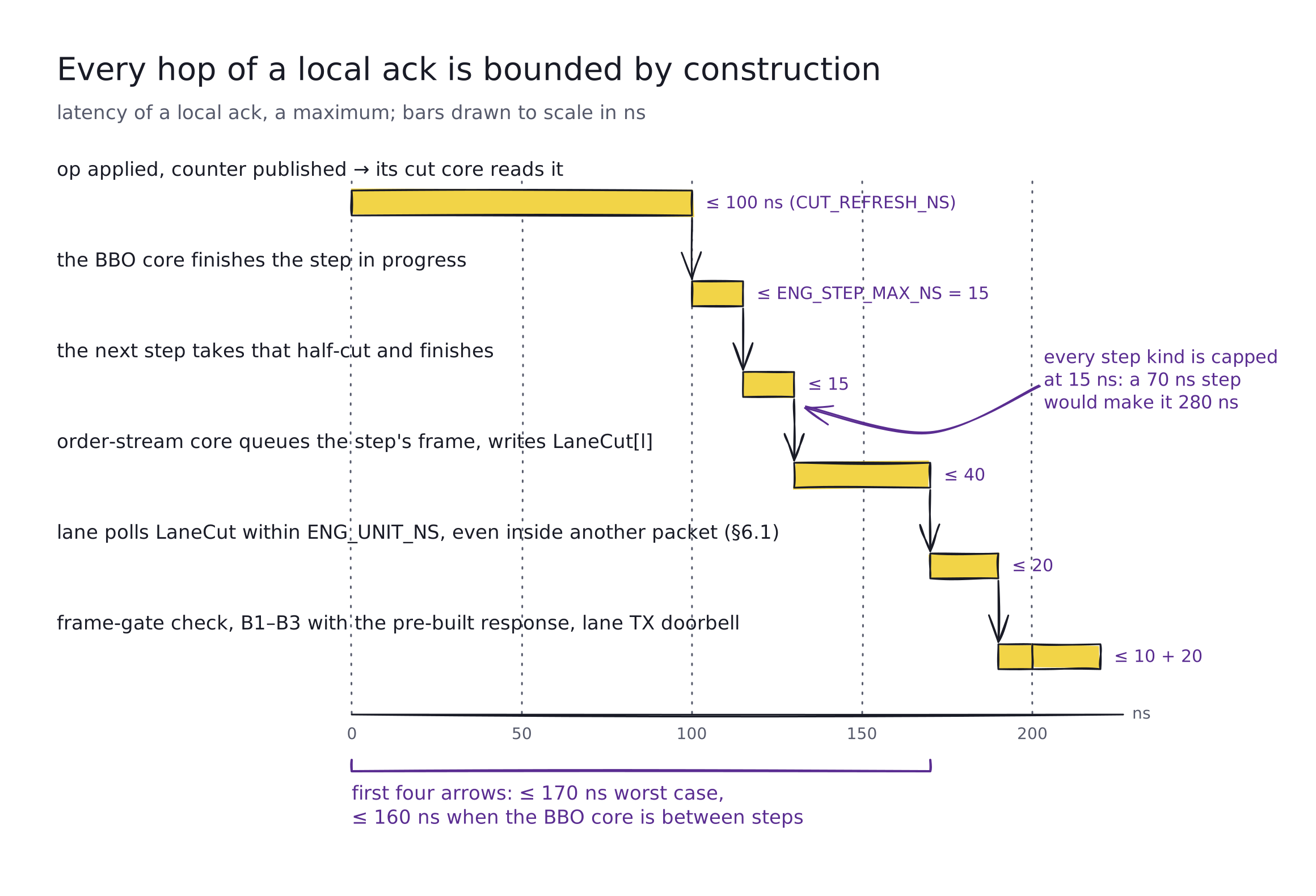
ASCII original
op applied, counter published ─► its cut core reads it          ≤ 100 ns (CUT_REFRESH_NS)
  ─► the BBO core finishes the step in progress                  ≤ ENG_STEP_MAX_NS = 15
  ─► the next step takes that half-cut and finishes              ≤ 15
  ─► order-stream core queues the step's frame, writes LaneCut[l] ≤ 40
  ─► lane polls LaneCut within ENG_UNIT_NS, even inside another packet (§6.1)   ≤ 20
  ─► frame-gate check, B1–B3 with the pre-built response, lane TX doorbell     ≤ 10 + 20
Every arrow is bounded by construction: the cut core's pass is fixed work, a BBO step is capped (D14), a stream core's frame is fixed work per step, and the lane's poll interval is a code property. The first four arrows are ≤ 160 ns when the BBO core is between steps (the 01 §14.2 term) and ≤ 170 ns in the worst case, when a 15 ns step is in progress and another one takes the cut. Deadline admission uses the worst case (§6.8). This is why every step kind is capped at 15 ns: a 70 ns step would make it 280 ns.
7.8 Physical maintenance#
These actions change memory but never logical state. They run in idle_work, in bounded slices
of ≤ ENG_IDLE_SLICE_NS.
| Action | Allowed when | Why it is safe |
|---|---|---|
Clear a position's pend bit |
the position's ins_seq and tomb_seq (if any) are ≤ LaneCut[l].cut |
every current and later step's cut is ≥ C_f[l] (F1), so the bits alone answer it (§4.6) |
Clear a position's active bit after a fill or a BBO kill |
its root's open = 0 or killed is known from an event of a step ≤ f |
no step > f can see it as live |
Retire a segment: unlink it from its FIFO (predecessor's succ, or the head word) |
all 16 positions assigned and none active or pend, or the level is empty |
no current or later step finds a live position in it; a BBO walk that is inside it reads succ, which still points forward |
| Clear the level head (level now physically empty) | after its last segment is retired | emits a CLEAR event; Lemma 7.1 |
Reuse a segment: gen += 1, clear masks, then write positions |
retired, and done_step ≥ σ + ENG_QSBR_LAG, where σ was done_step at the retire (reader epoch) |
a BBO step holds segment references only within one step, except head-cache cursors, which carry gen (§5.3) |
| Push a dead slot to the free FIFO; reuse it | at the boundary where it became settled-dead; reuse after its position's segment is retired or the slot is no longer named by any position, and ENG_QSBR_LAG steps |
the free FIFO's order is a function of boundaries only |
Write lazy tombstones for a CancelAll |
any time before the next CancelAll of the account |
AcctKill already hides those orders (§4.7) |
| Trim journal entries | seq ≤ LaneCut[l].cut |
later batches start above C_f[l] |
Reader epoch and ABA (Lemma 7.2). SnapshotLine.done_step is the BBO core's reader epoch.
A step that starts after done_step = σ cannot hold a reference taken before σ except a
head-cache cursor. (a) A segment retired at σ is reused only after done_step ≥ σ + 2, so no
step that could have read it before the retire is still running, and a step that reads it
between the retire and the reuse sees only dead positions and a valid succ. (b) A cursor
(seg, gen, pos) kept across steps is used only if seg.gen == gen both before and after the
BBO core reads the segment (the lane bumps gen before it rewrites anything); a reused
segment has gen + 1 (wrapping at 2^32 reuses of one segment: > 4 × 10^9 retires of one
block, more than an epoch can do, ENG_SEG_CAP ≥ 2^18), so the check fails and the BBO core
restarts that lane from its head word. (c) A slot index found in a valid segment names the slot
written for that position, because the slot is not reused while a live segment names it. So
neither a segment nor a slot is read under a stale identity. ∎
Slot allocation is deterministic. alloc_root and alloc_version pop the head of the free
FIFO. The FIFO's order is fixed by the order stream, so slot numbers, and hence Handle values
in Ack records, match in replay. If the head is not yet physically reusable, the lane spins
on it (latency only). The logical cap ENG_SLOT_CAP − ENG_FREE_MIN on live plus pending slots
(reject RISK_ORDER_COUNT) keeps the FIFO at least ENG_FREE_MIN deep, so the head was freed
at least ENG_FREE_MIN frees ago and the spin does not happen in practice.
Generation wrap. A root slot's generation repeats after 256 reallocations of that slot.
With a FIFO at least ENG_FREE_MIN = 2^18 deep, that needs ≥ 2^26 frees on the lane: ≥ 3.3 s
at the lane's peak of 20M ops/s (budget). A handle also must match the session (§4.2), so an
alias can only hit an order of the same session. A client that sends a Cancel for a handle more
than 3 s after its terminal response may cancel its own newer order. 04 states this rule.
Aliasing is deterministic, so it never forks replicas.
8. The BBO core#
8.1 Step kinds#
StepKind |
Source | Book effect (§2) | Emitted when |
|---|---|---|---|
| Code | StepKind |
Source | Book effect (§2) |
| --- | --- | --- | --- |
| 1 | Cross |
forwarded op | dependencies, then match_on_entry, ≥ 1 fill; CONT flag: a continuation |
| 2 | Improve |
forwarded op | dependencies, then match_on_entry, no fill (rests, or is rejected or killed) |
| 3 | Rescan |
none | no-op in L; the engine executes the crossing batch entries here |
| 4 | Depletion |
none | no-op |
| 5 | Idle |
none | no-op |
| 6 | Shed |
forwarded op | the op and its dependencies: Reject BUSY |
| 7 | Control |
control ring | phase (incl. Frozen) or band |
| 8 | Seal |
control ring | none; ends the epoch's L |
| 9 | Uncross |
control ring | one chunk of the auction allocation; the last chunk sets Continuous |
The codes are this chapter's (§17 R11 asks 01 to adopt them; 01 §14.10 names the kinds).
StepRecord.src_lane_seq = 0 means "no source". The record of a Rescan carries the band in
StepEntry.band_lo/hi; request R2 asks 01 to add it to StepRecord.
Seal is issued by 08 while the book is Frozen or Halted, once every lane's counter is in
the cut; its StepId is HandoffRecord.last_step (INV-FENCE), and later book ops get the
phase's reject at once.
8.2 Main loop#
fn bbo_main(b: &mut Bbo) -> ! {
    loop {
        let P = (b.read_newest(A), b.read_newest(B));  // two half-cuts, seqlocks, CCD-local
        let heads = b.poll_fwd_rings();                 // §8.4; after P (load order matters)
        b.retire_pend(&P);                              // Pend entries with f_lo ≥ their step
        let ctl = b.control_ring.peek();                // a control command takes precedence
        let src = if b.cont.is_some() { b.cont }        // a continuation runs first (§8.5)
                  else if ctl.is_some() { None } else { b.pick_source(&heads) };
        let C = b.step_cut(&P, &heads, src);            // §3.3, §8.3
        let band = if b.phase == Continuous { b.band_test(&C) } else { Band::EMPTY };
        if !band.is_empty() {
            let Cr = b.partial_rescan_cut(&C, band);     // bounded batch, §8.6
            b.exec_rescan(&Cr, band);                   // one step; b.cut = Cr afterwards
            continue                                    // the source, if any, waits one pass
        }
        if let Some(c) = ctl.filter(|_| src.is_none()) { b.exec_control(c, &C); continue }
        match src {
            Some(e) if b.clock.now_ns_lo32().wrapping_sub(e.deadline) as i32 > 0
                    && !e.is_continuation() => b.exec_shed(e, &C),     // §6.8, Shed
            Some(e) => b.exec_forwarded(e, &C),         // Cross or Improve, or a continuation
            None if C != b.cut => b.exec_idle(&C),      // Idle, or Depletion if a bound is stale
            None => b.idle_work(),                      // §8.11, no step
        }
    }
}
Each exec_* ends with b.finish_step():
1. append the StepEntry (and its delta lines) to StepLog              → order-stream core
2. push this step's FillEvents to each affected lane's FillRing       → lanes (in ordinal order)
3. push the TxEntries: deps packet, source packet, one per maker session → fill TX core
4. if B, A or phase changed: version += 1, record (B, A) in history, write SnapshotLine
5. write SnapshotLine.done_step = s (Release); BboFloor = (P_A.pub_id, P_B.pub_id) (Release)
6. b.cut = C; s += 1
Order 1-before-3 lets the fill TX core check FramesOut ≥ s before it sends (INV-FRAME-FIRST,
01 §14.5). Order 2-before-5 lets a lane that sees done_step or LaneCut for s find every
event of s in its ring. A Shed step costs the same as an Improve and writes one TxEntry
(the BUSY records) and one Reject event per op.
8.3 Step cut#
fn step_cut(b: &Bbo, P: &(CutPub, CutPub), heads: &Heads, src: Option<FwdEntry>) -> Cut {
    let mut C = b.cut;                                     // C_{s−1}
    for l in 0..N_LANES {
        let k = P.half(l).entry[l].seq;                    // half A for l < 25, else half B
        let h = heads.floor[l].unwrap_or(u64::MAX);        // dependency floor, §3.3
        C[l] = max(C[l], min(k, h - 1));
    }
    if let Some(e) = src {                                 // the source rule of §3.3
        let l = e.lane;
        let k = max(P.half(l).entry[l].seq, e.lane_seq - e.applied_back as u64);
        C[l] = max(b.cut[l], min(k, heads.next_floor[l].unwrap_or(u64::MAX) - 1, e.lane_seq));
    }
    C
}
heads must be read after P (Acquire on each half's newest, then Acquire on each ring head
word). The lane pushes a FwdEntry and marks its dependencies before it publishes any counter past
the dependency floor, so every explicit op with seq ≤ P.entry[l].seq is in heads and clamps
C[l] below itself. The two halves need not be from the same instant: F1–F3 are per lane.
8.4 Choosing the source#
poll_fwd_ringskeeps, per lane, the next ring slot's address. A poll of an unchanged ring is an L1 hit (~1 ns). The BBO core polls all 50 in one pass (~50 ns worst, ~25 ns typical with the lanes' lines in L1). When a lane writes an entry, the next poll misses and fetches it (~70–100 ns cross-CCD, vendor-class); the poll also prefetches the next two ring lines, which hold the entry'sFwdDeplines when it has any, so they arrive in the same round trip.pick_sourcetakes the ring head with the smallest key(prio_ts, rank_e(lane), lane_seq). The BBO core does not wait for a lane that may have an earlier entry in flight: aggressors are ordered by arrival at the BBO core among the visible heads, and by key among those. The choice is logged inStepRecord.src_*, so replay does not repeat it (§10).- Starvation is impossible: a ring's head is replaced only by entries with larger keys, so every head becomes the minimum after finitely many steps.
- A
Controlentry (halt, phase, band, uncross; from core 0) is executed before ring heads, at most one per loop pass.
8.5 Executing a forwarded op#
fn exec_forwarded(b: &mut Bbo, e: FwdEntry, C: &Cut) {
    let t = b.decode_taker(&e);                            // side, tick, qty, flags, version
    let mut out = StepOut::new(e);
    b.mark_explicit(&e);                                   // BboVer bit 1: source, Join deps
    b.apply_deps(&e, &mut out);                            // §3.7 (4): index order, below
    if b.phase != Continuous { return b.finish_noncontinuous(t, out) }   // §2.5 P1
    if t.kind == NewPrio && !b.replace_ok(&t, C) {         // old version's open was 0 at q
        return b.end(t, &mut out, Reject(TOO_LATE))
    }
    if t.post_only && b.would_cross(&t, C) {
        return b.end(t, &mut out, Reject(POST_ONLY_WOULD_CROSS))
    }
    if t.tif == Fok && b.dry_run_fillable(&t, C) < t.open() {           // no mutation yet
        return b.end(t, &mut out, Reject(FOK_UNFILLABLE))
    }
    b.resume_or_sweep(&mut t, C, &mut out);                // below; may stop at the step cap
    if out.capped { b.cont = Some(e.continuation()); return b.finish_step_with(out.cont()) }
    b.cont = None;
    match (t.tif, t.open()) {
        (_, 0)          => {}                              // fully filled
        (Ioc | Fok, q)  => b.end(t, &mut out, Out(IOC_REST, q)),
        (_, q)          => b.rest(t, &mut out),            // B or A moves to t.tick; Rested;
    }                                                      //   a Pend entry until the lane writes it
    out.kind = if out.n_fills > 0 { Cross } else { Improve };
    b.finish_step_with(out);
}

fn apply_deps(b: &mut Bbo, e: &FwdEntry, out: &mut StepOut) {
    for d in e.deps() {                                    // FwdDep lines, index order
        match d.kind {
            Join   => { b.pend.insert(e.lane, d, e.prio_ts, e.lane_seq − d.back);   // a leaf
                        out.dep_record(d, Ack) }           // W's Ack; fills/STP follow in order
            Cancel => { let o = b.open_of(e.lane, d.slot);                 // at this point of L
                        b.kill(e.lane, d.slot);            // BboSlotState.killed on its root
                        out.dep_record(d, if o == 0 { Reject(TOO_LATE) }
                                          else { CancelAck { canceled: o } }) }
        }
    }
}

fn sweep(b: &mut Bbo, t: &mut Taker, C: &Cut, out: &mut StepOut) {
    let side = t.side.opposite();
    while t.open() > 0 {
        if out.levels == 1 || out.n_fills >= ENG_STEP_FILLS {
            out.capped = true; return                      // D14: continue in the next step
        }
        let lvl = b.bound(side);                           // A for a buy taker, B for a sell
        if lvl == EMPTY || !t.can_trade_at(lvl) { break }
        let tree = b.level_tree(side, lvl, C, t.lane);     // cached for the touch, else built
        let mut level_qty = 0;
        while t.open() > 0 && out.n_fills < ENG_STEP_FILLS {
            let Some(run) = tree.pop_run(C) else { break } // one lane, one segment, keys < k2
            for m in b.segment_run(&run, t, C) {           // AVX-512 pass, below
                if m.lane == t.lane && t.stp != Stp::None && b.acct_of(&m) == t.acct_ix {
                    match t.stp {                          // own maker, incl. a Pend dependency
                        CancelNewest => { b.kill_taker(t, out, STP); return }
                        CancelOldest => { b.kill_maker(&m, out, STP); continue }
                        CancelBoth   => { b.kill_maker(&m, out, STP); b.kill_taker(t, out, STP);
                                          return }
                    }
                }
                let q = min(t.open(), m.open);
                b.filled[m.lane][m.root] += q; t.filled += q; level_qty += q;
                out.maker_fill(&m, lvl, q);                // ordinal += 1, event + maker TxEntry
                if t.open() == 0 || out.n_fills == ENG_STEP_FILLS { break }
            }
            tree.reseat(run.lane, C);                      // next live position of that lane
        }
        if level_qty > 0 { out.taker_fill(t, lvl, level_qty) }   // one taker Fill per level
        out.levels += 1;
        if t.open() > 0 && !out.capped { b.advance_bound(side, lvl, C) }   // next level
    }
}
The segment pass. segment_run turns one leaf's run into makers with no pointer chasing:
let fill  = _mm512_i32gather_epi32(_mm512_load_epi32(&g.slot), bbo_state(lane), 4);
let open  = _mm512_sub_epi32(_mm512_load_epi32(&g.qty), _mm512_and_epi32(fill, FILLED_MASK));
let live  = _mm512_cmpgt_epi32_mask(open, ZERO) & !_mm512_test_epi32_mask(fill, KILLED)
          & active(g.mask) & !pend(g.mask) & !g.vmask & run.from_mask();
let early = key_lt_mask(_mm512_add_epi64(g.base_ts, widen(g.dts)), rank, run.k2);
// positions live & early, in order; a prefix sum of `open` stops where the taker runs out.
// pend / vmask positions in `early` go through version_at (§5.1) one by one.
It reads the segment's three lines once and gathers 16 filled words from BboSlotState
(BBO-private, L1/L2 near the touch). STP needs a maker's account only when the maker's lane is
the taker's lane: one slot-line read per such position. Pend leaves are merged at their keys.
bound(side)isAorB.advance_boundscansoccmasks fromlvlaway from the spread for the next index with any bit set and a livelane_head(inline depletion). Outside the window it reads overflow pages lane by lane (§11.4).can_trade_at(lvl): buylvl ≤ t.tick; selllvl ≥ t.tick.dry_run_fillablewalks a copy of the touch tree (2.1 KB copy) and temporary trees for deeper levels, applying the STP skip/stop rules of §2.4, and stops att.open(). It writes nothing.would_crossist.can_trade_at(bound(opposite))followed by onepop_livepeek; it is exact because the bound level is revalidated (if it is empty,advance_boundruns first, read-only).replace_ok: for aNewPrioversion, comparefilled[root]with the old version's total (pred_total, §4.3). It is checked once per version and cached inBboVer(§4.11).restsetsB = max(B, t.tick)for a buy (A = min(A, t.tick)for a sell) and emitsRested { qty: open }. The position was assigned in pass 1 (D4); aPendentry stands in for it until the lane writes it at the boundary that applies this step (§7.4).kill_*setskilledinBboSlotStateand emitsOut { cause: STP }to the owner's lane; the record itself goes out in the step's TX-core packets (§8.10).Pendholds{ lane, side, tick, key, slot, root, qty, step }per explicit resting op or Join dependency (ENG_PEND_CAP= 256 entries).retire_penddrops an entry when its lane's half-cut showsf_lo ≥ step: the lane has applied that step's events, so the position, its SET event and its mask bits are visible to every later step (Lemma 7.1). At 30M forwarded ops/s and a lifetime of ≤ ~400 ns, ~12 entries are live on average.- The step cap (D14). A sweep stops after one level or
ENG_STEP_FILLS= 8 maker fills, well insideSTEP_FILL_CAP= 64 (01 §14.15.6), so no step exceedsENG_STEP_MAX_NS= 15 ns (§8.12). The rest runs as continuation steps (Cross,CONT) that take precedence over every other source; between them the cut may advance (acks keep flowing, §7.7) and the taker is in flight (§2.3). A continuation is never shed: it already traded. The cap is a count, so replay splits a sweep at the same fills.
8.6 The band test and the Rescan step#
For every lane l with C[l] > C_{s−1}[l], the batch ops of l were classified against
versions in [lowver[l], vcur], where lowver[l] is the snap_ver that came with the cut entry
C_{s−1}[l] (or the source op's FwdEntry.snap_ver, if C_{s−1}[l] was set by a source). Then:
fn band_test(b: &Bbo, C: &Cut) -> Band {
    let (mut hi, mut lo) = (b.B, b.A);                     // bounds of the book at C_{s−1}
    for l in lanes_advanced(C, &b.cut) {
        let (mb, ma) = b.envelope(b.lowver[l], b.vcur);    // max bid, min ask over versions
        hi = max(hi, mb); lo = min(lo, ma);
    }
    if lo <= hi { Band { lo, hi } } else {
        b.B = hi; b.A = lo;                                // widen bounds: still valid, no cross
        Band::EMPTY
    }
}
- Outside
Continuousthere is no band test: no step matches (§8.8). envelopescans the snapshot history whenvcur − lowver ≤ ENG_ENV_SCAN(usual: 0–2 versions). Otherwise it uses two monotonic deques over the history (amortized O(1)). Iflowveris older thanENG_SNAP_HISTversions, it returns(TICK_MAX, 0): the lane is suspect at every price.- An auction or halt version (flag bit 0) has envelope
(TICK_MAX, 0): in those phases lanes join at any price, so a batch classified against them is suspect everywhere. - When the band is empty, the bounds widen to
(max over envelopes, min over envelopes). Lemma 9.8 shows that they remain bounds of the true book. Widening can only make the next snapshot's spread narrower than the true spread: the safe direction.
lowver[l] is updated by finish_step: it becomes P.entry[l].snap_ver when C[l] = P.entry[l].seq, it becomes e.snap_ver for the source lane, and it is unchanged when the clamp
held C[l] below P.entry[l].seq (the older value is still a valid lower bound).
The Rescan step. It executes B_s restricted to the band, in key order:
fn exec_rescan(b: &mut Bbo, C: &Cut, band: Band) {
    let Cp = b.cut;                                        // C_{s−1}
    let mut ents = KWayMerge::new();                       // by key, across lanes
    for l in lanes_advanced(C, &Cp) {
        ents.add(journal(l).range(Cp[l] + 1 ..= C[l]).filter(|j| band.contains(j.tick)));
    }
    let mut out = StepOut::rescan(band);
    for j in ents {                                        // key order: §3.4 inside B_s
        if !matches!(j.kind, New | NewPrio) { continue }   // tombstones act via visible_at
        let mut t = b.taker_from_slot(j);                  // a join, now treated as a taker
        if !b.live_at(&t, C, &Cp, j.key) { continue }      // ended earlier in the batch
        if t.post_only && b.would_cross_at(&t, C, &Cp, j.key) {
            b.kill(t, &mut out, Reject(POST_ONLY_WOULD_CROSS)); continue
        }
        b.sweep_at(&mut t, C, &Cp, j.key, &mut out);       // sweep with visible_at(…, key)
    }
    b.recompute_bounds_in(band, C);                        // exact top on both sides
    out.kind = Rescan;
    b.finish_step_with(out);
}
- Batch entries outside the band cannot cross and cannot be crossed (Lemma 9.6), so the step skips them.
sweep_atissweepwith two changes: makers must satisfyvisible_at(…, key)(§5.2), and the maker trees are built fromlane_headwalks that also accept batch entries with a smaller key. Both work per segment: a leaf is a(lane, segment)run, and inside a run the positions are in key order, so the k-way merge compares one key per lane and advances inside a segment withtzcnton the run mask. A batch entry's position is in its lane's segment chain (independent ops are written before their counter publish), sovisible_atapplies to it like any position.- Partial cut, warm lines (D14). A
Rescanmust fit 15 ns, so it may not wait for a cross-CCD journal line. When the band test fires, the BBO core first takes anIdlestep whose cut holds the suspect lanes atC_{s−1}and prefetches their journal lines; the next step is theRescan, with the lines warm.partial_rescan_cutkeeps the in-band batch entries≤ ENG_RESCAN_MAX= 1 per step: it lowersC[l]of the lanes with the most in-band entries, never belowC_{s−1}[l], and the next steps take the rest. Any cut in that range is a valid step cut (§3.3) and is logged, so the result is exact (Lemma 9.7) and replay does not repeat the choice. A stalled lane's large backlog becomes a run of shortRescansteps instead of one long one. - A join that
Rescanfills is the taker: it getsliq = 1fill events. A join that it does not touch stays as it was: resting, unchanged. exec_rescanwith a non-empty band and no crossing entries is legal and changes nothing but the bounds. A band computed wider than necessary therefore never changes the output (superset corollary of Lemma 9.7); replay can use any superset of the band.
8.7 The Depletion step#
The bounds B and A can sit on levels that cancels have emptied. Matching corrects this
inline (advance_bound). The idle path corrects it eagerly, so that lanes see a tight snapshot:
exec_idle(C):
    if occ(B) has no lane with a live lane_head at C, or occ(A) likewise:
        advance_bound on that side (read-only walk); kind = Depletion
    else kind = Idle
    finish_step()   // publishes a new version if a bound moved
A Depletion step changes no order. It is logged because it positions the batch B_s and
consumes a StepId.
8.8 Auction mode (engine side; 08-epochs.md owns the rule)#
08 decides when an auction starts and ends and how the clearing price is chosen; the engine
provides the phase machinery, the histograms and the allocation. Draft 0.1 stalled the BBO core
for tens of µs while lanes built histograms, delaying every ack; draft 0.2 freezes the book and
allocates in 15 ns Uncross steps, so every response during an auction keeps the 1 µs bound.
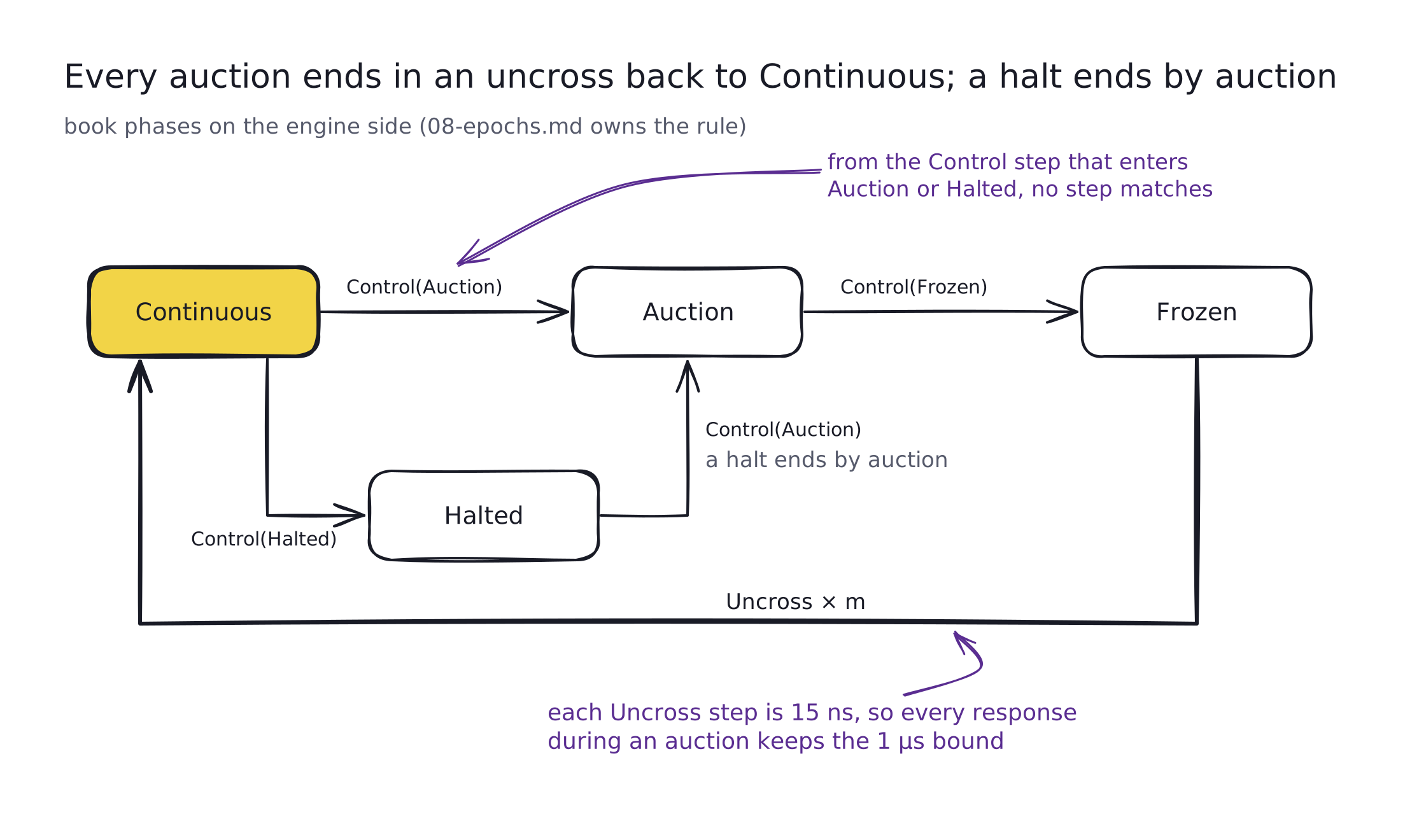
ASCII original
Continuous ──Control(Auction)──► Auction ──Control(Frozen)──► Frozen ──Uncross × m──► Continuous
     │                              ▲
     └──Control(Halted)──► Halted ──┘ (Control(Auction); a halt ends by auction)
-
Enter Auction or Halted. A
Controlsteps_asets the phase, publishes a snapshot with the auction flag and empty sides, and sends aPhaseevent to every lane. Froms_aon, no step matches. Lanes route every admittedNewasLocal(§6.5); IOC/FOK are rejectedAUCTION_PHASE; in Halted everyNewandReplaceis rejectedBOOK_HALTED. The book may become crossed.INV-UNCROSSEDstill holds, because the published snapshot has empty sides. -
Freeze.
08asks for the close. AControlsteps_fsets phaseFrozenwith cutC*=C_{s_f}and writesUncrossReq { step: s_f, cut: C*, lo, hi }into the box lineAuctionCtl(BBO-written, lane-read),lo..=hi= the auction collar (≤ENG_AUCTION_TICKS). From the lanes'Phaseevents on, every book op is rejectedAUCTION_PHASE(§2.5 P4), and ops positioned afters_fbut admitted earlier are rejected at settle and tombstoned at their own seq. So the book at every later step until the uncross is the book atC*. The BBO core keeps runningIdlesteps: acks, cancels' rejects and every other response keep the 1 µs bound. -
Histograms. Each lane walks its segments in
lo..=hiin idle slices, sumsopenof every order visible atC*[l]that is not killed, and writes itsAuctionHistbuffer (lane-written, control-core-read):buy[i], sell[i]: u64fori = tick − lo, thenready = s_f(Release). Lane cost: ~2 ns per order in the collar (budget), never more thanENG_IDLE_SLICE_NSat a time. -
Price, off the BBO core. When all lanes are ready, the control role on core 0 sums the 49 histograms into cumulative demand
D(p) = Σ_{t ≥ p} buy[t]and supplyS(p) = Σ_{t ≤ p} sell[t]and calls08's pure function:pub fn uncross_price(d: &[u64], s: &[u64], lo: Tick, reference: Tick) -> Option<(Tick, u64)>; // returns (clearing tick p*, matched qty Q) or None if nothing crossesIt posts
Uncross { p*, Q }on the control ring. The inputs are lane state atC*, so a replica's control role computes the same(p*, Q)(§10). -
Allocate in chunks. Buys at
tick > p*and sells attick < p*fill fully. Atp*, the side with more volume fills in merged-FIFO order (key order) untilQ. The BBO core walks the merged segment FIFOs from the best price inward with the same trees assweep, using visibility atC*, and emits fills at pricep*withliq = 2(01 §14.10;10sets the fee rule). EachUncrossstep allocates at mostENG_UNCROSS_CHUNK= 6 fills (≤ 15 ns), and the BBO core runs the chunks back to back, withIdlesteps between them when a cut is waiting. Fills carry theStepIdof their chunk; ordinals follow buys-then-sells per merged order inside each chunk. Because the book is frozen, splitting the allocation into chunks changes nothing but theStepIds, which are logged. -
Auction-only orders. After the last chunk
s_u, every visible auction-only order withopen > 0is dead (§2.5 P2). TheUncrossevent ofs_uto lanelcarriesC*[l]; the lane ends each such order withOut { cause: AUCTION }at B1. -
Continuous again.
s_upublishes the exact bounds and sets phaseContinuous. Lanes that classified ops under the auction version are suspect at every price until they refresh (§8.6 envelope rule), so any order that crosses the new book is caught byRescan.
uncross_price is a pure integer function, part of INV-DET. The freeze lasts ~2 ns per collar
order plus ~2.5 ns per fill (budget); 08 bounds it (ENG_FREEZE_MAX_US) and tells clients. It is
a market-structure rule, not a latency exemption: every message in it is answered within 1 µs.
8.9 Fill events and the step log#
Output of step s |
Ring | Content |
|---|---|---|
StepEntry |
StepLog |
kind, source, changed cut entries, band, fill_lanes, CONT |
maker Fill |
FillRing[maker lane] |
one per fill, liq = 0 (2 in an uncross) |
taker Fill |
FillRing[taker lane] |
one per level, liq = 1 (for the LaneSeq source and for Rescan takers) |
Rested/Out/Reject/Dep |
FillRing[taker lane] |
final status of the source op, of each dependency, or of a Rescan taker |
Out(STP) for a maker |
FillRing[maker lane] |
maker removed by STP |
Phase/Band/Uncross |
every FillRing |
control steps |
TxEntry role 1 |
TxRing |
the dependencies' records in index order (each Ack/CancelAck, then a Join dependency's own maker Fill or Out(STP)), on the first reserved resp_seq |
TxEntry role 0 |
TxRing |
the source's records: Fill per level, then Ack/Out/Reject; a continuation's records on the session's MakerSeq |
TxEntry role 2 |
TxRing |
one packet per maker session hit in the step: its Fills (and Out(STP)s), numbered from MakerSeq (01 §14.14) |
The fill TX core builds each packet from its TxEntry and the session's TX state (address,
K_out; installed at session open by the control path, 04). It sends nothing of step s
before FramesOut.step ≥ s (INV-FRAME-FIRST). Auction (Uncross) fills are not caused by a
request packet; their lanes send them after B1, like other unsolicited records.
Fill TX budget per step (01 §14.14, §14.15.3). TX-A (core 3) sends the packets of sessions
on lanes 0–24, TX-B (core 5) those of lanes 25–48. Each reads the step's TxEntrys as soon as the
BBO core writes them, and builds and tags its packets (8-way AVX-512 SipHash, ~15 ns for up to 8,
budget) while the stream cores frame the step (the 60 ns gate). After the gate only the CTPIO
writes are serial, per core: t_tx = 10 + 8k ns for the source packet and k maker packets on
the same core. A step has ≤ 8 maker fills, so k ≤ 8 on one core in the worst case (all makers
on one half): t_tx ≤ 74 ns. At index 9 the taker's fill leaves at 880 ns (§11.1) and the last
maker's ≤ 880 + 64 = 944 ns, inside LAT_MAX_NS − DEADLINE_GUARD_NS. A continuation step's
makers leave ~15 ns per step later, so at index 9 about five steps (≤ 40 fills) fit; §18 Q15.
8.10 Responses and packetization#
INV-DET covers every response byte, so the grouping of records into packets and the
assignment of resp_seq are fixed by these rules. All are functions of lane state at
boundaries and of step outputs.
- Forwarded message. In pass 1 the lane reserves
resp_seq = rfor it, andr, r + 1if it has dependencies (§6.6). The dependency packet (r) and the source packet (rorr + 1) hold exactly theirTxEntryrecords,echo_pkt = pkt_seq. The fill TX core sends them. AShedstep sends the same packets withReject { BUSY }records. - TX-core packets without a reservation. Maker packets and continuation packets of a session
take the session's next
MakerSeqnumber (§4.15),echo_pkt = 0for makers andpkt_seqfor a continuation. - Immediate rejects. In pass 1, all
Rejects of one request packet's local messages go into one packet (echo_pkt = pkt_seq), withresp_seqtaken after the forwarded reservations of earlier messages in the packet, in message order. Sent at once. A laneBUSYis one such packet for the whole request. - Boundary output (B3). For each session, in this order:
- Walk the settles of B2 in
LaneSeqorder. Before each settlet, emit the not-yet-emitted events of B1 that belong to a version ended byt, and theliq = 1events of the version created byt(a Rescan fill of a join), in(step, ordinal)order. Then emitt's record. - Then emit the remaining events of B1 in
(step, ordinal)order. Records answering one request packet are packed into packets withecho_pkt = pkt_seq; other unsolicited records that the TX core did not send (auction fills) go into packets withecho_pkt = 0. A packet holds at most 16 records;resp_seqincreases in emission order. Maker fills and every record the TX core sent are not emitted again (rule 5).
- Walk the settles of B2 in
- Mirroring. The lane writes the packets of rules 1 and 2 into the retention buffer, from
the events of B1, with their
resp_seq.
Rule 4.1 gives the natural order: a cancel's CancelAck follows every fill of the canceled
version; a join's Ack precedes every maker fill on it; a Replace shows the old version's fills,
then its Ack, then the new version's fills.
Pre-built responses (the 20 ns of B3 on the ack path). In pass 2 the lane appends each local
op's predicted record (Ack, or CancelAck with the open quantity known now) to the request's
local response packet, whose first resp_seq it reserved in pass 1, and absorbs it into a
SipHash state, checkpointed per record. At B3 a confirmed record costs nothing; the lane
finalizes the tag (~4 ns) and rings the doorbell. A record that changed (a fill of a canceled
order, a Rescan fill of a join) is re-absorbed from its checkpoint when its event appears in the
FillRing, ≥ 40 ns before LaneCut covers the op (§8.2, §4.15). The bytes are rule 4's either way.
8.11 Idle work and the prefetch plan#
When bbo_main finds no source and no new cut, it spends ≤ ENG_IDLE_SLICE_NS on, round robin:
revalidating 4 touch leaves per side (segment mask line, AcctKill line, head word; changed
lines are refetched), prefetching the three lines of each touch winner's segment and successor,
keeping the trees of the next levels (B − 1, A + 1) warm at half the rate, and running an
Idle/Depletion step if a touch tree is empty. Ring lines are prefetched by polling (§8.4).
This is what keeps a cross step at 15 ns (§8.12).
8.12 BBO budget#
Budgets at 5 GHz, with the prefetch plan in place (no cross-CCD miss on the critical path except the FwdEntry itself, which is counted in the hop).
| Step | Work | ns |
|---|---|---|
| any (included in every row below) | read two half-cuts (CCD-local), compute cut (SIMD), clock read for the deadline (pipelined), retire_pend, band test, finish_step (StepEntry, events, TxEntries, snapshot, floor) |
3 |
| Improve, Shed, Depletion | decode, bound compare, rest (one Pend insert) or one advance_bound word scan, event, TxEntry |
~3 |
| Cross, 1 level, ≤ 2 makers in one run | head prefetched by the poll (§11.3), one segment pass (3 lines in L1/L2, 16-lane gather, compare, prefix sum), events, TxEntries | ~15 = BBO_CROSS_NS (01 §14.15.2) |
| each extra maker in the run | prefix-sum lane, event, TxEntry when a new session | +1 |
| each extra run (another lane or segment) | tree replay (6 compares), segment pass (prefetched in idle) | +3 |
| dependencies | FwdDep lines (arrived with the entry), Pend inserts, kills, records |
+1 per dependency |
| a continuation step (next level) | advance_bound, tree of k lanes from prefetched heads, segment pass |
~15 |
Rescan (1 entry, lines warmed by the Idle step before it) |
merge, sweep | ~15 |
| Idle | cut + finish | ~4 |
The caps of §8.5, §8.6 and §8.8 keep every step ≤ ENG_STEP_MAX_NS = 15 ns; a step that the
caps allow but would exceed 15 ns is a budget error that B3 reports. At the design mix, 10M
crosses/s × 15 ns + 20M improves/depletions/s × 3 ns + ~1M dependencies × 1 ns ≈ 0.21
(01 §14.15.2), far below BBO_MAX_LOAD = 0.60. The BBO shed tail is then P(wait > 90 ns) ≈ 4e-8
(01 §14.15.2). B3 checks both.
9. Equivalence with the sequential specification#
Theorem. For every order stream, the parallel engine (live or replay) produces the same
responses, the same fills with the same execution IDs (StepId, ordinal), and the same canonical
state as the sequential specification of §2 applied in the order L of §3.4.
The proof is a chain of lemmas. "The book at a point of L" means the sequential specification's book after applying L up to that point.
9.1 L is well defined and respects lane order#
Lemma 9.1. pos(l, q) exists for every op that some step's cut covers, pos(l, q − 1) ≤ pos(l, q), and inside B_s the key order restricted to one lane is LaneSeq order.
Proof. C_s[l] ≥ q implies C_s[l] ≥ q − 1, so the first such s for q − 1 is not later.
Within one lane, prio_ts is non-decreasing in LaneSeq (§3.2) and ties are broken by seq,
so key order is LaneSeq order. A KeepPrio version keeps its order's key but is not a batch
element of its own: the batch element is the Reduce op, whose key is the op's key. ∎
Lemma 9.2 (F1, INV-CUT-MONO). C_s ≥ C_{s−1} pointwise.
Proof. Every entry of the rule of §3.3, the source's included, and every partial cut, is a
max with C_{s−1}[l]. Each half's entries are monotone on their own (§7.1), but the rule does
not even need that. ∎
Lemma 9.3 (F2). The source (l, q) of step s and each of its dependencies (l, x) have
pos = s, and no cut before s covers any of them.
Proof. pos = s holds by the definition of §3.4. Before step s executes the entry, its
dependency floor φ ≤ x ≤ q bounds h[l] ≤ φ at every step (ring entries are consumed in order
and this one is unconsumed; an entry not yet pushed has a larger floor than every op before it,
and the lane marks the dependencies before it publishes any counter past φ, §8.3), so
C_{s'}[l] ≤ φ − 1 < x for s' < s. ∎
9.2 What a step sees#
Lemma 9.4 (exact view). During step s, for every queue position of lane l, the BBO core
finds it live (through the segment mask, version_at and live, or as a Pend leaf) exactly
when the book at S_s's point of L has a live order there: its op is at or before C_s[l] in
lane l's order or is explicit at a step ≤ s, and no op at or before that point ended it.
Proof. Independent ops. Let x = V.ins_seq ≤ C_s[l]. By F3 the lane wrote V, the position
(slot, qty, dts, then mask with Release) and the journal entry before it released a
counter ≥ x that reached the BBO core through a half-cut, or through the source's FwdEntry
(a, §3.3); the BBO core acquired it, so it reads the final values (happens-before is
transitive). If x > C_s[l], visible is false whatever the BBO core reads. For a tombstone,
the same argument applies to tomb_seq ≤ C_s[l]; a tombstone with seq > C_s[l] is either not
seen or seen with seq > C_s[l]; both give "live". The mask. The lane clears pend only when
LaneCut[l].cut ≥ the position's seqs, and every current or later cut is ≥ that (F1), so a
non-pend bit answers the same as the slot check (§4.6). A mask store and the slot writes it
covers are ordered (Release); a mask read older than a cancel still shows active, which is
correct for a cut below the cancel. Explicit ops. The source and its Join dependencies are
Pend leaves until the lane writes them; the lane writes them with the EXPLICIT mark already
set by the BBO core, so the hand-over is seamless, and the slot match prevents double counting
(§5.4). A Cancel dependency sets killed at its own step. Segments. Lemma 7.2: a segment or
cursor is never read under a stale identity. For AcctKill, the lane finishes the old
CancelAll's tombstones before overwriting kill_seq (§4.7). BboSlotState and BboVer have
one writer, the BBO core itself. ∎
Corollary. The set of live orders the BBO core sees at step s is the book at the end of
B_s in L, provided B_s contains no crossing op (then every local New in B_s just rests,
and Lemma 9.6 below shows that this is what L does).
9.3 Commutation inside a batch#
Lemma 9.5. Let x, y ∈ B_s be ops of different lanes, and suppose neither trades when
applied in L. Then applying them in either order gives the same book and ledgers.
Proof. x and y touch disjoint ledgers (an account has one lane), disjoint slots, and
disjoint FIFOs (a lane FIFO belongs to one lane). In the book they touch only the level FIFOs,
where each is placed by its key, not by arrival. A cancel or reduce changes only its own order.
Without a trade, nothing else depends on the other. ∎
9.4 The crossing lemma#
Lemma 9.6 (crossing). Let step s compute [lo, hi] by §8.6 from bounds (B, A) with
B ≥ true best bid and A ≤ true best ask of the book after S_{s−1}, and that book
uncrossed. Apply B_s in key order with matching on entry. Then every trade in B_s is between
two orders whose ticks lie in [lo, hi]. In particular, if lo > hi, no op of B_s trades.
Proof. Every New or NewPrio op in B_s is local (§3.6). A local order was classified in
Continuous against a version v with v ∈ [lowver[l], vcur] (§6.5, the lowver rule of §8.6), so a
buy has tick ≤ b_v ≤ mb_l ≤ hi and a sell has tick ≥ a_v ≥ ma_l ≥ lo. An order classified
under an auction or halt version gives mb_l = TICK_MAX, ma_l = 0, which only widens the band.
Every resting bid of the pre-batch book has tick ≤ true best bid ≤ B ≤ hi; every resting ask
has tick ≥ true best ask ≥ A ≥ lo. Cancels and reduces add no order and change no tick.
So at every point of B_s, every bid has tick ≤ hi and every ask has tick ≥ lo. A trade
needs a bid tick ≥ an ask tick: the buy order's limit p_b and the sell order's limit p_s
satisfy p_s ≤ p_b (the maker's tick lies between them). Then lo ≤ p_s ≤ p_b ≤ hi. ∎
Same snapshot (DESIGN's form). If every op in B_s used one version v and the pre-batch
bounds equal (b_v, a_v), then hi = b_v < a_v = lo, so nothing crosses. The general form
above covers different versions: they can cross only inside [min a, max b], the range the BBO
core moved through since the oldest version in use.
Lemma 9.7 (Rescan is exact). If lo ≤ hi, then exec_rescan produces the same trades,
fills and final book as applying B_s in key order with matching on entry.
Proof. Split B_s into in-band ops I and out-of-band ops O. By Lemma 9.6 no op of O
trades, and no op of I trades with an order outside the band. An op of O is a join that
rests outside the band, or a cancel or reduce of an order outside the band, so it does not
change any order in the band: it commutes with every op of I (Lemma 9.5 extended: the only
interaction is through the band, which O does not touch). So L's result is: apply I in key
order, then O. exec_rescan iterates I's journal entries in key order (k-way merge of
per-lane runs, each in LaneSeq = key order). For each New/NewPrio entry with key k it
matches against makers that satisfy visible_at(…, k): exactly the orders that exist at k's
point of L (pre-batch orders not ended before k, plus batch orders created before k and not
ended before k). Cancels and reduces are not executed as actions; they act through
visible_at, at their key. That is matching on entry at k. The O ops are already linked and
need no action. ∎
Corollary (superset bands). Running exec_rescan with any band ⊇ [lo, hi] gives the same
result, because an extra in-band op either trades in L (then it is in [lo, hi]) or does not
(then the sweep finds no maker and leaves it resting). So a replica may use a wider band.
9.5 Bounds and the safe direction#
Lemma 9.8 (bounds). After every step in Continuous, B ≥ true best bid, A ≤ true best
ask, and B < A, where "true" means the book after S_s.
Proof by induction. Initially both sides are empty. Step s:
- Batch. If the band is empty, the batch only adds bids
≤ hiand asks≥ loand removes orders, and the BBO core setsB := hi,A := lowithhi < lo(§8.6). If the band is not empty,exec_rescanrecomputes the exact top (recompute_bounds_in), and the book is uncrossed after it because matching on entry leaves no crossing pair (§2.4). - Cross/Improve. The sweep moves
A(for a buy) only past levels it found empty or exhausted, soAstays≤true ask; it stops at a level the taker cannot trade at, or with the taker filled. A resting residual atpsetsB := max(B, p); the sweep stopped because the next live ask is> p(or the side is empty), sop < A. A rejected or killed source leaves the book and the bounds unchanged. - Depletion.
advance_boundmoves a bound only past levels with no live order atC_s. - Cancels inside the batch lower the true bid or raise the true ask, which keeps both
inequalities.
So the inequalities hold and
B < A. ∎
Corollary (INV-UNCROSSED). Every published snapshot is a pair (B, A) from Lemma 9.8, or
has empty sides (Auction, Halted). So bid < ask or a side is empty.
Lemma 9.9 (stale only in the safe direction). Let a lane classify an order against version
v, published by step s_v with bounds (b_v, a_v). Suppose no step after s_v moved a bound
inward, that is, the only changes since are cancels, fills of resting orders, and joins
classified against v. Then (a) if the order crosses the book at its position in L, the lane
forwards it, and (b) if the lane keeps it local, the true best bid stays ≤ b_v and the true best
ask stays ≥ a_v after it.
Proof. Under the assumption, true bid ≤ b_v and true ask ≥ a_v at every point after s_v
(cancels and fills only lower the bid and raise the ask; joins against v have buy ≤ b_v and
sell ≥ a_v). (a) A buy that crosses has tick ≥ true ask ≥ a_v, so classify forwards it.
(b) A kept buy has tick ≤ b_v. ∎
Lemma 9.9 is the DESIGN statement "a stale snapshot sends extra orders to the BBO core, never
fewer". When a step does move a bound inward (an improve or a residual), versions older than that
step are no longer safe on their own; Lemma 9.6 and the Rescan step cover that case exactly.
9.6 The forwarded step#
Lemma 9.10. exec_forwarded at step s produces the same result as S_s = matching on
entry of the source op on the book after B_s.
Proof. By Lemmas 9.4–9.7 the live orders at C_s are the book after B_s (if the band fired,
a Rescan step processed the batch first and the source runs at a later pass). apply_deps
applies the dependencies in index order (Lemma 3.7 (4)). The sweep visits levels in price order
from the bound: advance_bound misses no non-empty level, because the masks are conservative
(Lemma 7.1), wild and lag lanes are probed, Pend leaves are merged, and levels outside the
window are read from the lanes directly. At a level it takes makers in (prio_ts, rank) order
across lanes (the tree) and in position order within a lane; positions were assigned in key
order and never move (§4.6), and a run stops at the runner-up's key (§5.4), so the fills are in
key order, which is best_maker's order. The STP, FOK, post-only and IOC branches are the same as
§2.4 line by line; the FOK dry run reads the same sequence without writing. replace_ok
implements the TOO_LATE rule of Replace, because after pos(q) only the new version can
change filled[root] and it cannot trade before its first check. A continuation resumes the
same loop on the book at its own point of L (§2.3). ∎
Lemma 9.15 (shed is replayable and in-order). A Shed step's effect is a function of the
log, and equals the sequential outcome with the op and its dependencies rejected BUSY.
Proof. The decision (now > deadline) is the only clock read; its result is the step's kind,
which is logged, and replay reads it (§10). The step applies nothing to the book (§2.3), the lane
writes no position or tombstone for those ops (§7.4), and their reservations are released from
the Reject events at a logged boundary. Lemma 3.7 (5) gives the in-order outcome. A lane's
SHED record takes no LaneSeq and changes only the session's resp_seq, which the record
fixes. ∎
9.7 Cancel against fill#
Lemma 9.11 (cancel-vs-fill is deterministic). For a Cancel op t of order o: (a) the
fills of o's ended version are exactly those of steps < pos(t); (b) pos(t) is a function of
the logged cuts; (c) the lane's answer is TOO_LATE if those fills sum to the version's open
quantity, else CancelAck { canceled: total − fills }; (d) live and replay compute the same
answer at the same boundary.
Proof. (a) For s ≥ pos(t), C_s[l] ≥ t, so the tombstone is visible and visible is false
(Lemma 9.4). For s < pos(t), the tombstone is outside the cut. (b) pos(t) is defined from
C_s, which StepRecord.cut carries. (c) is §7.6. (d) The lane answers at the first boundary
with t ≤ C_f[l], f = fills_applied; f is in the PacketRecord and C_f in the
StepRecord; at that boundary the lane has applied all events of steps ≤ f ≥ pos(t) (B1), so
by (a) it has all fills of the version. ∎
The same argument covers Reduce, Replace and CancelAll (through AcctKill).
9.8 Lane determinism and INV-ACK-AFTER-CUT#
Lemma 9.12. The state of lane l after each boundary, and the responses it emits there, are
functions of the order stream and the data.
Proof. A boundary applies B1 (events of steps ≤ f), B2 (settles ≤ min(C_f[l], applied)),
B3 (packing rules of §8.10, a function of B1–B2's output and lane state); then pass 1 and pass 2
of the packet (the data; the routing of each message is read from the log in replay, §10). f
and the boundary's position (between packets, or MID before a logged op and pass) are logged,
so applied is known. Step
outputs are functions of the order stream by induction: step s reads lane ops ≤ C_s[l], each
processed at a boundary whose f < s (the lane applied the events of f before it processed and
published the op, and step s read the published op after step f finished). So the
dependency graph of steps and boundaries is acyclic, and induction along it works. The schedule
of LaneCut updates, the timing of B1–B2 and of idle work do not appear in any of these
functions. ∎
Lemma 9.13 (INV-ACK-AFTER-CUT). Every Ack and CancelAck is sent after a logged step
cut includes its op.
Proof. Local ops: staged in B2 only for t ≤ C_f[l], where C_f is step f's cut, and sent
only after LaneCut for f, which its stream core writes after step f is framed (frame gating, §4.15).
Forwarded ops and dependencies: staged in their step's TxEntry; the step positions them
(Lemma 9.3) and its record logs the source, from which replay derives the dependencies. The
StepEntry is written before the TxEntry (§8.2), and the fill TX core sends only after
FramesOut ≥ s. ∎
9.9 Physical choices do not matter#
Lemma 9.14. The following never change any output: the window center and re-centering; the
occupancy masks and wild; the head cache and its cursors; polling order; prefetching; the
free-FIFO spin; the schedule of pend-bit clears, segment retires and reuses, and of LaneCut
writes; the Pend table's lifetime; the phase offset between the two cut cores; whether a
pre-built response was confirmed; the snapshot values (beyond the routing they cause, which is
logged as step sources and Rescan steps).
Proof. Each item changes only where the BBO core looks, when, or how fast. Lemmas 9.4, 7.1 and 9.10 show that the BBO core finds the same live orders whatever the masks, cache or window contain, as long as the masks are conservative. Lemma 9.12 shows that lane outputs do not depend on schedules. Routing: for any routing, Lemmas 9.6–9.10 prove equality with L, provided each step's band covers its crossing ops, which §8.6 guarantees for the versions the lanes actually used. ∎
Proof of the theorem. Apply L element by element. A batch B_s without crossing ops equals
the engine's state change at C_s (Lemmas 9.4, 9.5, 9.6). A batch with crossing ops is executed
by a Rescan step (Lemma 9.7). A source step equals S_s (Lemma 9.10), a Shed step its
BUSY outcome (Lemma 9.15), a packet's ops in L give its index-order outcome (Lemma 3.7), and
pooled lanes keep one writer per field and a logged account order (Lemma 6.1).
Ledgers and responses are lane functions of the stream (Lemma 9.12), and cancels resolve
identically (Lemma 9.11). Fill ordinals are assigned in the order the engine executes trades
within a step, which is the order L applies them. ∎
10. Replay mode#
A replica runs vyrn-engine with the same lane, BBO and settlement code. Three inputs change
(01 §11.6):
| Live | Replay |
|---|---|
NIC RX queues → process_packet |
PacketRecord + data (by pkt_hash) → process_packet; the record's rx_ts is the timestamp |
| deadline admission at the lane | PacketRecord.flags.SHED: answer BUSY, apply nothing; no clock is read |
LaneCut polls inside a packet |
MID Advance records: run the boundary before the named op and pass |
| two cut cores → half-cuts | StepRecord.cut is the step's cut C_s; step_cut and partial-cut choices are not repeated |
pick_source over ring heads, band test, the BBO deadline test |
StepRecord.src_*, kind (incl. Shed, CONT) and the Rescan band (request R2; without it, the band is all ticks, which is correct by the superset corollary of Lemma 9.7) |
LaneCut[l] read by the lane |
PacketRecord.fills_applied = f and C_f[l] from StepRecord f |
snapshot routing in classify |
op (l, q) is forwarded iff a StepRecord has src = (l, q) |
dependency lists in FwdEntry |
recomputed from the packet's bytes by the replayed pass 1 (§6.6: a function of the messages and lane state) |
core 0's uncross_price |
the replica's control role computes it from its own lanes' histograms at C* |
| pool token CAS and stealing (§6.9) | AcctTake { acct, ver } records: a lane waits at one until the account's previous ver is replayed |
Scheduler. The replica schedules lanes and the BBO core as a dataflow:
- Lane
lmay run the boundary of recordronce steps≤ r.fills_appliedare done. - Lane
lmay run pass 1 for opqonce it knows whetherqis forwarded: that is known at the firstStepRecordwithcut[l] ≥ q, or withsrc = (l, q')for someq' ≥ q(itssrcis(l, q)or not). Dependencies follow from pass 1. - The BBO core may run step
sonce every lane has run pass 1 for its source and pass 2 for every independent op≤ C_s[l].
Lemma 9.12 shows that this graph is acyclic, so the scheduler never deadlocks. vyrn-replica
runs it with the same pinned threads as live or, in vyrn-sim, on one thread in a fixed order.
Both give the same bytes.
Why the output is bit-identical (INV-DET). Every decision of §6–§8 reads only packet
bytes and rx_ts; LaneSeq positions, fills_applied, boundary positions, SHED, AcctTake
and step cuts, sources and kinds (all in the order stream); state built from those; and book
parameters installed by Control steps or at epoch start (§13). No decision reads a clock except
the two logged deadline tests, a random number, a hash-map order, a float, or a ring's fill level
(§14.2). Lemma 9.14 covers the physical choices. Integer overflow is a checked reject or a fault
(§14.3). Replay needs no cut core, masks, snapshot line or TX cores; its BBO core keeps (B, A)
for Rescan and advance_bound and publishes nothing.
Check. B4 (DESIGN §9 #4) replays a live log on a separately built replica and compares the
state hash and every fill. vyrn-sim also feeds the same stream to vyrn-vx-oracle and compares
oracle_state_hash after every element of L (§2.8).
11. Performance#
11.1 Latency paths (bare metal REF, budget, 01 §14.2)#
Message index i = 0..9 of a packet of n messages; the worst case is i = n − 1 = 9.
Cross fill (forwarded op that trades), index 9                       index 9   index 0
  NIC RX: first bit in → RX completion visible to the lane (ef_vi)      320       320
  pre-pass: age check, session, MAC, prefetch                            45        45
  pass 1 up to and including message i (5 per message)                   50         5
  push FwdEntry (+ FwdDep lines)                                         10        10
  lane → BBO hop: poll pass + one cross-CCD round trip                  100       100
  BBO step: deadline test, cut, band, deps, segment sweep, events        15        15
  frame gate: stream cores frame the step (TX cores build, MAC)          60        60
  TX core of the taker's half: CTPIO (makers follow, §8.9)               40        40
  NIC TX: CTPIO → first bit on the wire                                 240       240
                                                               total    880       835

Join or cancel ack (local op), index 9 of 10
  NIC RX                                                                320       320
  pre-pass                                                               45        45
  pass 1 of all n messages                                               50        50
  pass 2 up to and including message i (9 per message)                  90         9
  logged cut via LaneCut (cut ≤ 100, BBO step 20, stream core 40)       160       160
  lane notices LaneCut (poll interval ENG_UNIT_NS)                       20        20
  frame gate (already open: LaneCut follows the frame)                   10        10
  B1–B3 with the pre-built response, lane TX doorbell                    20        20
  NIC TX                                                                240       240
                                                               total    955       874
Index 0 is 45 ns faster on the cross path and 81 ns faster on the ack path (01 §14.2 says "~90").
The cross path is 01 §14.15's 880 ns. The ack path adds the 20 ns "lane notices" term (the lane's
poll interval, §6.1), which 01 §14.2's 935 ns list leaves out: a lane in the middle of another
packet cannot notice LaneCut in zero time.
What is a maximum and what is not. Every lane term is a maximum by construction (fixed work,
warm lines after the commit point, the 20 ns poll interval). The BBO-side terms of the cross path
are protected by the BBO core's deadline test: an op that would leave later than LAT_MAX_NS − DEADLINE_GUARD_NS is shed before it trades (§6.8). The ack path has no shed after the commit,
so its maximum is the worst case of §7.7: 965 ns at index 9 of 10 (the cut term is 170,
not 160, when a 15 ns step is in progress and another one takes the cut). The admission table
(§6.8) uses that worst case, so no accepted packet is late. Each maker fill of the taker's first
step leaves ≤ 64 ns after the taker's (§8.9).
11.2 Cross-CCD traffic (budget at 1B msgs/s, 100M packets/s)#
| Line | Direction | Transfers/s | GB/s |
|---|---|---|---|
FwdEntry + FwdDep lines |
lanes → CCD 0 | 30M + ~3M | 2.1 |
maker segment lines (3 per segment), head words, AcctKill (prefetched) |
lanes → CCD 0 | ~45M | 2.9 |
CounterLine reads (two cut cores, 25 lanes each) |
lanes → CCD 0 | ≤ 250M (1 per lane per 100 ns pass while the lane is busy, ~0.45 of passes) | 16 |
MakerSeq lines |
lanes → CCD 0 | ~3M (one per 8 maker packets of a session) | 0.2 |
| journal lines (Rescan only) | lanes → CCD 0 | ≤ 2M | 0.1 |
OsRing (PacketRecord, pre-encoded) |
lanes → CCD 0 | 100M records, ~50M lines | 3.2 |
SnapshotLine |
CCD 0 → lanes | ≤ 100M (one per packet when changed) | 6.4 |
LaneCut lines |
CCD 0 → lanes | ≤ 100M | 6.4 |
FillEvents |
CCD 0 → lanes | ~30M events, ~15M lines | 1.0 |
FwdCons/FillCons (only when a ring looks full) |
both | ~0 | 0 |
Into CCD 0: ~25 GB/s. Out of CCD 0: ~14 GB/s. Vendor figures for one Zen 5 CCD's link to the
I/O die are about 64 GB/s read and 32 GB/s write at FCLK 2 GHz. The two cut cores' 100 ns passes
are the largest item; B3 measures it (§18 Q1). The SnapshotLine and LaneCut
reads are invalidation-driven: each costs one transfer only if the line changed since the
lane's last read, so idle or slow lanes cost less.
11.3 Prefetch plan#
| Core | What | When |
|---|---|---|
| lane | the next RX descriptor and payload of each VI | at the top of each loop |
| lane | SnapshotLine, LaneCut[l] |
at the top of each loop, consumed after the RX parse |
| lane | for every message of the packet: the SlotAux/RootAux and slot line of a Cancel/Reduce/Replace handle, its segment's mask line, the session's account line, the level tail segment |
in the pre-pass, all at once; wait_lines waits for them before the commit point (§6.3) |
| lane | the free-FIFO head slot and the next free segment | after each allocation |
| cut cores | their 25 CounterLines each |
at the start of each pass |
| BBO | touch leaves' segment lines, AcctKill lines, next segments, next level's tree |
idle slices (§8.11) |
| BBO | the next two ring lines (FwdDep), the source lane's head word at the touch, the taker's first target level |
when a poll finds a new FwdEntry, before the step starts |
| BBO | occA/occB words ahead of advance_bound |
during a sweep, one word ahead |
A Cancel whose lines are in DRAM costs ~90 ns (vendor DDR5 latency). The pre-pass issues it
with the other messages' prefetches, so a packet with several cold cancels pays one DRAM latency,
not several, and pays it before the commit point, where the admission check sees it (§6.8).
11.4 Sweeps across many levels#
Inside the window, advance_bound scans occ(side, ·) one word pair per 32 levels (L1/L2) and
stops at the first non-zero word with a live head. For each level with k lanes present, the
BBO core builds a temporary tree from k head segments; with one-level-ahead prefetch the cost
is ~15 ns (§8.12). A level costs one step, so a sweep of m
levels is m steps of ≤ 15 ns, and acks of every lane keep flowing between them. Outside the
window, it reads each lane's overflow bitmap: ~50 × 70 ns per page touched, which exceeds one
step; the collar keeps every sweep inside the window (§13.2), and a configuration whose collar
does not is rejected by 11.
11.5 Memory#
Reference config, 1 GB huge pages, ≈ 8.7 GB: OrderSlot arenas 49 × 2^20 × 64 B ≈ 3.2 GB;
Segment16 arenas 49 × 2^18 × 192 B ≈ 2.4 GB; SlotAux + RootAux ≈ 2.4 GB; BboSlotState +
BboVer ≈ 250 MB; directories, tails, bitmaps ≈ 5 MB; overflow pages ≈ 106 MB; journals 49 MB;
rings ≈ 118 MB; session, account and pool tables ≈ 80 MB. A lane's hot set (sessions, accounts,
level arrays, recent slots and segments) is ~3–4 MB, inside its share of the CCD's 32 MB L3
(vendor); the BBO core's is < 2 MB. DRAM bandwidth is dominated by NIC DMA (~24 GB/s each way)
against ~460 GB/s of 12-channel DDR5-4800 (vendor).
11.6 Worst-case and adversarial inputs#
| Input | Effect | Bound | Mitigation |
|---|---|---|---|
| All liquidity at one level (49 lanes × many orders) | one tree of 49 leaves; runs within a segment | +1 ns per maker in a run, +3 per run; ≤ 8 fills per step | none needed; a cross's cost is linear in makers it hits, which the taker's qty bounds; ≤ 3 maker sessions per step |
| Cancel storm on head orders at the touch | each canceled head costs a mask-line refetch (~70 ns) in the next segment pass | ≤ 1 miss per changed segment per step; idle revalidation removes most before the cross | lane rate limits (04); cancels are cheap for lanes, and the BBO core pays per segment, not per order |
| 1000-level sweep | one continuation step per level | ≤ ENG_BAND_MAX_TICKS steps of ≤ 15 ns; other sources wait, and are shed if they become late; acks keep flowing |
collar caps the levels (§13.2); empty levels cost ~0.1 ns each via masks; the sweep's later maker fills are §18 Q15 |
| One account floods one lane | that lane's budget is used by one account; other lanes unaffected | lane at 100% load; late packets get BUSY at ~20 ns each; the leaf-switch policer bounds the backlog (§6.8) |
per-session rate limit (04); a market maker that needs more spreads over sub-accounts on several lanes (DESIGN §3) |
| One account toggles many levels empty↔non-empty | more than 3 occupancy events per cut pass | lane goes wild; BBO probes that lane's head word at each level it scans | wild costs ≤ 1 line per level per sweep; cut core resyncs in ≤ 16 lines |
| Oscillating BBO (improve, then sweep, repeatedly) | envelopes of lanes with old versions overlap the new bounds; Rescan steps |
one in-band entry per Idle + Rescan pair, 2 × 15 ns |
each oscillation needs a forwarded op (fee per cross, DESIGN §3); lanes refresh within one packet, so bands close within ~300 ns |
Stalled lane holds an old lowver |
that lane's next batch is suspect everywhere | a run of short Rescan steps when it resumes (partial cuts, §8.6) |
bounded by its batch size; journals give the entries |
| Generation wrap | handle alias after 256 reuses of one slot | ≥ 3.3 s (§7.8) | session check; free-FIFO depth ENG_FREE_MIN |
Huge CancelAll (65,536 orders) |
O(1) on the critical path (AcctKill), lazy tombstones in idle |
~130 µs of idle lane time, ~2 ns per order | the next CancelAll of the same account waits for the lazy work; ENG_CANCELALL_EAGER caps the multi-session case |
| Many forwarded ops from one lane | FwdRing fills; lane stalls (§14.2) | BBO throughput | CROSS_CAP; crosses priced per message type |
11.7 The ceiling, tied to the budgets#
- Lanes:
49 × (1 / LANE_NS_PER_MSG) × 0.6 ≈ 1.0B msgs/sis the budget ceiling (42 dedicated + 7 pooled lanes, 01 §10). At 1B msgs/s spread evenly, each lane takes ~2M packets/s: 185 ns each = 0.37 busy on the packet path, 225 ns = 0.45 in total (§6.7); a pool core adds ~20 ns of token CAS per packet. - BBO core: 10M crosses/s × 15 ns + 20M improves or depletions/s × 3 ns ≈ 0.21 (§8.12).
- Fill TX cores: ~30M source and ~20M maker packets/s at ~13 ns each (build 3, SipHash share 2, CTPIO 8) split over two cores: ~0.33 each, above 01 §14.15.3's 0.25 (§18 Q14).
- Stream cores: ~50M
PacketRecords/s and 30M steps/s each, framing andLaneCut: 07 owns the budget (Q2). - Cut cores: one 100 ns pass each, back to back: busy 1.0 by design, like a poll loop.
- So one book takes 1B msgs/s while forwarded ops are ≤ 3% and crosses ≤ 1% of messages. The
consumer box (11 lanes) gives
11 × 33.3M × 0.6 ≈ 220M msgs/swith the same BBO core.
11.8 The BUSY rate#
BUSY happens when a packet's age at dequeue (or at the commit point) exceeds 970 − path_ns[n][kind]: 450 ns for one message, 325 ns for ten (§6.8). The age is the actual NIC RX
time plus the lane's queueing wait.
-
A single shared server cannot meet
BUSY ≤ 1e-6. A model of Poisson arrivals at 2M packets/s and 185 ns service (ρ = 0.37, 4M packets, measured on the model) gives:wait w(ns)5 50 150 300 600 1000 P(wait > w) 0.36 0.30 0.15 0.035 2.0e-3 4.7e-5 With 5–130 ns of slack, a shared single-core lane would shed 10–36% of packets. This is the gap that 01 §14.15 closes with lane classes.
-
Dedicated, paced lanes:
BUSY = 0. A paced client never queues (§6.9); its packet waits at most oneENG_UNIT_NS= 20 ns work unit. For ten-message packets this needsRX ≤ 305 ns(325 − 20), 15 ns below the 320 ns RX budget; one- to eight-message packets have ≥ 20 ns of margin. SoBUSY = 0holds for every packet size only if B1 qualifies RX at ≤ 305 ns, or if the work unit for dedicated lanes is ≤ 5 ns (§18 Q13). -
Pooled lanes: M/M/c with c = 7. 01 §14.15.1 gives ≈ 1e-3 at full book load and ≤ 1e-6 at ≤ 20% load; the token CAS (~20 ns) and a steal (~20 ns) come out of the same slack. B3 publishes the measured curve.
-
BBO shed: at ρ ≈ 0.21 with 15 ns steps, P(wait > 90 ns) ≈ 4e-8 (01 §14.15.2).
12. Fairness#
12.1 Time priority across 4 NICs#
- Every packet's
rx_tsis the NIC's hardware RX timestamp in PTP time (TAI). The four NICs' PHCs are disciplined by06-platform.mdto a common clock with skew ≤ENG_PHC_SKEW_NS(budget 20 ns; 06 owns the number and its measurement). - A lane polls its 4 VIs and always processes the packet with the smallest
rx_tsamong the heads that are present. A packet that arrives at the lane later than a packet with a largerrx_ts(DMA or PCIe reordering) getsprio_ts = max(rx_ts, last prio_ts)(§3.2). The clamp raises a timestamp by at most the RX-completion skew between VIs (budget ≤ 100 ns, measured by B1-style captures). That is the only intra-lane deviation from purerx_tsorder. - Across lanes, resting priority is exactly
(prio_ts, rank_e(lane)): no core's timing enters. - Passive against aggressive has cut granularity: a join's position relative to a cross is
decided by whether the step's cut includes it, which depends on the 100 ns cut period
(
CUT_REFRESH_NS, per half). The DESIGN states this, and this chapter keeps it. Inside one packet the order is the index order (Lemma 3.7). - Pooled lanes: a stolen packet keeps its own
rx_ts; itsprio_tsis clamped to the thief lane's previousprio_tslike any packet of that lane (§3.2), so stealing can delay a priority by at most the pool's queueing time, never reorder one session (§6.9). - Aggressor against aggressor: forwarded ops are taken in key order among the FwdRing heads
that are visible when the BBO core polls (§8.4). Two crosses from different lanes that arrive
within one hop time (~100 ns) can execute in either order relative to their
rx_ts.
12.2 Tie-break rotation#
Equal prio_ts across lanes is broken by rank_e(l) = (l + e) mod N_LANES. Over N_LANES
consecutive epochs every lane holds every rank once. With 3 epochs per day, one full rotation of
49 lanes takes ~16 days. 04 publishes rank_e per epoch in the EpochNotice data.
12.3 What the engine does not promise#
- It does not order two packets of one session by anything but
pkt_seq(they share a lane). - It does not equalize lanes' load. Account → lane assignment (
10) is the only balancing tool.
13. Book parameters#
All parameters are fixed at epoch start from the epoch's configuration (08), or changed by a
Control step (logged). No parameter changes on a clock.
13.1 Tick ladder and quantities#
| Parameter | Type | Rule |
|---|---|---|
tick_size |
decimal, display only | price = tick × tick_size (01 §3) |
QUOTE_PER_TICK_LOT |
u64 | quote atomic units for 1 lot at 1 tick; px(t) = t × QUOTE_PER_TICK_LOT |
lot_size |
u64 | base atomic units per lot |
TICK_MIN, TICK_MAX |
Tick | 1 ≤ TICK_MIN, TICK_MAX ≤ 2^24 − 1 (ENG_LADDER_PAGES × 4096); tick 0 is "no bid" |
ENG_MIN_QTY |
Qty | 1 lot |
ENG_MAX_ORDER_QTY |
Qty | ≤ 2^31 − 1; per book |
| max notional | u64 | qty × rpl(tick) must fit in u64; checked at entry, else BAD_QTY |
A New with tick ∉ [TICK_MIN, TICK_MAX] is BAD_TICK; qty ∉ [ENG_MIN_QTY, ENG_MAX_ORDER_QTY]
is BAD_QTY. The ladder is linear in v1. A non-linear ladder (tick size by price band) is
expressed as a linear ladder at the finest tick plus a per-band "allowed tick" bitmap checked at
entry (BAD_TICK); v1 does not use it.
13.2 Price band (collar)#
ref      : Tick   the band reference: the last trade tick, or the auction price
half     : u32    ENG_BAND_HALF_TICKS (≤ ENG_BAND_MAX_TICKS / 2)
band     : [ref − half, ref + half] ∩ [TICK_MIN, TICK_MAX]
update   : when a step's last trade tick differs from ref by more than ENG_BAND_HYST ticks,
           the same step sets ref := that tick and emits a Band event to every lane
- Lanes check every
NewandReplacetick against the band they hold (lane order). That band comes fromBandevents applied at boundaries, so the check is replayable. - The band limits the limit price, so a cross sweeps at most
2 × halflevels. Withhalf ≤ 512and the window layout of §4.6, every sweep stays inside the window while the center is withinENG_RECENTER_DRIFT = 256ticks of the mid. - Resting orders outside a moved band stay in the book; they can trade at their own price.
13.3 Halts#
- An operator halt arrives on the control ring from core 0 (
vyrn-admin). The BBO core executes it as aControlstep: phaseHalted,Phaseevents to every lane. - In
Halted:NewandReplaceare rejectedBOOK_HALTED(lane order view);Cancel,Reduce,CancelAllwork; no step matches; forwarded ops that reach their step are rejectedBOOK_HALTED(§2.5 P1). - A halt ends with
Control(Phase = Auction), a freeze and an uncross (§8.8). The engine has no automatic circuit breaker in v1;10may add one as a rule that issuesControlsteps from logged data.
14. Failure inside the box#
14.1 A lane core stalls#
The control role (core 0) watches every lane's CounterLine.lock. A lane republishes it at least
every ENG_BEAT_NS (budget 1 µs) even when idle.
| Silence | Action |
|---|---|
< ENG_LANE_STALL_NS (20 µs) |
count it (eng_lane_gap{lane}); every response the gap made late is counted in eng_late_resp (§14.5). The BBO core keeps running (§14.4). |
≥ ENG_LANE_STALL_NS |
alert, metric eng_lane_stall{lane}; the box keeps running |
≥ ENG_LANE_DEAD_NS (1 ms) |
fail-stop the sequencer: the control role tells both stream cores to stop sending frames and both fill TX cores to stop sending responses. Replicas see silence and fail over after FAILOVER_SILENCE_MS (07). |
Why not take over the lane on a spare core. A wedged thread can resume at any instruction and write lane memory; inside one process it cannot be fenced except by killing the process, and two writers would fork the state silently. Fail-stop turns the fault into a 20 ms published outage. (A pool core's packets are stolen by its siblings while it stalls, but its tokens and segments cannot be, so the same rule applies to it.)
Cooperative handover to a spare core (57, 59–63). The control role can move a healthy lane
(for example on corrected machine-check errors): it sets the lane's handover request; the lane
finishes its packet, writes CounterLine.state = Parking, then Parked (Release), and spins;
the new thread on the spare core, which has already warmed the lane's ~4 MB hot set and polls the
same ef_vi VIs (busy polling needs no re-bind, 06), sets Running and continues at the next
boundary. No logical state changes. Packets that wait during the switch (~300 ns, budget) are
admitted or answered BUSY by the normal test, so none is late. The control role schedules
handovers in a freeze window (§8.8) when it can.
14.2 Rings and buffers that fill#
Every policy stalls the producer; none drops or rejects after the order stream has the input.
A lane takes its ring space for the whole packet (OsRing entry, journal entries, FwdRing
lines for every New/Replace with its worst dependency count, slots, positions) in the
pre-pass, before the commit point. So a lane stall happens before the commit, where admission
sees it, and never inside pass 1 or pass 2.
| Ring | Producer when full | Can it deadlock? | Logged as |
|---|---|---|---|
| NIC RX queue | the NIC drops (before any LaneSeq; the client resends per 04); the leaf policer keeps this rare (§6.8) |
no | NIC drop counter |
FwdRing |
lane spins in the pre-pass, copying FillRing events into its private buffer (§6.6) |
no: the BBO core never waits on the lane while the lane drains | eng_fwd_full{lane} |
FillRing |
BBO core moves the event to its spill buffer (ENG_FILL_SPILL events, BBO-private) and refills the ring as the lane drains |
no; spill exhaustion is a fault (§14.3) | eng_fill_spill{lane} |
OsRing |
lane spins in the pre-pass | no: the order-stream core never waits on a lane | eng_os_full{lane} |
| journal | lane spins in the pre-pass until LaneCut advances |
no: pass 2 of earlier packets never waits | eng_journal_full{lane} |
StepLog, TxRing |
BBO core spins | no: their consumers depend only on NIC TX | eng_steplog_full |
MakerSeq range used up |
fill TX core holds that session's maker packet until the lane refills | no | eng_maker_seq_wait (§18 Q14) |
| free FIFO head or free segment not reusable | lane spins in the pre-pass | no | eng_slot_spin{lane} |
A stall changes only timing. The order stream records what happened, and every decision reads only the order stream (§10), so a stall can never cause a replica to diverge.
14.3 Faults#
These mean a bug or a hardware fault. Each one fail-stops the sequencer (as in §14.1) and writes a fault record with the lane, the step and the check that failed:
- a checked subtraction in settlement fails (§7.5);
- a physical pool is empty although its logical cap holds (slots, overflow pages, held clears);
B ≥ Aafter a step inContinuous(INV-UNCROSSED);- a lane FIFO walk exceeds
ENG_SEG_CAPsegments (a cycle); - the
Pendtable is full (ENG_PEND_CAP); - the
FillRingspill buffer is full.
Replicas see the same order stream and check the same invariants, so a replica either reproduces
the fault (a deterministic bug: finality halts, which is the intended outcome of CLIENT_SPLIT)
or does not (a hardware fault on the sequencer: failover).
14.4 The BBO core when a lane counter stops#
- The cut core keeps publishing the lane's last
seq; every step'sC[l]stays there. No step waits. - The lane's resting orders stay in the book and can be filled; their slots are write-once, so the BBO core reads them safely.
- Its unexecuted
FwdRingentries are executed normally. Its fill events accumulate inFillRing, then in the spill buffer. - The lane's own
lowverstays old; when it resumes, its next batch is suspect everywhere and gets a run of shortRescansteps (§8.6). - Its
Pendentries stay until it resumes and applies their steps; the BBO core keeps merging them, so its explicit orders stay visible. - Other lanes' acks do not depend on the stalled lane:
C_f[l']advances for everyl' ≠ l.
14.5 Late responses are defects#
Every path is bounded by construction (§7.7, §11.1) or shed before acceptance (§6.8). An accepted
packet can be late only if a pinned core stops running (SMI, machine-check, an interrupt on an
isolated core). The TX cores and lanes count eng_late_resp{core}; B3 fails on one; 06 delivers
cores with SMIs and interrupts off. This is the fault model of the theorem, not an exemption.
15. Interfaces to other chapters#
Consumes:
| From | What |
|---|---|
01 |
names, types, constants, wire layouts, invariants, determinism rules |
02 |
REQ-LAT-1 (1 µs maximum, 01 §14.0), REQ-THR-* (1B msgs/s), measurement points for acks and fills |
03 |
core map (01 §10: cut cores 1/6, TX cores 3/5, stream cores 4/7, control 0, hasher 50), the fill TX cores' FramesOut wait, the pool CCD (cores 56–62), book groups (K) |
04 |
packet and session checks (check_packet, session_msg), pkt_hash, rate limits, retention and resend, session TX state for the fill TX core, CancelAll scope, the handle-reuse client rule (§7.8), the BUSY resend rule and the backlog proof (§3.5) |
06 |
NIC RX timestamps, TSC↔PHC mapping for the age check, PHC skew bound ENG_PHC_SKEW_NS, VI polling for handover, huge pages, isolation with SMIs and interrupts off (§14.5) |
07 |
PacketRecord/StepRecord encoding (lanes pre-encode into OsRing in pass 1), the order-stream core, frame gating, failover on silence |
08 |
auction start/stop, the freeze and ENG_FREEZE_MAX_US, uncross_price, Seal, epoch-start parameters, rank_e epoch number |
10 |
account → lane assignment and each account's class (dedicated or pooled, 01 §14.15.4), fee tiers, ENG_MAX_FEE_BPS, auction fee rule, ACCOUNT_KILLED, BookSpec with the admission table path_ns |
11 |
B2 (lane budget), B3 (BBO and TX load, latency maxima, BUSY rate), B4 (replay), the vyrn-sim scheduler, the canonical state encoding |
Provides:
| To | What |
|---|---|
03 |
the writer map (§4.1), the cross-CCD traffic plan (§11.2), budgets (§6.7, §8.12, §11.1) |
04 |
response packetization and resp_seq rules (§8.10); which rejects are immediate and which wait for the cut |
07 |
Advance records (count = 0 PacketRecord); StepEntry deltas and fill_lanes; the Rescan band; the dataflow replay scheduler (§10) |
08 |
Phase control steps, AuctionHist, uncross allocation (§8.8) |
10 |
settlement events per fill with (StepId, ordinal), fee accumulators per lane, ledger rules (§2.6) |
11 |
vyrn-vx-oracle interface (§2.8), equivalence lemmas to test (§9), adversarial inputs (§11.6) |
vyrn-md, vyrn-dropcopy |
fills in L order with execution IDs; book changes per step (from replicas) |
Hard constraints: the engine runs on general-purpose CPU cores only, on Linux (live) and
Linux/macOS (replay, vyrn-sim, oracle) (C-UNIX); it uses no FPGA, ASIC, SmartNIC logic, P4 or
GPU (C-NOCHIP); it needs only cache-coherent shared memory, 16-B aligned atomic loads (or the
seqlock fallback) and COTS NICs through 06's backends (C-COTS); the same vyrn-engine binary
runs live and replay, selected by configuration (C-ONEBIN).
16. Local definitions#
16.1 Constants (all budgets unless marked)#
| Name | Value | Meaning |
|---|---|---|
ENG_SLOT_CAP |
2^20 (config, ≤ 2^24 = SLOT_BITS) |
slots per lane arena |
ENG_SEG_CAP |
2^18 (config) | Segment16 blocks per lane arena |
ENG_UNIT_NS |
20 | maximum lane work between two LaneCut polls (§6.1) |
ENG_STEP_FILLS |
8 (≤ STEP_FILL_CAP = 64) |
maker fills per step; one level per step (§8.5) |
ENG_STEP_MAX_NS |
15 | maximum duration of any BBO step (§8.12) |
LANE_PACE |
path_ns[n][kind] of the previous packet |
minimum gap between a dedicated client's packets (§6.9) |
ENG_RESCAN_MAX |
1 | in-band batch entries per Rescan step (§8.6) |
ENG_UNCROSS_CHUNK |
6 | fills per Uncross step (§8.8) |
ENG_PEND_CAP |
256 | Pend entries (BBO core) |
ENG_POOL_CORES |
7 (cores 56–62, lanes 42–48) | pooled lane group (01 §10) |
ENG_FREEZE_MAX_US |
set by 08 |
maximum auction freeze |
path_ns[n][kind] |
§6.8 table (config, BookSpec) |
predicted_path_ns for deadline admission |
ENG_FREE_MIN |
2^18 | minimum free-FIFO depth; logical cap = ENG_SLOT_CAP − ENG_FREE_MIN |
ENG_MAX_OPEN_PER_ACCT |
65_536 | open orders per account (RISK_ORDER_COUNT) |
ENG_MIN_QTY |
1 | lots |
ENG_MAX_ORDER_QTY |
≤ 2^31 − 1 (per book) | lots per order |
ENG_MAX_FEE_BPS |
set by 10 |
maximum fee rate; sizes reservations |
ENG_LADDER_PAGES |
4096 | 4096-tick pages in the ladder (TICK_MAX < 2^24) |
ENG_OVF_PAGES |
64 | overflow pages per lane per side (physical) |
ENG_FAR_PAGES_MAX |
56 | distinct far pages with orders per lane per side (logical cap; BAD_TICK beyond). |
ENG_RECENTER_DRIFT |
256 ticks | mid–center distance that triggers re-centering |
ENG_QSBR_LAG |
2 steps | grace period before a slot or directory is reused |
ENG_JOURNAL |
65_536 | journal entries per lane |
ENG_FWD_RING |
1024 | FwdRing entries per lane |
ENG_FILL_RING |
65_536 | FillRing entries per lane |
ENG_OS_RING |
4096 | OsRing entries per lane |
ENG_FILL_SPILL |
2^20 | BBO-private spill events (all lanes) |
ENG_STEP_LOG, ENG_TX_RING |
4096 each | entries |
ENG_SNAP_HIST |
4096 | snapshot versions kept for envelopes |
ENG_ENV_SCAN |
8 | version range scanned directly before using deques |
ENG_HELD_CLEARS |
64 | held CLEAR events per lane in the cut core; beyond: wild |
ENG_BEAT_NS |
1_000 | maximum lane heartbeat interval |
ENG_LANE_STALL_NS |
20_000 | stall alert |
ENG_LANE_DEAD_NS |
1_000_000 | stall that fail-stops the sequencer |
ENG_IDLE_SLICE_NS |
20 | maximum idle-work slice on a lane or the BBO core |
ENG_PHC_SKEW_NS |
20 | cross-NIC PHC skew assumed for fairness (06 owns) |
ENG_BAND_MAX_TICKS |
1024 | maximum collar width |
ENG_BAND_HALF_TICKS |
≤ 512 (per book) | collar half-width |
ENG_BAND_HYST |
8 ticks | band reference hysteresis |
ENG_AUCTION_TICKS |
2048 | maximum auction histogram width |
ENG_CANCELALL_EAGER |
1024 | orders tombstoned eagerly by a multi-session CancelAll |
16.2 Types#
PrioKey, Route { Local, Forward }, Phase { Continuous, Auction, Frozen, Halted },
Band { lo, hi }, OrderSlot (§4.3), SlotAux, RootAux (§4.5), Segment16, Cursor
(§4.6, §5.3), AcctKill (§4.7), JEnt (§4.9), CounterLine, OccEvent (§4.10), BboSlotState,
BboVer (§4.11), FwdEntry, FwdDep, FillEvent (§4.12), CutPub half A/B, BboFloor
(§4.13), SnapshotLine (§4.14), StepEntry, TxEntry, MakerSeq, LaneCut (§4.15), Pend
(§8.5), AuctionCtl, AuctionHist (§8.8), Advance record with MID (§6.2), Class (§6.8),
AcctTok, PoolAcct, AcctTake (§6.9).
FillEvent.kind: 1 Fill, 2 Rested, 3 Out, 4 Reject, 5 Phase, 6 Band, 7 Uncross,
8 Dep. StepKind codes: §8.1. PacketRecord.flags (u8, 01 §6.6): bit 0 SHED, bit 1 ADVANCE; this chapter adds bit 2
MID, bit 3 PASS2.
Out causes and new codes are 01 §14.10's: causes 1 IOC_REST, 2 STP, 3 AUCTION, 4
EXPIRED; rejects 21 ACCOUNT_KILLED, 22 RESEND_GONE, 23 BAD_BOOK, 24 BUSY. Draft 0.1's
REPLACE_FILLED is gone (§2.3). The engine emits EXPIRED only from a Control step that 08 or
10 issue (none in v1).
16.3 Invariants#
| Name | Statement |
|---|---|
INV-ENG-1 |
A lane's snapshot affects only routing (local or forwarded). Every observable outcome is decided by the sequential specification. |
INV-ENG-2 |
Every lane-written field that the BBO core reads is written before its position is active, except the tombstone and next_ver (each written once) and the segment mask (bits change only as §4.6 states, each change stamped by a LaneSeq or dead at every later cut). |
INV-ENG-3 |
Occupancy masks are conservative for the cut of every step that reads them (Lemma 7.1). |
INV-ENG-4 |
After every Continuous step, B ≥ true best bid, A ≤ true best ask, and B < A (Lemma 9.8). |
INV-ENG-5 |
A lane settles a local op t at the first boundary with t ≤ min(C_f[l], applied), f = fills_applied, and at no other point. |
INV-ENG-6 |
No logical decision reads a ring's fill level or any timing, except the two deadline tests, whose results are logged (SHED, Shed); full rings stall the producer before the commit point. |
INV-ENG-7 |
Queue positions are assigned in pass 1 in key order and never move; only a cancel, a fill or a kill ends one (01 §14.13). |
INV-ENG-8 |
An explicit op (a source or a dependency) enters L only at its step, and no step's cut covers an op that its lane has not applied or made explicit (F2, F3). |
17. Requests to 01#
Resolved by 01 §14 and removed: R1 (Control step, §14.10), R3 (Advance records, §14.11), R5
(Out causes, §14.10, 4 = EXPIRED), R6 (INV-ENG-1, -2, §14.11), R7 (IOC, FOK and post-only
are forwarded, §14.2), R10 (LaneCut writer and control on core 0, §14.11, 01 §10), the SHED
flag half of R11 (§6.6 now has flags), and R14's step part (15 ns steps, §14.15.2).
| # | Request | Reason |
|---|---|---|
| R2 | Add an optional band: (Tick, Tick) to StepRecord for Rescan. |
Replay can rescan exactly the band; without it, all ticks (correct, slower). |
| R4' | In INV-ACK-AFTER-CUT, "a published cut" means a step cut logged in a StepRecord; define the step cut as in §3.3 (two half-cuts, clamped below each lane's dependency floor, the source at min(max(K, a), q), explicit ops at their step). |
Draft 0.1's "raised to q" is wrong with early dispatch (§3.3). |
| R8 | State in 01 §6.2/§6.4 that Replace keeps the Handle, a Reduce is answered CancelAck { canceled }, a Replace Ack { tick' }, and a Replace to qty' ≤ filled CancelAck { canceled: open }. |
One handle per order; 01 §14.10 has no REPLACE_FILLED. |
| R9 | Add rank_e(l) = (l + e) mod N_LANES as the tie-break rotation. |
04, 08, vyrn-md need the same rank. |
| R11 | Add PacketRecord.flags bits 2 MID and 3 PASS2, and the numeric StepKind codes of §8.1. |
Mid-packet boundaries need a logged position (§6.2). |
| R12 | Add Phase::Frozen (every book op rejected AUCTION_PHASE). |
The freeze keeps an uncross within 1 µs per response (§8.8). |
| R13 | Promote INV-ENG-7 and INV-ENG-8. |
07 and 11 test positions and explicit ops. |
| R14 | Add the 20 ns "lane notices LaneCut" term to 01 §14.2's ack path (935 → 955 typical, 965 worst). |
A lane inside another packet polls LaneCut every ENG_UNIT_NS (§6.1). |
| R15 | Add AcctTake { acct, ver } to the lane record stream (01 §6.6, 07). |
01 §14.15's "each core's LaneSeq logs the token order" does not order one account's work across two pool cores; ver does (Lemma 6.1). |
| R16 | Reconcile N_LANES_REF = 50 with the core map's 49 lanes (42 + 7), and BBO_CROSS_NS = 40 in §5 with 15 in §14.15.2. |
Two definitions of one name. |
18. Open questions#
Settled by 01 §14 and removed: Q3 (LaneCut on the stream cores), Q7 (fail-stop on a dead lane),
Q9's liq half (liq = 2), Q12's percentile form (cold lines are paid before the commit point).
| # | Question | Owner | Settled by |
|---|---|---|---|
| Q1 | Does a half-cut pass over 25 counter lines fit in CUT_REFRESH_NS = 100, and do ~25 GB/s into CCD 0 leave margin (§11.2)? |
05 | vyrn-bench cut-pass microbenchmark, B3 |
| Q2 | Do the two stream cores take ~50M PacketRecords/s each, 30M steps/s, frame gating and LaneCut? |
07 | B3, busy ≤ 0.25 per core |
| Q4 | How often does Rescan fire on real quote flow (each in-band entry costs an Idle and a Rescan step)? |
05 | vyrn-sim replay of recorded L3 data |
| Q5 | Is ENG_PHC_SKEW_NS = 20 achievable across the X2541 NICs in one box? |
06 | PTP skew benchmark with a capture NIC |
| Q6 | Is a 3.3 s minimum handle-reuse interval acceptable, or is a 16-bit generation needed? | 04 | client survey; stale-cancel fuzz in vyrn-sim |
| Q8 | 16-B single-copy atomicity on Apple M-series (FEAT_LSE2) for LaneCut. |
06 | litmus test; else the seqlock fallback |
| Q9 | Auction fees. | 10 | fee-rule review |
| Q10 | CancelAll scope: session or account. |
04 | protocol review |
| Q11 | Book groups: does the lane budget hold for K = 8 cold books per lane? | 03 | B2 with 8 books on one lane |
| Q12' | How often does a cold-line wait in the pre-pass turn a packet into BUSY? |
05 | B2 with uniformly old cancel handles |
| Q13 | Dedicated BUSY = 0 for ten-message packets needs RX ≤ 305 ns or a ≤ 5 ns work unit (§11.8). Which? |
01, 06 | B1 RX maxima; B2 work-unit sizes |
| Q14 | Fill TX cores at ~0.33 each vs 0.25 (§11.7); MakerSeq gives 8 spare numbers, which a market maker hit by many consecutive crosses can use up before its lane refills (eng_maker_seq_wait). |
01, 05 | B3 with a market maker at the touch |
| Q15 | 01 §14.14 bounds every maker fill by the taker's first bit. At index 9 about five continuation steps (≤ 40 fills) fit; later steps' maker fills exceed LAT_MAX_NS. Cap the fills one taker may take, or re-budget? |
01 | decision; B3 with a 64-maker sweep |
| Q16 | A crash after an ack but before its boundary record leaves loses the boundary's position (01 §14.16 gates on op and step records). Gate on the boundary record too? | 07 | failover test with acks in flight |