VYRN Specification
Draft 0.2, 2026-11-13. Repository: github.com/bajpainaman/VYRN. Source of the design: ../DESIGN.md.
VYRN is an exchange with one central limit order book per instrument. It meets these requirements at the same time:
- A fill at most 1 µs after the order's first bit reaches the exchange NIC.
- 1B inbound messages per second on one book.
- BFT finality within 10 ms.
- A book that moves between continents every 8 hours.
- An optional on-chain mode with 5 validator operators.
Hard constraints on everything in this specification#
| ID | Constraint |
|---|---|
| C-UNIX | Every process runs on a Unix-based computer. Production roles run on Linux, and macOS is supported for development, tests and the reference book. No role needs Windows, a hypervisor feature, or a proprietary OS. |
| C-NOCHIP | No custom or programmable chips: no FPGA, no ASIC designed for this, no programmable switch (P4/Tofino), no SmartNIC or DPU running our logic, no GPU on any path. All logic runs on general-purpose CPUs. |
| C-COTS | Only commercially available parts: x86-64 or aarch64 CPUs, ASIC NICs bought off the shelf (AMD Solarflare X2, NVIDIA ConnectX-6/7, AWS ENA), merchant L2/L3 switches with PTP, NVMe drives. |
| C-ONEBIN | The same binaries run on bare metal, AWS and a consumer box. Configuration selects the NIC backend and the core map. |
Reading order#
| # | File | Contents | Lines (draft 0.2) |
|---|---|---|---|
| 00 | 00-index.md |
This page: constraints, map, master diagram | — |
| 01 | 01-conventions.md |
The contract every chapter follows: glossary, types, constants, byte layouts, invariants, IDs, and the binding draft 0.2 decisions (§14) | 607 |
| 02 | 02-requirements.md |
Requirements, measurement points, SLOs, budgets, acceptance | 1,360 |
| 03 | 03-architecture.md |
System, region, box and core diagrams; data flows; sequence diagrams; component catalog | 1,722 |
| 04 | 04-protocol.md |
Client protocol: sessions, packets, messages, responses, reliability, rate limits | 1,922 |
| 05 | 05-engine.md |
Matching engine: lanes, cut, BBO core, data structures, algorithms, proofs | 2,973 |
| 06 | 06-platform.md |
Unix host platform: hardware, BIOS, kernel, NIC backends, C shim, PTP, AWS, consumer, macOS | 1,886 |
| 07 | 07-replication.md |
Log, ordering frames, data tier, Simplex, finality, storage, failover, replay | 2,162 |
| 08 | 08-epochs.md |
Follow the sun: schedule, handoff, certificate, opening auction, fencing, failures | 1,498 |
| 09 | 09-chain.md |
On-chain mode: validators, custody, bridge, authentication, commitments, slashing | 2,026 |
| 10 | 10-accounts-risk-md.md |
Accounts, risk, positions, fees, market data, drop copy, surveillance | 1,738 |
| 11 | 11-build.md |
Repo, crates, coding rules, Vx client, tests, benchmarks, observability, ops, milestones | 2,381 |
Master diagram#
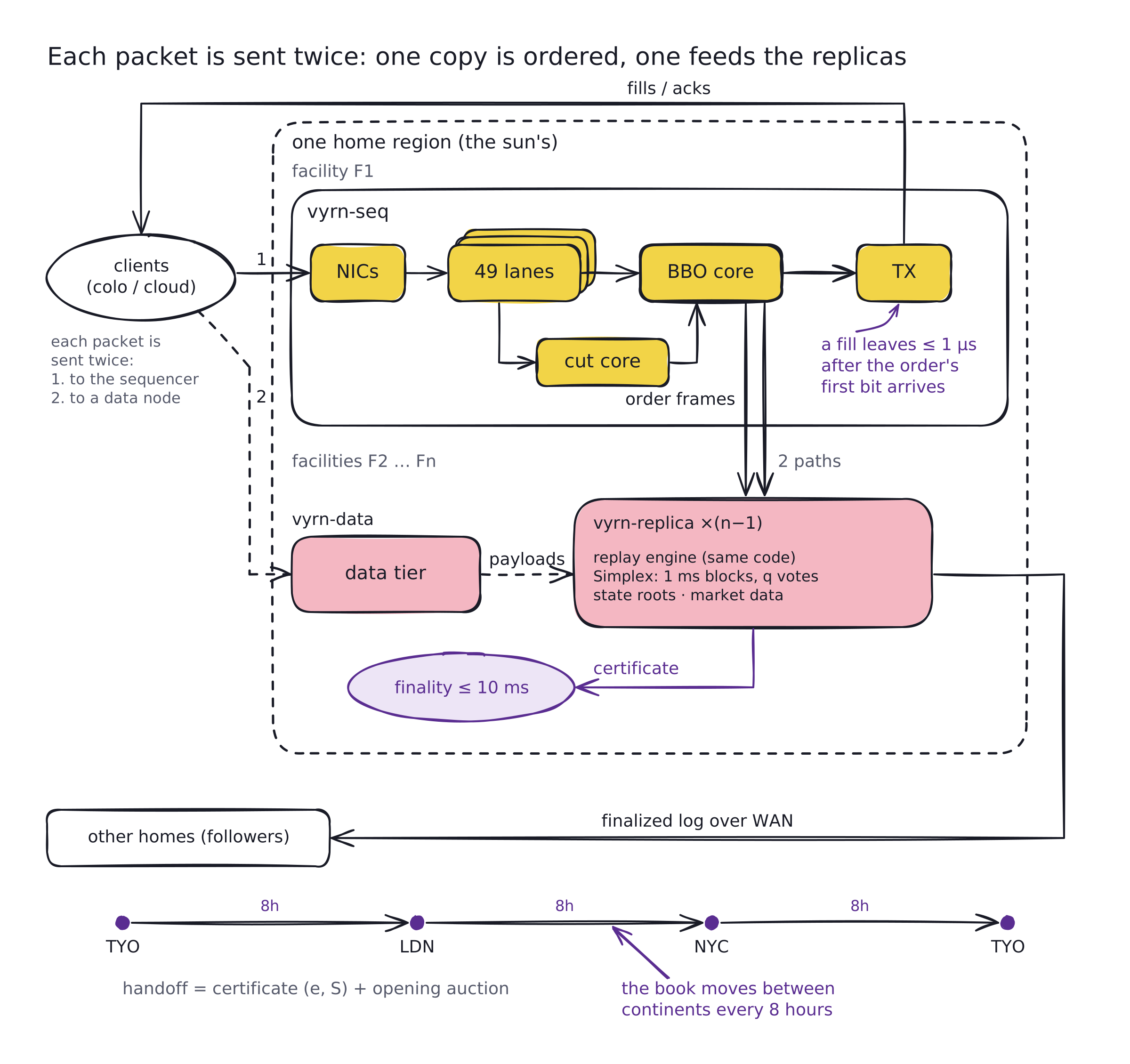
ASCII original
                              ┌── one home region (the sun's) ──────────────────────────────────────┐
  clients (colo / cloud)      │  facility F1                                                        │
  each packet is sent twice   │  ┌── vyrn-seq ─────────────────────────────────┐                    │
                              │  │                                             │                    │
    1. to the sequencer ──────┼─►│ NICs ─► 49 lanes ─► BBO core ─► TX ─────────┼─► fills/acks ──────┼──► clients
    2. to a data node         │  │            │            ▲ │                 │                    │
      │                       │  │            └─► cut core─┘ └─► order frames ─┼───┐                │
      │                       │  └─────────────────────────────────────────────┘   │ 2 paths        │
      │                       │                                                    │                │
      │                       │  facilities F2 … Fn                                ▼                │
      │                       │  ┌── vyrn-data ──┐              ┌── vyrn-replica ×(n−1) ──────────┐ │
      └───────────────────────┼─►│ data tier     ├── payloads ─►│ replay engine (same code)       │ │
                              │  └───────────────┘              │ Simplex: 1 ms blocks, q votes   ├─┼─┐
                              │                                 │ state roots · market data       │ │ │
                              │                                 └───────────────┬─────────────────┘ │ │
                              │                                                 │                   │ │
                              │         finality ≤ 10 ms ◄── certificate ───────┘                   │ │
                              └─────────────────────────────────────────────────────────────────────┘ │
                                                                                                      │
   other homes (followers) ◄── finalized log over WAN ────────────────────────────────────────────────┘
   TYO ──8h──► LDN ──8h──► NYC ──8h──► TYO      handoff = certificate (e, S) + opening auction
Status of numbers#
Every number in this specification is one of three kinds, and the text says which:
- Budget: a target the design commits to. A benchmark in
11-build.mdchecks it. - Measured: a result of one of our benchmarks, with its ID. Draft 0.1 has none.
- Vendor: a figure published by a vendor. It is taken as given until our own benchmark replaces it.
Draft 0.2 changelog#
The full text of every decision is in 01-conventions.md §14, which
overrides any chapter. In short:
- Hard requirements are not negotiable (§14.0). 1 µs is a maximum for every accepted packet,
every message type and every index 0–9. Exactly three facts are stated as facts:
- AWS wire latency belongs to Nitro.
- The handoff window is set by light.
- BFT needs a timely network.
- Deadline admission (§14.1): an answer or
BUSYwithin 1 µs. The decision is logged, so replay stays deterministic. - Two-pass lanes with early dispatch (§14.2).
- Two cut cores (§14.3).
- Lane classes (§14.15, §14.17): 42 dedicated lanes (a paced client never waits in its lane)
and one pooled 7-core group.
BUSYis bounded per class. - Cores and steps: a 15 ns BBO step, three TX cores and two order-stream cores.
- Replication: the sequencer never votes, a warm standby keeps the Rust/Vx client split through failover, and every response is frame-gated (§14.4, §14.5).
- Finality gate in both modes (§14.9): the sequencer halts rather than issue fills that cannot be final within 10 ms.
- Maker fills within 1 µs (§14.14, §14.17.5).
- Adopted from onebook (§14.13): Segment16 FIFOs, immutable queue positions, separate attestations, and epoch-settled balance domains.
- Naming: crate and binary prefix
vyrn-, C shim prefixvyns_(§14.12).
Open items for draft 0.3 are listed in 01 §14.18 (O1–O7), each with an owner and a benchmark.
Requests to 01 that are already resolved. Several chapters' "Requests to 01" sections were written before the last edits to 01 and still ask for these, which 01 now has:
N_LANES_REF= 49BBO_CROSS_NS= 15- §14.3 aligned with the core map
FINALITY_MAX_MSFIN_GATE_BLOCKS- the
AcctTakelayout PacketRecord.flags
Diagrams. The rename made some ASCII diagram lines up to 2 characters wider. Most were realigned. A few box headers are still slightly off; they read correctly.